Miguasha is one of those paleontological names that can be flattened by admiration. The flattening usually takes the shape of a threshold myth: this is the place where fish were already halfway to hands, already halfway to land, already halfway to us.[1][3] The admiration is earned, but the framing is too narrow. A stronger field reading starts with the site itself. Miguasha matters because the Escuminac Formation preserves a Late Devonian estuarine world densely enough that the fish-to-tetrapod threshold can be studied inside an ecosystem rather than through one isolated icon.[1][2]
UNESCO's listing still provides the cleanest first orientation. The park on Quebec's Gaspé coast preserves a fossil heritage from roughly 370 million years ago, contains five of the six fossil fish groups associated with the Devonian "Age of Fishes," and is especially important for its exceptionally rich record of lobe-finned fishes tied to the origin of tetrapods.[1] That alone would make the site notable. What turns it into a field-report locality instead of a slogan is the broader biota around that claim. Richard Cloutier's Geoscience Canada review describes a diverse aquatic assemblage with 20 species of lower vertebrates, a smaller invertebrate component, and a continental signal that includes plants, scorpions, and millipedes.[2]
That breadth changes the way the site should be read. Miguasha is not simply a cabinet of "near-tetrapod" trophies. It is a shoreline archive where vertebrate diversity, preservation quality, sedimentary setting, and growth history reinforce one another.[1][2] The famous hand story told by Elpistostege becomes more convincing here precisely because it comes out of a much thicker fossil world.
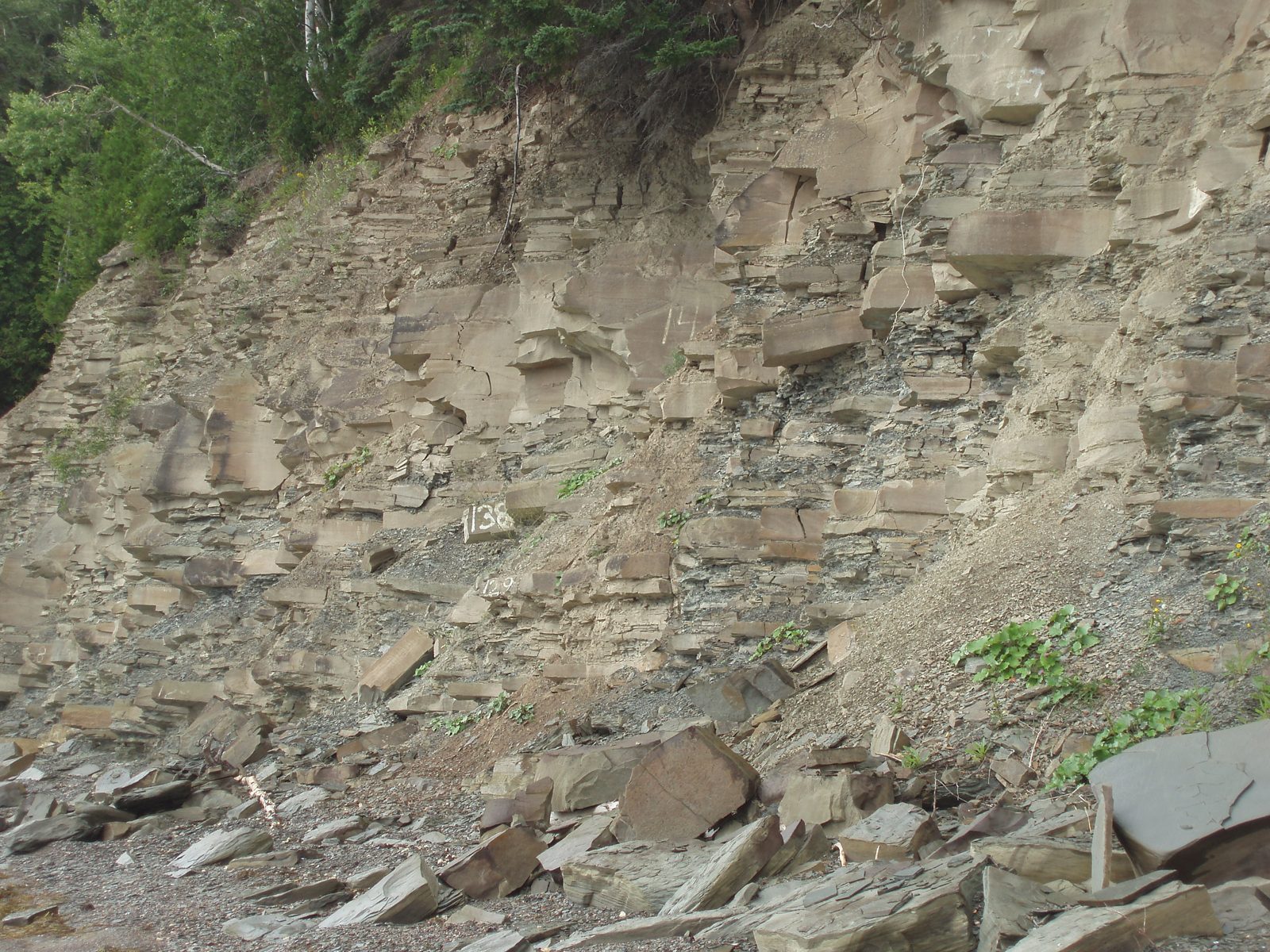
Image context: the cover uses a real Wikimedia Commons photograph of the Miguasha outcrop.[4] It belongs here because this article depends on keeping the cliff in view. The site's argument begins with the exposed beds themselves: layered rock, repeated burial, and the physical persistence of the fossil-bearing shoreline.
1) The site makes most sense as an estuary archive
Cloutier's review is useful because it captures the interpretive shift in one sentence. Miguasha was once commonly described as a freshwater lake deposit, but paleontological, taphonomic, sedimentological, and geochemical evidence now supports a brackish estuarine setting.[2] That update is more than a background correction. It changes the logic of the fossil site.
An estuary is a mixing problem. River influence, coastal water, sediment pulses, shoreline vegetation, and animal transport all meet in one constrained space. Once Miguasha is understood that way, the biota looks less like a random Late Devonian sample and more like a coherent edge environment. Fish dominate the record, but the site also carries land-derived plants and arthropods close enough to remind the reader that this was a shoreline system, not an abstract fish tank.[2]
That is also why the park's tetrapod significance has such unusual weight. The lobe-finned fishes at Miguasha did not live in some featureless evolutionary waiting room. They lived in a setting where shallow-water maneuvering, substrate contact, variable sediment conditions, and periodic burial were all part of the same environmental package.[1][2] The threshold between fin and limb therefore appears here with landscape around it.
2) Miguasha preserves populations and growth, not just specimen-grade miracles
The second reason the locality stays powerful in 2026 is scale. Cloutier reports that more than 18,000 fish specimens have been recovered from the Miguasha biota, with multiple modes of preservation that include uncompressed material and soft tissues.[2] Most vertebrate taxa are represented by numerous complete, articulated individuals, and larval or juvenile material has been identified for 14 of the 20 fish species.[2] Those details matter because they move the site beyond rarity.
Many fossil localities are scientifically important because one extraordinary skeleton survives. Miguasha is stronger because repetition survives. Growth stages survive. Whole bodies survive. Population-level comparison survives.[2] That allows paleontologists to ask how an animal changed through ontogeny, how anatomy varied within a taxon, and how a fauna was structured across the shoreline system. The site is a time capsule, but it is also a census archive.
UNESCO's integrity note strengthens that field reading. The protected beach matters because fossils weather out of the cliff and are moved by the tides before recovery, and the park's national fossil collection holds some 13,000 specimens, including complete fossils, three-dimensional material, and soft tissues.[1] The locality therefore remains a live interface between erosion, recovery, and curation. Miguasha is not frozen only in display cases. It is continuously mediated by the physical cliff.
3) Elpistostege matters more because it comes from this larger system
The 2020 Nature paper on Elpistostege watsoni is the piece most likely to be remembered outside paleontology, and for good reason.[3] Using computed tomography on a complete fossil from the Upper Devonian of Canada, Cloutier and colleagues showed that the pectoral fin contains a humerus, radius, ulna, rows of carpals, and digit-like elements arranged inside a still fish-like fin.[3] The result pushes the skeletal pattern of the vertebrate hand down into the fish level.
That finding is easiest to overread when detached from place. Miguasha itself helps control the interpretation. The site does not hand over a cartoon of a fish standing upright on a beach. It provides a richly preserved estuarine fauna in which one tetrapodomorph shows how far the internal architecture of the fin had already advanced before fin rays disappeared and a fully limbed body plan arrived.[2][3] The argument is structural before it is heroic.
This is why the article's "threshold" language matters more than "missing link." A threshold keeps attention on a boundary condition. Elpistostege shows that the hand did not arrive all at once, outside the fish body, in one theatrical leap.[3] Parts of its pattern were already nested within a Devonian fish from a shoreline system that preserved many neighboring forms well enough to make the comparison meaningful.[1][2][3]
4) The cliff is the message
The right way to read Miguasha, then, is to hold three scales together at once. The first is the cliff scale: an exposed Devonian shoreline archive still shaped by weathering and tides.[1][4] The second is the fauna scale: a fish-dominated estuarine community with articulated skeletons, juvenile material, and exceptional preservation across many taxa.[2] The third is the threshold scale: a lobe-finned fish record strong enough that Elpistostege can illuminate the internal history of the hand without carrying the whole site on its own.[3]
If the site is reduced to a shrine for one almost-tetrapod, much of its real force disappears. Miguasha deserves a larger reading. It is one of the places where deep-time vertebrate history remains attached to habitat, preservation mode, and population depth all at once. That is why the cliff still matters. It does not merely yield famous fossils. It keeps the shoreline world around them intact enough that the transition remains readable.
Sources
- UNESCO World Heritage Centre, "Miguasha National Park" - official listing page describing the Escuminac Formation, the Devonian age, the five fossil fish groups, tetrapod significance, integrity of the cliff and beach, and the park collection.
- Richard Cloutier, "Great Canadian Lagerstatten 4. The Devonian Miguasha Biota (Quebec): UNESCO World Heritage Site and a Time Capsule in the Early History of Vertebrates," Geoscience Canada 40, no. 2 (2013).
- Richard Cloutier, Alice M. Clement, Michael S. Y. Lee, and colleagues, "Elpistostege and the origin of the vertebrate hand," Nature 579 (2020).
- Wikimedia Commons, "File:Miguasha affleurement 2.jpg" - source page for the real outcrop photograph used as the article image.