Green River fossils are so widely reproduced that the site can shrink in the mind. A reader sees a split fish on pale stone, maybe a stingray or a bat, and the locality becomes a specimen style rather than a place.[2] That is exactly what a field report should reverse. At Fossil Butte, the famous slabs are the surface expression of a tighter geological story: a small Eocene lake inside a larger three-lake Green River system, a fossil-rich middle member made of laminated carbonate mud, and a water column that was often stratified enough to preserve bodies before decay and scavenging erased them.[1][4]
The National Park Service geology page gives the broad frame first. The Green River Formation records three former lakes: Fossil Lake, Lake Gosiute, and Lake Uinta.[1] Fossil Lake was the smallest of the three, never more than about 100 feet deep and covering roughly 1,500 square miles at maximum extent, though its shape and size changed through time.[1] The monument protects only a small remnant of that larger history, nearly 13 square miles in southwestern Wyoming.[1] That mismatch in scale matters. The butte is not the lake. It is a surviving cut through the lake's deposits.
That is the first reason the locality deserves to be read as an archive rather than as a pile of isolated marvels. The top tan beds capping the ridges were once mud at the bottom of Fossil Lake, and the chemistry of those rocks still records alkaline water rich in calcium and magnesium.[1] The landscape is already doing paleolimnology in plain sight. Before a fossil is identified as a fish, bird, insect, or mammal, it has already passed through a basin history.
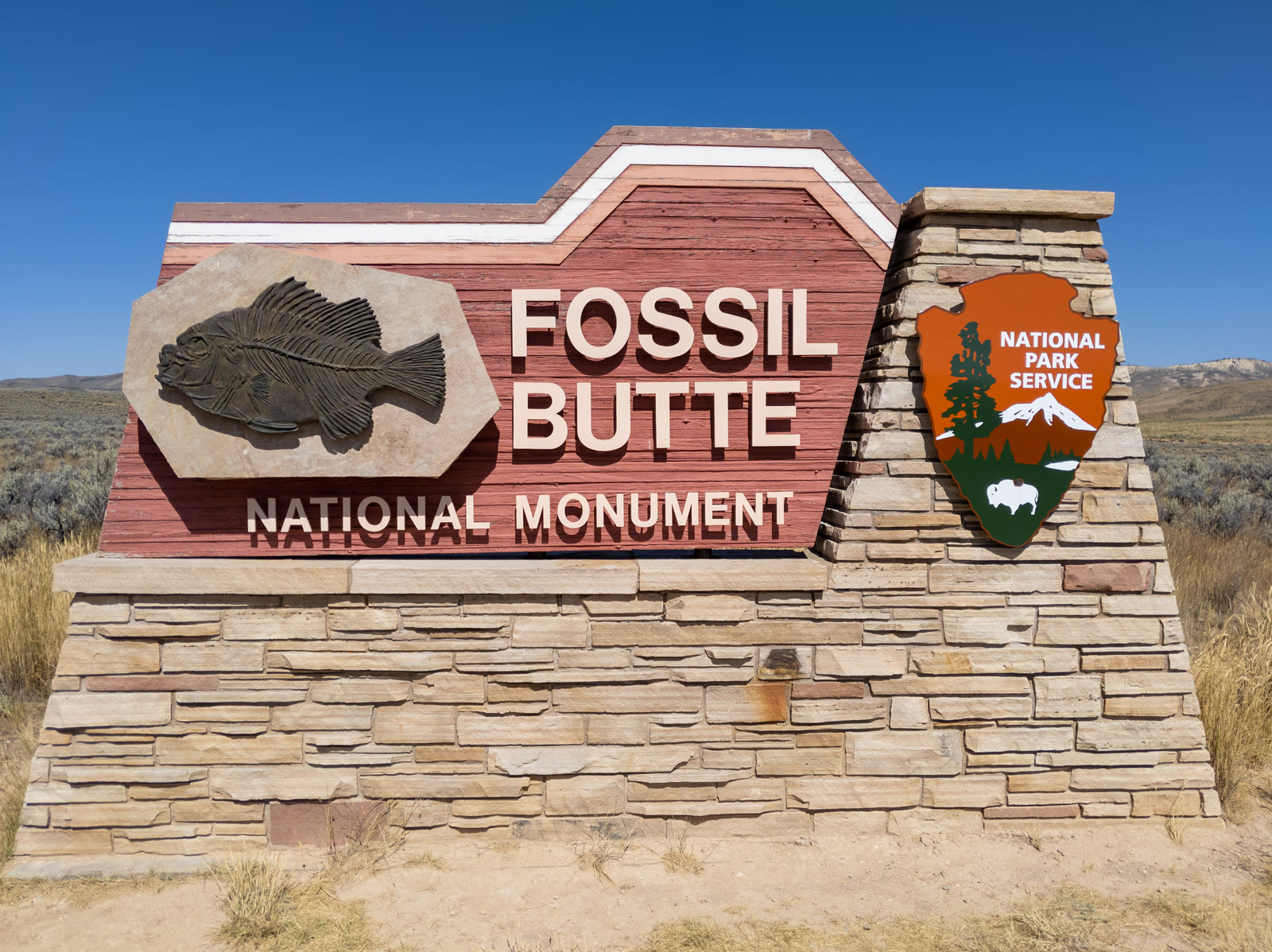
Image context: the cover uses a real Wikimedia Commons photograph of Fossil Butte National Monument.[6] It belongs here because the article's argument starts at ridge scale. The point is not simply that remarkable fossils were found somewhere in Wyoming. The point is that a visible piece of Fossil Lake still survives as layered topography, with the Green River beds standing out above the older Wasatch slopes.
1) The middle of the section is where the lake becomes most legible
The NPS stratigraphic summary is unusually useful for field reading because it makes the lake behave as a sequence instead of a static postcard. Within Fossil Basin, the Green River Formation is divided into the Road Hollow, Fossil Butte, and Angelo members.[1] The Road Hollow Member records an earlier stage when sedimentation alternated between river-delivered and lake-formed deposits.[1] The Fossil Butte Member marks the deepest and most expansive phase of the lake, when calcite-rich sediment precipitated in the basin and fossil yield reached its peak.[1] The Angelo Member records a later decline, with the lake shrinking, shallowing, and becoming more saline as evaporation overtook water supply.[1]
That middle phase is the reason Fossil Butte became famous. The NPS describes the Fossil Butte Member as composed mostly of laminated calcite-rich mudstone, and calls it world renowned for fossil preservation, abundance, and diversity.[1] It is also the unit behind the familiar collecting vocabulary of the site: the 18-inch layer, the minifish bed, the gastropod bed, and the sandwich bed bounded by volcanic ashes.[1] These are not just colorful quarry nicknames. They are reminders that the archive is stratified internally. Different layers favor different sizes, abundances, and preservational payoffs.
The companion NPS fossils page shows what that archive contains when the system works. Fossils from the Fossil Butte Member are described there as world famous for abundance, diversity, and preservation, with Knightia eocaena singled out as the most common vertebrate fossil in the world.[2] But the site's range matters even more than its famous fish. The same unit also preserves complete bats, freshwater stingrays, insects with preserved wing venation, plants, reptiles, birds, and mammals.[2] A quarry that yields fish alone would still be interesting. A lake deposit that carries fish, air-breathing vertebrates, delicate insects, and color pattern evidence is operating at a much higher resolution.
2) Stratification did the heavy preservational work
The 2024 organic geochemistry paper is the best recent reason not to treat Green River preservation as vague luck.[4] Elson and colleagues sampled sediments from the celebrated 18-inch layer and argued that the Fossil Basin archive is geochemically distinct from the other Green River basins.[4] Their abstract is explicit about the environmental package: photic zone euxinia, persistent anoxia, and a freshwater cap combined with salinity and density stratification that suppressed vertical mixing.[4] In that setting, carcasses could remain in preservable condition long enough to enter the sedimentary record instead of being rapidly shredded by the usual lake-bottom processes.[4]
That matters because Fossil Butte is often romanticized from the fossil outward. People start with a perfect fish or a whole bat and then imagine a miracle. The stronger explanation runs in the opposite direction. First there is a basin of limited size and distinctive shape. Then there is water-column structure. Then there is the restricted mixing that keeps deep conditions hostile to ordinary breakdown.[4] Only after that do the famous slabs make sense.
The paper also sharpens a second field point. Fossil Basin was small enough, and shaped tightly enough, that terrestrial and freshwater inputs were focused into the lake in ways unlike the larger Green River basins.[4] That helps explain why the site can preserve a broad local ecosystem without being reduced to one generic "Eocene lake" template. Fossil Butte is part of a larger formation, but it is not simply interchangeable with the rest of it.
3) The lake was not a simple dead-bottom cartoon
A good field report has to keep one boundary in view. Stratification explains a great deal at Fossil Butte, but it does not justify the simplest possible picture of a permanently lifeless floor. The 2010 PLOS ONE paper on the feeding trace of Notogoneus osculus is useful precisely because it complicates the basin without dissolving it.[5] Martin, Vazquez-Prokopec, and Page described the first known feeding and swimming trace attributed to this bottom-dwelling fish from the 18-inch layer, and argued that the trace provides independent evidence that lake-bottom waters were occasionally oxygenated enough to support feeding opportunities in deeper parts of Fossil Lake.[5]
That is a valuable correction. It does not cancel the case for stratification or preservation. It tells us the system had episodes, gradients, and windows. Deep-water preservation could still dominate, while bottom conditions were not permanently identical every hour of every season.[4][5] The best reading of Green River therefore avoids both extremes. The site is neither a totally ordinary lake nor a fantasy chamber where every layer behaved the same way forever.
H. Paul Buchheim's long-running work at Fossil Basin reinforces that wider field logic. His early research agenda at Fossil Butte was framed around mapping the vertical distribution of fossil biota and trace fossils, tracking lateral variation, and locating ancient shorelines, deltas, and islands inside the basin.[3] That is exactly how a mature locality gets read. Not as one split fish after another, but as a spatial and stratigraphic system in which environment, behavior, and preservation vary together.
4) Why Green River still matters as a field report
The strongest summary is geological with biological consequences. Fossil Butte matters because it lets a reader watch a lake archive stay organized across several scales at once.[1][2][4] At basin scale, Fossil Lake sits inside the larger Green River story.[1] At member scale, the Fossil Butte Member concentrates the most productive laminated carbonates and the best-known fossil horizons.[1] At preservational scale, stratified chemistry made exceptional fossilization possible.[4] At behavioral scale, trace evidence keeps the system honest by showing that even this famous deep-lake archive had ecological variability.[5]
That is why the site should be read as more than a source of decorative slabs. The fossils are real, beautiful, and scientifically rich. But the harder achievement lies under them: an Eocene lake system preserved well enough that rock chemistry, water structure, fossil diversity, and even moments of bottom-feeding behavior can still be argued from the same section.[1][2][3][4][5] Green River becomes much more impressive once the fish stop being the whole story.
Sources
- National Park Service, "Geology" - overview of Fossil Lake, the three Green River lakes, member-level stratigraphy, lake depth and size, and the laminated fossil-rich Fossil Butte Member.
- National Park Service, "Fossils & Geology" - overview of the Fossil Butte Member's abundance, diversity, and preservation, including fish, bats, stingrays, insects, and other fossils from ancient Fossil Lake.
- H. Paul Buchheim, "Paleoenvironments and Paleoecology of the Green River Formation in Fossil Basin (Fossil Butte National Monument), Wyoming," UW-National Park Service Research Station Annual Reports 5 (1981) - research program framing Fossil Lake through vertical biotic distribution, trace fossils, lateral variation, and ancient shorelines, deltas, and islands.
- Amy L. Elson, Lorenz Schwark, Jessica H. Whiteside, and colleagues, "A paleoenvironmental and ecological analysis of biomarkers from the Eocene Fossil Basin, Green River Formation, U.S.A.," Organic Geochemistry 195 (2024) - geochemical evidence for photic zone euxinia, persistent anoxia, a freshwater cap, and stratification-linked exceptional preservation.
- Anthony J. Martin, Gonzalo M. Vazquez-Prokopec, and Michael Page, "First Known Feeding Trace of the Eocene Bottom-Dwelling Fish Notogoneus osculus and Its Paleontological Significance," PLOS ONE 5, no. 5 (2010) - trace-fossil evidence that deeper bottom waters in Fossil Lake were occasionally oxygenated enough for feeding behavior.
- Wikimedia Commons file page for the real landscape photograph used as the article image.