
The Natural History Museum's short Stegosaurus film looks, at first glance, like a standard exhibit teaser. A famous dinosaur arrives, cameras circle the plates, scientists mention scanning, and the public gets a promise of secrets still locked inside the bones.[1] The better reading is stricter than that. What makes the video worth curating is not that Stegosaurus is famous. It is that the specimen nicknamed Sophie is complete enough, and preserved cleanly enough in three dimensions, to let several usually separate questions collapse into one animal.[1][2]
That distinction matters because Stegosaurus has been culturally overfamiliar and scientifically underconstrained for a long time. The Natural History Museum's own Q&A makes the point bluntly: although the genus has been known for more than 130 years, the last detailed study before Sophie was old enough to feel almost Victorian in methodological terms, and many classic skeletons were too incomplete or too distorted to answer the basic biological questions well.[2] A specimen missing fewer major parts does not just improve display quality. It changes the kinds of tests paleontologists can run. If the skull is preserved, feeding can be modeled. If the plates are numerous and well arranged, their strength and internal vascularity become testable rather than purely speculative. If the limb proportions and trunk are preserved in one articulated body, gait stops being a cartoon and becomes a biomechanical problem.[1][2][3]
That is the frame to carry into the video. The clip matters because it shows completeness turning a mascot into a specimen again. Instead of repeating the old "tiny brain, big plates, funny tail" shorthand, the museum team treats Sophie as a dense package of linked evidence: a body that can be scanned, measured, reconstructed, and argued with.[1][2][3]
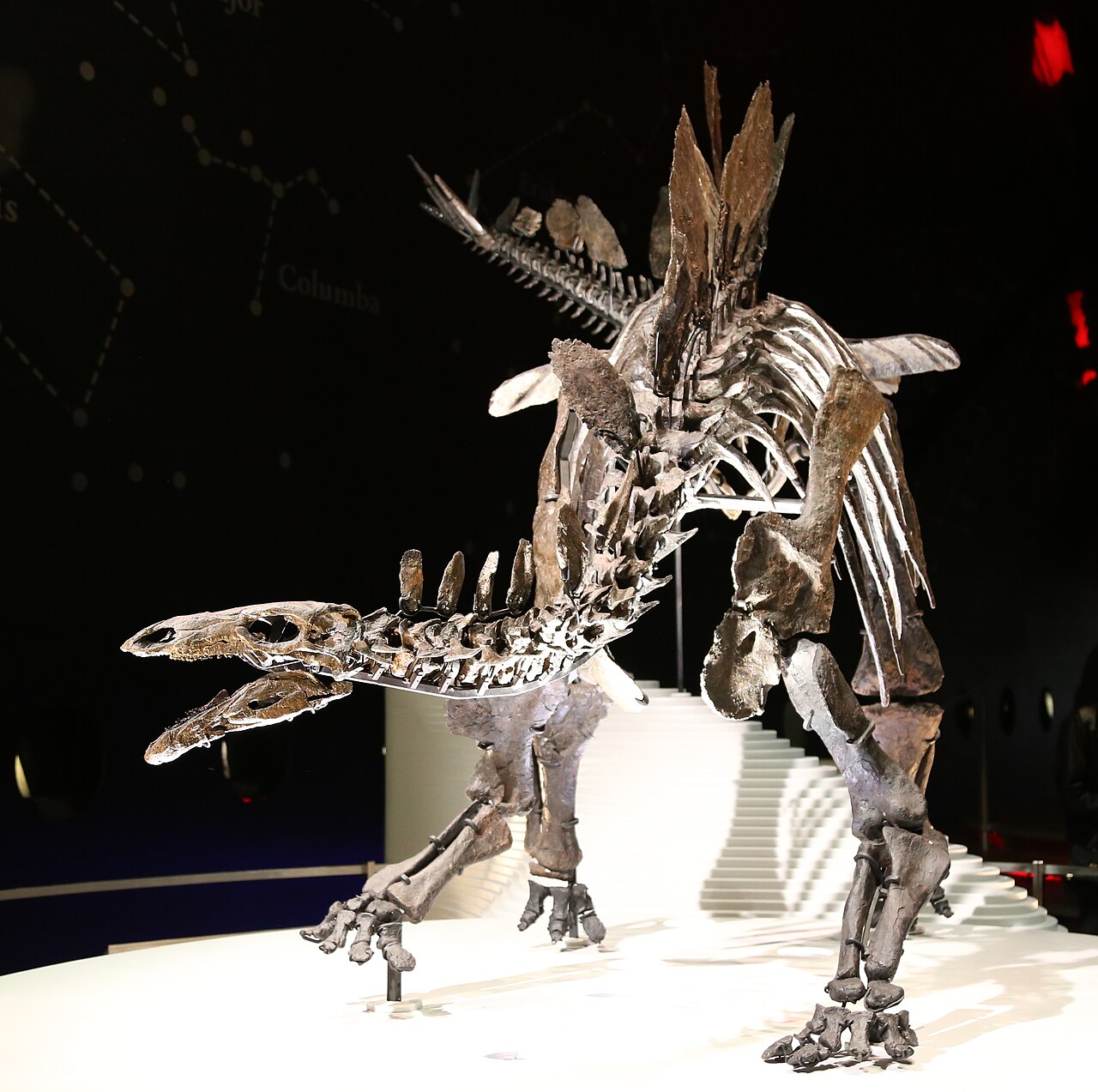
Image context: the cover uses a real Wikimedia Commons photograph of Sophie mounted in London's Natural History Museum.[6] It belongs here because the article's main claim is visual as well as analytical. From the front, you can see the specimen as a coordinated structure rather than as a pile of famous parts: skull, forelimbs, hindlimbs, ribcage, and the tall paired plates all remain tied to one individual skeleton.
Around 0:30, the key word is not fame but completeness
The video's most important sentence arrives early, when the museum identifies Sophie as the most complete Stegosaurus yet found and singles out the unusually good run of plates along the back.[1] That is more than publicity language. The Q&A page explains why the claim matters scientifically: the skeleton is almost complete, preserved three-dimensionally rather than crushed flat, and missing only the left arm and the base of the tail.[2] In paleontology, that kind of preservation changes argument quality. A flattened or heavily reconstructed skeleton can still tell you that a taxon existed. It is much worse at telling you how the skull worked, how the body mass was distributed, or how the dermal plates sat relative to the spine.
The museum's "brought to life" page sharpens the same point from the side of locomotion.[3] Because the skeleton was laser-scanned and reconstructed digitally, the museum could move from a mounted display to a whole-body walking model grounded in actual limb proportions rather than generic dinosaur balance. The resulting animal is not a graceful sprinting machine. It reads as a slow, weight-bearing quadruped with short forelimbs, long hindlimbs, and a gait the museum compares to large modern herbivores moving only a few miles per hour.[3] That is exactly the kind of inference that improves when completeness improves. The better the skeleton, the less freedom there is for artists and preparators to hide uncertainty inside posture.
Around 1:10, the plates stop being a symbol and become a materials problem
The clip then pivots to the classic Stegosaurus question: what were the plates for?[1] The video names the familiar candidates in compressed form, defence, display, and heat exchange, but the stronger lesson is methodological. Once a good specimen exists, the plate debate can be pushed away from pure iconography and toward structure.[1][2] The museum's Q&A describes exactly that shift: CT scans can be turned into virtual three-dimensional models and then broken into many small elements so their strength can be tested computationally.[2] In other words, the plate argument becomes an engineering problem.
That matters because the published literature narrows the field in a useful way. Farlow, Hayashi, and Tattersall's study of internal vascularity found that Stegosaurus plates were extensively supplied with blood vessels, which keeps thermoregulation and display on the table for anatomical reasons rather than because those explanations sound elegant.[5] At the same time, the museum's own public explanation notes that the plates are thin and fragile enough that a simple shield reading has become much less attractive than it once was.[2][3] A complete skeleton does not magically solve the problem, but it makes the problem sharper. You can ask where the plates sat, how many were present, what their internal structure looked like, and whether their geometry matches the loads expected of genuine armor.[1][2][5]
Around 1:45, scanning matters because the small skull can finally do scientific work
The video's second major turn comes with scanning: high-resolution laser work on the plates, then CT slices through the skull.[1] This is where the specimen's value stops being theatrical and becomes deeply anatomical. The museum emphasizes that Sophie's skull is exceptionally well preserved, and that the separated bones let researchers examine three-dimensional fit instead of guessing from a crushed block.[1][2] That is a major upgrade for a dinosaur long mocked for having a tiny head.
What the video shows around the two-minute mark is not simply that the brain cavity was small. It is that CT imaging lets the team look inside the skull bones and recover enough structure to ask functional questions about the head rather than repeating the old folklore about "two brains."[1][3] The museum's broader Stegosaurus page explicitly rejects that myth and reframes the skull as a feeding problem: a small mouth, fingernail-sized teeth, and a body large enough to demand a serious herbivorous throughput.[3] Once the skull is legible, the old joke gives way to an actual ecological question.
Reichel's bite-mechanics model helps explain why that question is interesting.[4] The paper treats the jaws as a functional system rather than as a visual punchline and argues that the tooth row and musculature can be modeled in a way that constrains how Stegosaurus cropped and processed plant matter.[4] The museum summary translates that finding for a broader audience by comparing the bite force to that of a cow or sheep.[3] Read together, the video and the written sources make the same larger point: a small-headed herbivore is not automatically a biologically incompetent one. Sophie's skull matters because it lets paleontologists turn a familiar silhouette into a feeding mechanism again.[1][3][4]
What the video leaves behind
That is why this short museum film is stronger than it first appears. It is not mainly about the thrill of getting a famous dinosaur into a London gallery. It is about the scientific consequences of having one unusually complete Stegosaurus in hand.[1][2] Completeness here does not mean that every debate is over. Plate function is still contested, and locomotion or feeding models remain models rather than time-travel footage.[2][3][4][5] But the specimen changes the level at which those debates happen. Fewer arguments have to be stitched together from incompatible skeletons, damaged skulls, or isolated plates.
Sophie's real contribution, then, is methodological. The skeleton lets plate arrangement, vascular structure, skull mechanics, and whole-body posture be read as connected features of one animal. That is a much better reason to watch this video than Stegosaurus celebrity. The film records the moment when an icon becomes analytically dense enough to do new science.
Sources
- Natural History Museum, "Secrets of the stegosaurus skeleton," YouTube video.
- Lisa Hendry, "World's most complete Stegosaurus: Q&A with a dinosaur expert," Natural History Museum.
- Katie Pavid, "A Stegosaurus brought to life," Natural History Museum.
- Miriam Reichel, "A model for the bite mechanics in the herbivorous dinosaur Stegosaurus (Ornithischia, Stegosauridae)," Swiss Journal of Geosciences (2010).
- James O. Farlow, Shoji Hayashi, and Glenn J. Tattersall, "Internal vascularity of the dermal plates of Stegosaurus (Ornithischia, Thyreophora)," Swiss Journal of Geosciences (2010).
- Wikimedia Commons file page for the lead image, "File:Stegosaurus (Natural History Museum, London).jpg".