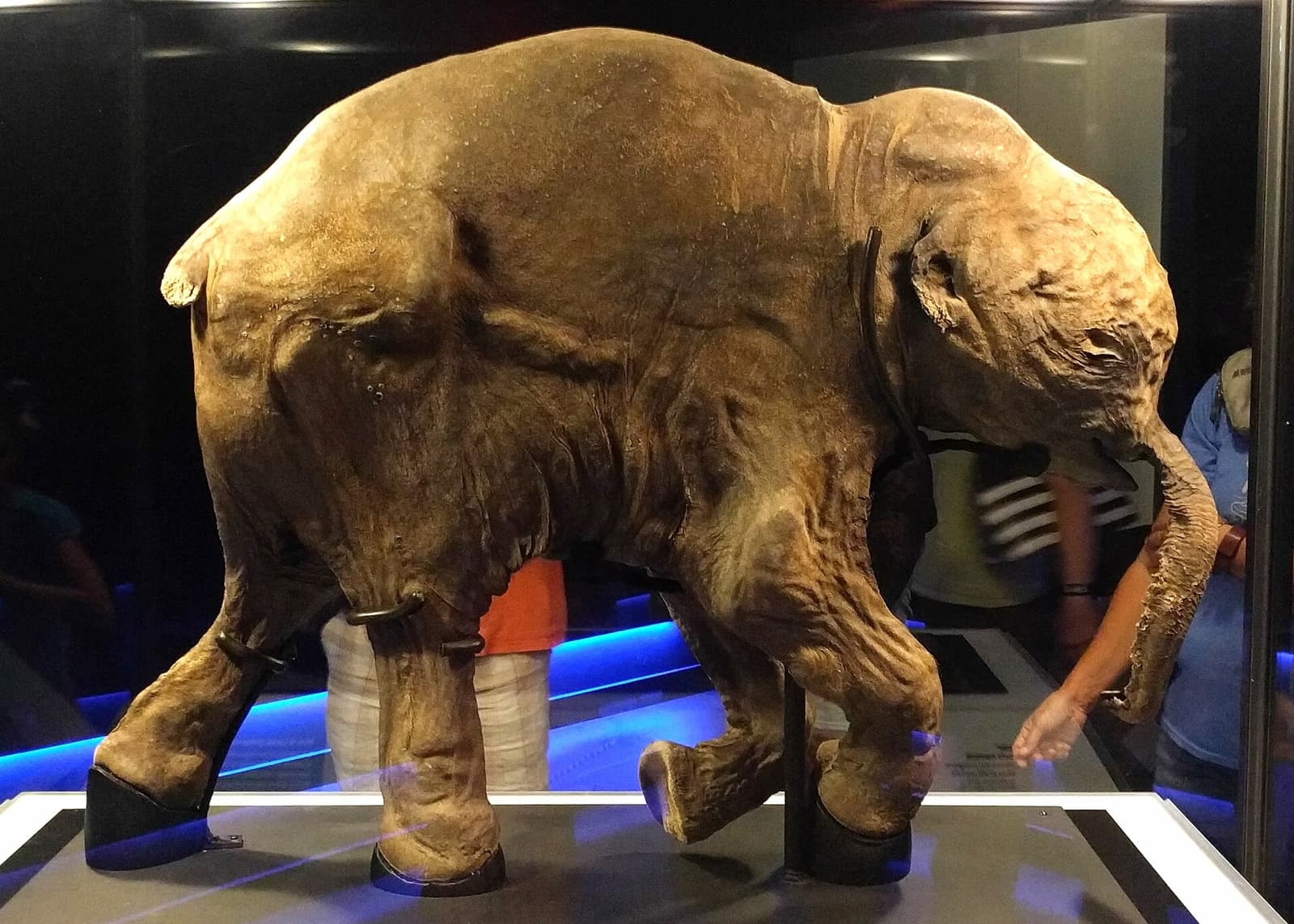
Lyuba is one of those fossils that can get trapped by its own charisma. A baby woolly mammoth with skin, trunk, ears, and a whole curled body looks like Ice Age preservation turned sentimental.[1][4] That is why the specimen needs a close reading. Lyuba matters less because she is adorable and more because her body preserves an unusually tight chain of evidence about neonatal life, death, burial, and postmortem change on the Yamal Peninsula roughly 41,800 radiocarbon years ago.[1]
The first scientific temptation is to treat the calf as a perfect freeze-frame. The papers do not support that simpler story. Lyuba was exceptionally preserved, but not unchanged. Fisher and colleagues describe a calf whose tissues, gut contents, dentition, and bone interiors all have to be read together.[1][4] Some clues belong to life, some to the last minutes of death, and some to what happened after the body lay in sediment and permafrost.[1][4] That layered sequence is what makes the find so valuable.
The second temptation is to read Lyuba as a generic mammoth baby. The evidence again gets more interesting once it becomes more specific. Tooth development places her at only about 30 to 35 days old at death, and the same developmental work argues for a gestation length close to that of modern elephants and a spring birth season for woolly mammoths.[2] Gut contents then show that this was still a nursing animal whose digestive tract also held swallowed maternal feces, a behavior with developmental and microbial logic rather than sentimental meaning.[2][3]
Image context: the lead image uses a real museum photograph of Lyuba from Wikimedia Commons. It belongs here because the article is about the specimen as preserved evidence, not as a painted reconstruction. The dark skin, compact body, and downturned head are visually arresting, but the point is to keep that first impression attached to the specimen's harder record of life history and taphonomy.[5]
1) The death scene matters because it narrows the last event
Fisher and colleagues' anatomical study is the clean starting point because it insists that Lyuba is not only a mummy but a death case.[1] The calf was found in 2007 on the Yamal Peninsula after exposure from riverbank erosion and flooding, and the paper argues that the body reached science with enough integrity to preserve information about both life condition and dying process.[1] One of the strongest claims, later reinforced by CT work, is that Lyuba died after aspirating mud.[1][4]
That detail changes the whole register of the fossil. Instead of a vague "the calf froze and survived to us" story, the specimen begins to look like a short, violent terminal event followed by fast enough burial and freezing to hold the body together.[1][4] The value lies in sequence. If the mud really entered the airways during the death event, then the fossil keeps a trace not just of anatomy but of mechanism.[1][4]
This is also where the article needs to hold the boundary carefully. Lyuba does not preserve every second of her last hour, and no paper can turn the find into cinematic certainty. But the aspiration evidence is strong enough to rule out a soft, unspecified disappearance. The calf died in contact with mud and slurry, and that fact gives the specimen much of its paleobiological sharpness.[1][4]
2) The gut contents show a calf's world before they show a steppe landscape
The intestinal-contents paper is useful because it keeps Lyuba from becoming a pure taphonomy story.[3] The gut still records life. The authors describe a mix of milk-related intake, plant remains, and swallowed maternal feces, and that combination matters because it places the calf firmly in an early developmental window.[2][3] Lyuba was not yet a small independent grazer wandering the mammoth steppe on her own terms. She was still embedded in maternal biology.
That makes the environmental evidence richer and trickier at the same time. The intestinal material does preserve clues to the surrounding vegetation, including steppe-tundra signals, but the authors also stress that some of what entered the digestive tract came through nursing behavior and coprophagy rather than through direct foraging in the adult sense.[3] In practical terms, this means the fossil can illuminate habitat, but only if the reader remembers whose stomach this is: a calf only about a month old, still borrowing ecology through its mother.[2][3]
This is one reason Lyuba is stronger than a generic "frozen mammoth" headline. The specimen ties environmental reconstruction to developmental stage. It does not simply say "this is what mammoths ate." It says that even a calf's gut can hold plant and microbial evidence, but only after the life-history filter is taken seriously.[3]
3) Tooth development turns the mummy into a clock
Rountrey and colleagues sharpen the timing even further by using early tooth development to estimate gestation and age at death.[2] That is a technical move with a large payoff. It lets Lyuba's body be read against a growth schedule rather than against visual intuition. The calf's dentition indicates an age of about 30 to 35 days, and the authors argue that woolly mammoth gestation was broadly similar to that of living elephants.[2]
The same work matters for seasonality. Because dental growth stages can be connected to birth timing, the paper argues for a spring birth season.[2] That matters because it pushes Lyuba out of the museum case and back into annual structure. The calf belongs to a reproductive calendar, not just to a dramatic preservation event.
This is where the close reading gets especially strong. Lyuba is not just a body that happened to remain whole. She is a body whose age can be estimated internally, which in turn helps organize the death story, the nursing evidence, and the environmental clues into one short segment of life.[2][3][4]
4) Preservation did not stop when freezing began
The CT paper adds an important correction to the word "mummy."[4] Lyuba is beautifully preserved, but the body kept changing after death. Fisher and colleagues show that postmortem processes produced nodules of vivianite around the skull and within long bones, and they treat CT scanning as the only comprehensive way to map that mineral distribution through the specimen.[4] This matters because it prevents the oldest mistake in mummy reading: assuming that what looks intact is chemically straightforward.
That same CT work also compares Lyuba with another calf mummy, Khroma, and in doing so makes Lyuba's specific preservation history easier to see.[4] Khroma froze quickly after death; Lyuba underwent more postmortem alteration.[4] The contrast is valuable because it reminds the reader that exceptional preservation is not one thing. Permafrost can preserve bodies along different pathways, and those pathways leave different signatures in soft tissue, bone density, and internal mineral formation.[4]
So the fossil preserves at least three linked histories at once. There is the neonatal history of a nursing calf.[2][3] There is the terminal history of mud aspiration and death.[1][4] Then there is the geochemical history of burial, freezing, and later mineral growth through the body.[4] Lyuba matters because one specimen keeps all three visible.
5) What this fossil find can really support
High confidence first. Lyuba is an exceptionally complete woolly mammoth calf from the Yamal Peninsula, dated to roughly 41,800 radiocarbon years ago.[1] She died at about one month of age, remained in a nursing stage, and preserves evidence of aspirated mud associated with death.[1][2][4] Her intestinal contents are informative, but they have to be read through calf behavior, including swallowed maternal feces, rather than treated as a simple adult-diet proxy.[3] And her preservation includes important postmortem mineral change, not just straightforward freezing.[4]
The stronger summary, then, is not that Lyuba gives us an untouched baby mammoth. The stronger summary is that she gives paleontology a rare sequence: neonatal growth, maternal dependence, environmental contact, terminal aspiration, and postmortem mineralization all compressed into one body.[1][2][3][4] That is why the fossil remains scientifically larger than its fame. Lyuba is a mummy, but she is even more usefully a process fossil.
Sources
- Daniel C. Fisher and others, "Anatomy, death, and preservation of a woolly mammoth (Mammuthus primigenius) calf, Yamal Peninsula, northwest Siberia," Quaternary International 255 (2012).
- Adam N. Rountrey and others, "Early tooth development, gestation, and season of birth in mammoths," Quaternary International 255 (2012).
- Bas van Geel and others, "Palaeo-environmental and dietary analysis of intestinal contents of a mammoth calf (Yamal Peninsula, northwest Siberia)," Quaternary Science Reviews 30, no. 25-26 (2011).
- Daniel C. Fisher and others, "X-ray computed tomography of two mammoth calf mummies," Journal of Paleontology 88, no. 4 (2014).
- Wikimedia Commons file page for the museum photograph of Lyuba used as the lead image.