The Stairway Sandstone is useful because it makes early vertebrates feel local before they become evolutionary symbols. In central Australia, Ordovician sandstones and siltstones preserve Arandaspis prionotolepis, one of the famous armored jawless fishes from the southern hemisphere record.[1][2] The fossil is easy to turn into a mascot for "the first fish." The better field reading is less tidy and more valuable: this is a shallow marine habitat problem, not just an origin-point trophy.
Ritchie and Gilbert-Tomlinson's 1977 description made Arandaspis central because the material was unusually complete for an Ordovician vertebrate and because it came from the southern hemisphere at a time when early vertebrate records were still sparse and unevenly distributed.[1] But the body does not explain itself by age alone. It sits inside the Stairway Sandstone, a Middle Ordovician unit whose fish-bearing beds also carry trace fossils, shells, shifting sand bodies, and a wider microvertebrate record.[2][3] Once that setting stays in view, Arandaspis becomes less like a solitary fossil celebrity and more like a body caught in a working shallow sea.
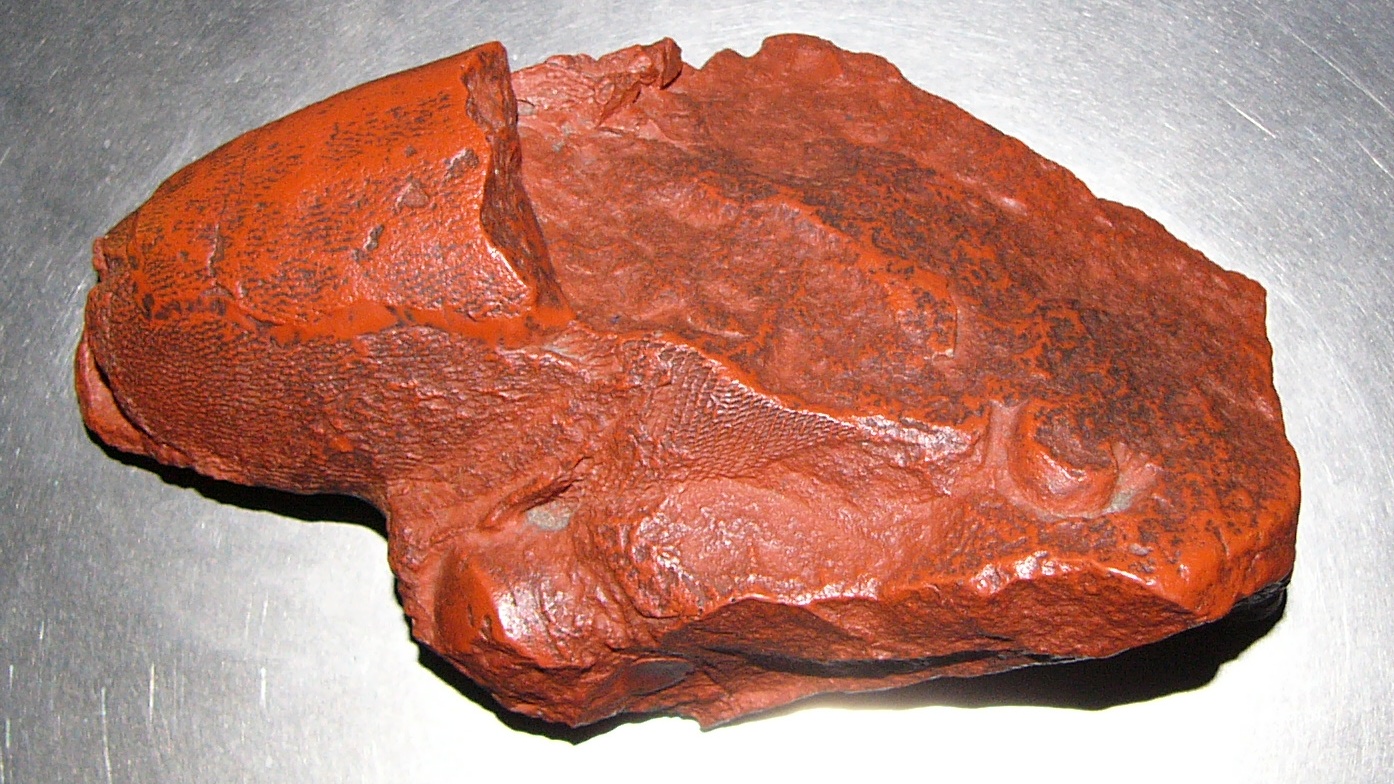
The Fossil Is Strongest When It Is Not Asked To Stand Alone
The central animal was small, armored, jawless, and old enough to carry a heavy interpretive burden. That burden should be handled carefully. Arandaspis belongs among early pteraspidomorph-grade jawless vertebrates, with the head and front of the body protected by dermal armor rather than by the jaws, paired fins, and mobile feeding systems that later make fishes look familiar.[1][3] Its importance is not that it already resembles a modern fish in miniature. Its importance is that it shows a vertebrate body before much of the later fish package had assembled.
That is why armor is the right place to start but the wrong place to stop. The plates are the part most likely to fossilize and the part most available to classification. They define openings, surface ornament, and body boundaries. They also tempt overconfidence. A preserved shield can make a flattened animal feel more complete than it is, especially when the trunk and tail are not equally secure. The field-report habit is to ask what the slab gives directly, what it implies by comparison, and what still depends on related taxa.
Comparison with Sacabambaspis helps here, but only if it is used cautiously. Pradel and colleagues' work on the Bolivian arandaspid tail showed that a related Ordovician jawless fish preserved a more informative caudal region, with dorsal and ventral webs and an elongated notochordal lobe.[4] That does not simply paste a tail onto every Arandaspis drawing. It gives a comparative boundary: arandaspids were more anatomically organized than loose armor plates suggest, but the precise tail and trunk model for Arandaspis still has to respect what the Australian fossils preserve directly.[1][4]
The Sandstone Turns A Fish Into A Habitat Signal
Davies, Sansom, Nicholl, and Ritchie made the crucial environmental correction in their study of the Stairway Sandstone fish-fossil beds.[2] They treated the fish-bearing horizons as part of a shallow marine system, with sandy substrates, trace fossils, and regularly shifting depositional conditions. That matters because early vertebrates often enter public stories as abstract ladder steps. The Stairway Sandstone puts the animal back into water, sand, current, invertebrate activity, and burial.
The shallow-sea setting changes what the fossil can mean. A jawless armored fish in this environment was not simply a primitive body waiting for later improvement. It was an animal living in a sedimentary world that constrained swimming, feeding, sensory use, and preservation.[2] Sand-rich beds can abrade, bury, expose, and concentrate remains. Trace fossils record other organisms moving through the same surfaces. Shell accumulations and sparse invertebrate body fossils show that the fish beds were not empty stages built for vertebrate drama.[2]
This is the useful correction to origin-story language. The Ordovician vertebrate record is not a neat row of ancestral portraits. It is a patchwork of habitats that occasionally preserved enough dermal bone, scales, and articulated material to make early vertebrate anatomy readable. In the Stairway Sandstone, the habitat signal is especially important because it helps explain why the remains are not merely taxonomic points on a chart. They are products of a shallow epeiric sea whose sedimentary behavior helped decide what survived into the record.[2][3]
Microfossils Broaden The Story Beyond One Display Specimen
The visible Arandaspis slab is the best doorway into the subject, but it is not the whole archive. Young's 1997 study of Ordovician microvertebrate remains from the Amadeus Basin widened the evidentiary field around the better-known articulated material.[3] Microvertebrate remains are less cinematic than a museum fossil, but they are essential because they turn early vertebrates from a few displayable bodies into a distributed record of hard tissues, localities, and repeated occurrence.
That distributed record matters for two reasons. First, it makes the Amadeus Basin more than the place where one famous animal appeared. Second, it keeps the evolutionary claim appropriately scaled. Early vertebrates in this setting were part of a wider Gondwanan pattern, but not every fragment resolves into a full animal with equal confidence.[3] Field-report writing should hold both facts at once: the record is richer than one slab, and many pieces remain partial by nature.
This is where Arandaspis becomes scientifically more interesting than the "oldest fish" shortcut. A shortcut asks for a single first. The fossil record usually supplies a cluster: articulated specimens, isolated plates, scales, related taxa, and local sedimentary contexts. The cluster lets paleontologists ask better questions. Were these animals restricted to particular shallow environments? How did armor help in water full of sand, invertebrate movement, and predators? How much of the apparent distribution is biological range, and how much is preservation opportunity?[2][3]
Gondwana Is The Better Map
The wider arandaspid story also resists a single-locality frame. Sacabambaspis in Bolivia and arandaspid material from other Gondwanan margins show that these armored jawless fishes were not an Australian oddity alone.[3][4] The comparison is powerful because it links early vertebrate anatomy to paleogeography. In the Ordovician, the relevant map is not a modern country map. It is a Gondwanan margin map, with shallow seas and basins preserving different pieces of a vertebrate radiation.
This broader geography also protects the article from over-selling Arandaspis. The Australian material is important, but not because it single-handedly explains vertebrate origins. It is important because it anchors one strong southern-hemisphere data point inside a record that can be compared with Bolivia, Oman, Argentina, and other Ordovician occurrences discussed in the arandaspid literature.[3][4] The scientific force comes from pattern, not isolation.
There is a visual lesson here as well. A museum fossil photograph necessarily compresses the animal into a surface. The viewer sees pale stone, dark traces, and armored pieces. The field report asks the opposite movement: expand the slab outward into a section, then into a basin, then into a continent-scale marine margin. That expansion does not make the fossil less concrete. It makes its concreteness useful.
The Best Reading Is A Modest One
The strongest interpretation of the Stairway Sandstone fish beds is deliberately modest. Arandaspis is not a completed preview of later fish. It is an armored jawless vertebrate whose preserved parts show a very early stage in vertebrate body history.[1] The Stairway Sandstone is not a neutral container. It is a shallow marine archive whose sand, trace fossils, shell beds, and depositional shifts shaped what could be preserved and how the animal's habitat should be imagined.[2] The wider Amadeus Basin record is not a pile of footnotes. It turns a famous fossil into part of a larger pattern of Ordovician vertebrate remains.[3]
That modesty is not a retreat from significance. It is the significance. Early vertebrate history becomes clearer when firsts give way to settings. A shield plate tells us there was armor. A body tells us there was an animal. A fish-bearing sandstone tells us the animal lived in a real seafloor system, among moving sediment and other organisms, on a Gondwanan margin where vertebrates were already experimenting with protection, orientation, and life close to the bottom. The Stairway Sandstone matters because it keeps all of those scales in the same hand.
Sources
- Paleobiology Database, "Arandaspis" taxon record - taxonomy, age range, fossil occurrence context, and Ritchie & Gilbert-Tomlinson primary-reference metadata.
- Ghent University Academic Bibliography, Neil S. Davies, Ivan J. Sansom, Robert S. Nicholl, and Alex Ritchie, "Ichnofacies of the Stairway Sandstone fish-fossil beds (Middle Ordovician, Northern Territory, Australia)," Alcheringa 35, no. 4 (2011).
- Semantic Scholar, Gavin C. Young, "Ordovician microvertebrate remains from the Amadeus Basin, central Australia," Journal of Vertebrate Paleontology 17, no. 1 (1997).
- University of Birmingham research record, Alan Pradel, Ivan J. Sansom, Pierre-Yves Gagnier, Ricardo Cespedes, and Philippe Janvier, "The tail of the Ordovician fish Sacabambaspis," Biology Letters 3, no. 1 (2007).
- Wikimedia Commons, "File:Arandaspis prionotolepis fossil.jpg" - source page for the photographed Natural History Museum fossil used as the article image.