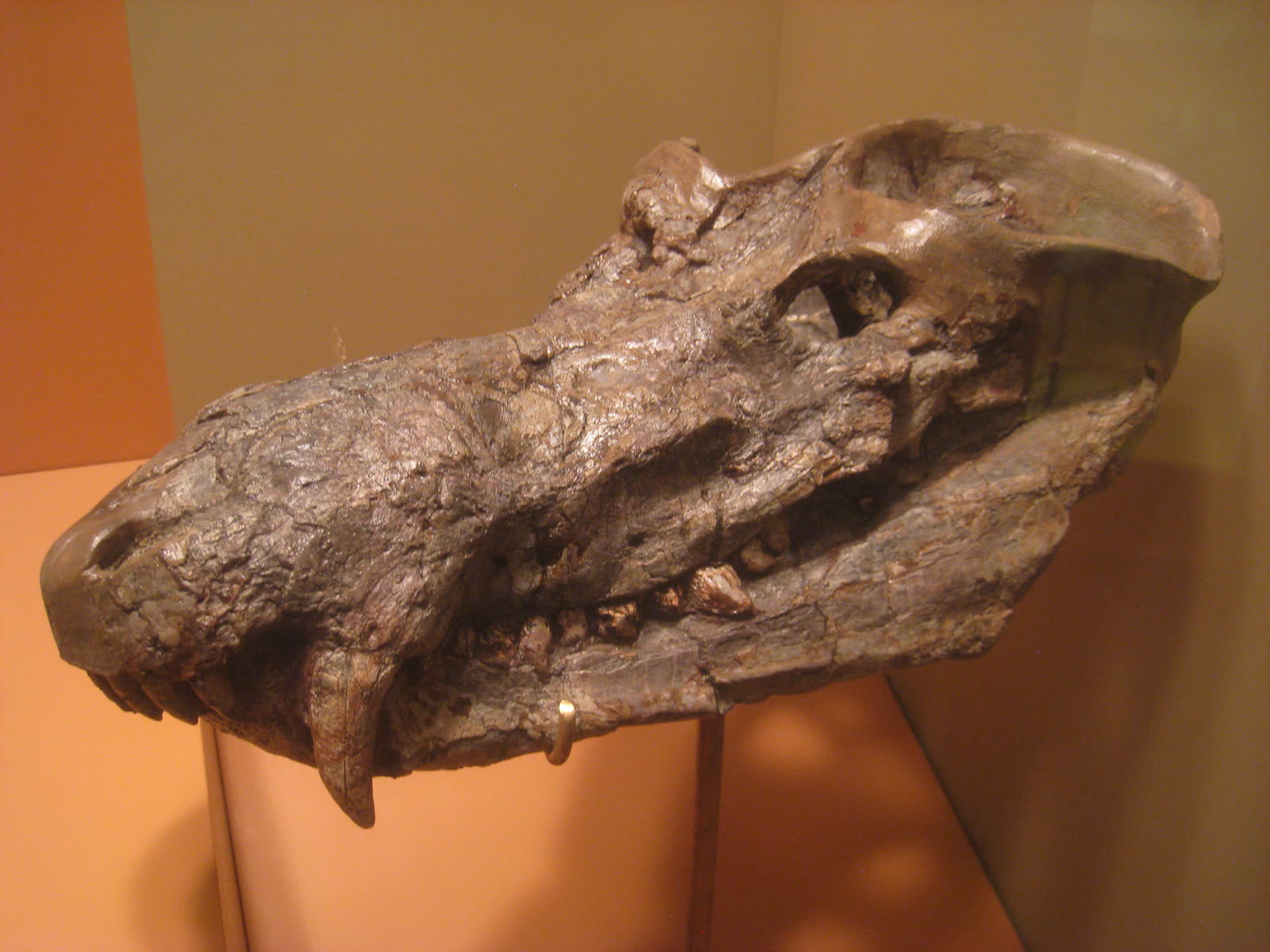
Cynognathus crateronotus is easy to make too modern. The name means "dog jaw," the skull looks predatory in a way a mammal reader can recognize, and the animal sits inside Cynodontia, the broader mammal-line group from which true mammals eventually emerged. That combination invites a lazy sentence: here is a reptile turning into a mammal. The fossil is better than that. Cynognathus matters because it shows a Triassic predator assembling several mammal-line traits inside a still non-mammalian body: differentiated teeth, a strong skull, rapid growth, isotope-readable ecology, and a Karoo-to-Argentina record broad enough to keep the animal from being a single-locality curiosity.[1][2][3][4]
The useful profile starts with the skull, not with a destiny. Seeley's 1895 monograph on the Karroo cynodont material treated Cynognathus as a serious anatomical problem because the skull and skeleton did not fit older reptile expectations cleanly.[1] The jaws were long and forceful, the dentition was not a simple row of repeated cones, and the postcranial skeleton belonged to a robust terrestrial animal rather than a small hidden ancestor waiting at the edge of the dinosaur story.[1] That is still the right entry point. Cynognathus should be read as a functioning carnivorous cynodont first, and as a mammal-line signal second.
The teeth are where the animal becomes most legible. In a generalized reptile shorthand, teeth often do one basic job: seize, hold, maybe tear. In Cynognathus, the mouth is already more divided. The famous dog-jaw impression comes from a skull built around canines and sectorial postcanine teeth, a system that makes feeding look more processed than simple grabbing.[1][3] That does not make the animal a mammal. It does mean that one of the major mammalian themes, a mouth in which different teeth do different mechanical work, was already important before crown mammals existed.
That point matters because cynodont evolution is often remembered through soft features that rarely fossilize: hair, whiskers, warm-bloodedness, nursing. Those are tempting, but Cynognathus keeps the evidence on harder ground. Bone and tooth structure can show function without asking the fossil to preserve every living surface. A secondary palate and differentiated tooth row suggest an animal whose head was not simply a scaled-down reptilian predator, while the skull proportions and jaw equipment keep the predatory role visible.[1][3] The strongest claim is not that Cynognathus was "almost a mammal." The stronger claim is that mammal-line anatomy was being built through predation, feeding efficiency, and sustained activity.
Growth evidence sharpens that picture. Botha and Chinsamy's bone-histology study compared Cynognathus with the coeval cynodont Diademodon and found markedly different growth signals: Diademodon showed cyclical growth, while Cynognathus bone tissue indicated continuous, rapid growth through the year.[2] That is not a minor technical result. It gives the animal a life-history tempo. A predator with uninterrupted fibro-lamellar bone growth is not just a skull in a display case. It is a body investing quickly and continuously in size, tissue, and activity.[2]
The comparison with Diademodon also prevents overgeneralizing. Two cynodonts living in the same broad Karoo world did not have to grow the same way.[2][3] That is the point a species profile should preserve. Early mammal-line animals were not moving along one synchronized escalator toward mammalhood. They were already ecologically and physiologically varied. Cynognathus gives the carnivorous side of that variation: large head, cutting dentition, and fast growth. Diademodon gives a different herbivorous or omnivorous register. The evolutionary story becomes richer once those differences stay separate.
Isotope work adds environment to the body. Botha, Lee-Thorp, and Chinsamy used stable carbon and oxygen isotope analysis of tooth enamel to examine the palaeoecology of Cynognathus and Diademodon from the Karoo Basin.[3] The important lesson is methodological as much as ecological: the same animals that look familiar or unfamiliar in bone can also be tested through chemistry. Tooth enamel records a lived relationship with food and water, not merely a taxonomic position. For Cynognathus, that means ecology is not inferred only from scary teeth. It is approached through a stack of evidence that includes dentition, growth tissue, and geochemical signals.[2][3]
The body scale matters too, because Cynognathus can shrink or swell in public imagination depending on whether the reader sees only the skull or a full restoration. A 2022 Acta Palaeontologica Polonica paper on body-mass estimation in Triassic cynodonts from Argentina treated the sectorial-toothed Cynognathus crateronotus as part of its comparative sample and reported an average estimate around 20 kilograms by humerus equations.[4] That number should not be turned into the final size of every individual, but it usefully keeps the animal out of both extremes. Cynognathus was not a tiny hidden proto-mammal, and it was not a monster. It was a substantial terrestrial cynodont predator whose skull and postcranial evidence have to be reconciled.[1][4]
That scale correction gives Cynognathus a second kind of importance. Some fossils matter because they transform anatomy. Others matter because they discipline proportion. Cynognathus does both modestly but durably. In the skull, it shows a predatory cynodont whose jaw and teeth make mammal-line feeding more exact. In the long bones, it shows a growth strategy that differed from neighboring cynodonts. In enamel chemistry, it becomes part of an ecological comparison. In mass-estimation work, it becomes a reminder that a charismatic head still needs a measured body.[1][2][3][4]
The boundary is just as important as the signal. Cynognathus was not a dog, not a mammal, and not a direct portrait of the first furry ancestor. It was a non-mammalian cynodont predator living in the Early-to-Middle Triassic aftermath of the greatest extinction in Earth history. Its value lies in the mismatch. The head carries mammal-line sophistication without becoming a modern carnivore. The body grows rapidly without giving us a full soft-tissue physiology. The distribution is broad enough to help correlate southern rocks without turning one genus into a whole ecosystem by itself.[1][2][3][4]
Read that way, Cynognathus becomes more interesting than the old "mammal-like reptile" label. The label points in the right direction and then stops thinking. The fossil asks for a sharper sentence: early mammal-line evolution was already a predator problem, a growth problem, an ecological problem, and a map problem. The dog jaw is only the doorway.
Sources
- Harry G. Seeley, "Researches on the Structure, Organization, and Classification of the Fossil Reptilia. Part IX., Section 5. On the Skeleton in New Cynodontia from the Karroo Rocks," Philosophical Transactions of the Royal Society of London B 186 (1895), Internet Archive mirror.
- Jennifer Botha and Anusuya Chinsamy, "Growth patterns deduced from the bone histology of the cynodonts Diademodon and Cynognathus," Journal of Vertebrate Paleontology 20 (2000), author-hosted PDF.
- Jennifer Botha, Julia Lee-Thorp, and Anusuya Chinsamy, "The palaeoecology of the non-mammalian cynodonts Diademodon and Cynognathus from the Karoo Basin of South Africa, using stable light isotope analysis," Palaeogeography, Palaeoclimatology, Palaeoecology 223 (2005), author-hosted PDF.
- Agustin G. Martinelli et al., "Body mass estimation in Triassic cynodonts from Argentina based on limb variables," Acta Palaeontologica Polonica 67 (2022), HTML article page.
- Wikimedia Commons, "File:Cynognathus crateronotus - National Museum of Natural History - IMG 1987.JPG" - source page for the Smithsonian specimen photograph used as the article image.