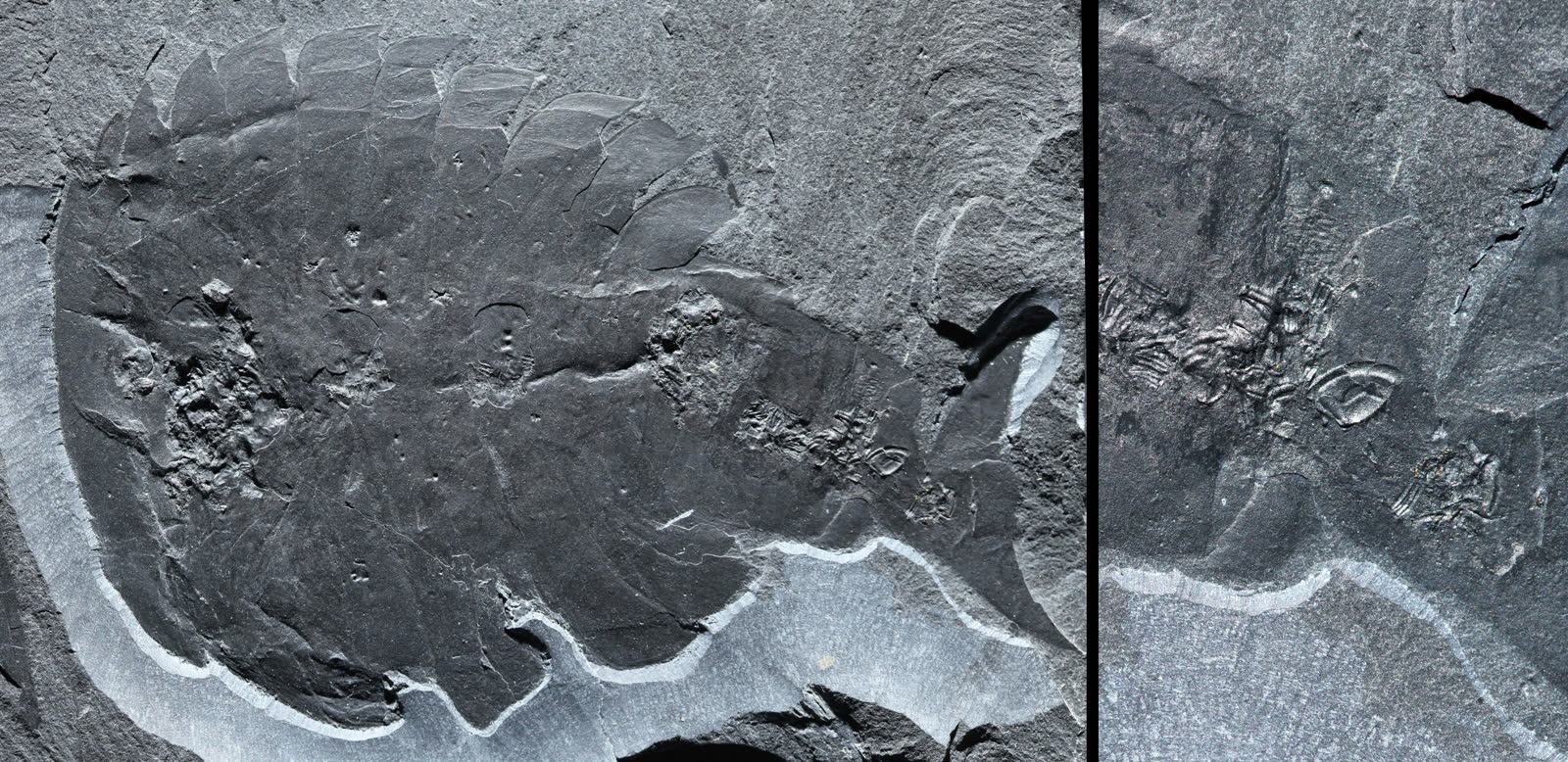
Sidneyia inexpectans is easy to file away as one more Burgess Shale oddity: a flattened Cambrian arthropod, older than familiar sea scorpions, walking over a sea floor crowded with trilobites, worms, brachiopods, sponges, and stranger soft-bodied animals. That summary is not wrong, but it misses the best part. Sidneyia becomes important when the animal is read through what passed through it. Its gut contents turn a general predator into a specific ecological instrument: a body that could find, handle, crush, swallow, and preserve traces of small hard-shelled prey in a 505-million-year-old food web.[1][2]
The fossil also asks for a narrower kind of attention than the phrase "Cambrian predator" usually gets. Anomalocaris gets the dramatic role; Opabinia gets the surreal silhouette; trilobites get abundance and recognition. Sidneyia is quieter. It has a head shield, antennae, segmented trunk, walking limbs, and a tail fan, but its strongest evidence sits under the animal, in the limb bases and gut. The useful close reading starts there: not with a full-body fantasy, but with the machinery of feeding.[1][2][4]
The specimen keeps the claim honest
The Royal Ontario Museum's Burgess Shale gallery is useful because it shows Sidneyia as a set of specimens, not only as a reconstruction. ROM 60744, the cover image used here, is described as a complete Sidneyia inexpectans from the Walcott Quarry with gut content visible and a specimen length of 86 mm. The same ROM page also shows the Smithsonian lectotype, USNM 57487, a larger complete specimen with antennae and gut content, measured at 156 mm with antennae.[1]
Those details matter. A specimen with gut content is not merely a nice fossil. It is a rare bridge between body plan and behavior. Teeth, claws, and spines can suggest a feeding role, but gut contents can name part of the meal. That does not make every ecological question easy. A gut can mix recent food, older sediment, resistant fragments, and postmortem alteration. Still, it is a better starting point than guessing from silhouette alone.[2][3]
The name Sidneyia inexpectans comes from Charles Walcott's Burgess Shale work, and the animal was long treated as one of the major non-trilobite arthropods from the quarry.[1] Later studies refined the anatomy and classification, but the fossil has kept one stable value: it shows that Cambrian arthropod ecology was not a simple ladder of soft grazers and one spectacular apex predator. There were animals operating at the water-sediment interface with limbs capable of processing hard material, and Sidneyia sits squarely in that problem.[2][4]
The meal was not scenery
The most direct modern account of Sidneyia feeding is Axelle Zacai, Jean Vannier, and Rudy Lerosey-Aubril's reconstruction of its diet. Their analysis treated gut contents as evidence for prey choice and feeding mode, not as decorative debris. The important conclusion is that Sidneyia fed largely on small ptychopariid trilobites, with brachiopods, possible agnostids, worms, and other material also present. The authors interpreted the animal as primarily durophagous: a hard-prey feeder with predatory and/or scavenging habits at or near the sea floor.[2]
That word, durophagous, is doing real work. It keeps the animal from becoming a vague "hunter." A durophagous animal has to solve a mechanical problem. It must contact prey, hold or orient it, break or shred resistant parts, and move the pieces inward. For Sidneyia, the relevant equipment was not a jaw like a vertebrate's. It was the spined basal parts of the limbs, the gnathobases, working along the underside of the body.[2][4]
The gut contents also revise the prey into a fossil community, not a menu label. Small trilobites and brachiopods were not passive tokens. They had their own shells, habits, and positions near the sediment-water boundary. When their fragments appear inside Sidneyia, the fossil is showing a contact zone: a sea floor where armored and shelled animals could become food for another arthropod built to process them.[2][3]
That is why the article's image should be a fossil photograph, not a polished life restoration. The dark, flattened specimen looks less spectacular than a painted Cambrian scene, but it keeps the evidence in the right order. First the animal. Then the preserved gut. Then the inference about feeding. The reconstruction comes last.
The limb bases make the gut plausible
Gut contents can say what went in, but they do not by themselves explain how the food was handled. That is where the limb bases matter. Work on Sidneyia has repeatedly returned to the gnathobasic spines: hardened, inward-facing structures on the basal limb segments that would have helped crush or shred prey beneath the body.[2][4]
Biomechanical analysis made that interpretation more testable. Russell Bicknell and colleagues compared shell-crushing abilities in modern and ancient arthropods and included Sidneyia in the ancient side of the problem. The broader result was not that a Cambrian arthropod must be treated as a living horseshoe crab in costume. It was that mechanical modeling can ask whether preserved limb structures were compatible with crushing resistant food.[4]
That matters because paleontology often has to join different kinds of evidence without pretending they are equal. Gut contents are direct evidence of what the digestive tract held. Limb anatomy is evidence of possible handling and processing. Biomechanics tests whether the anatomical interpretation is mechanically plausible. The strongest reading of Sidneyia uses all three: meal, tool, and force.[2][4]
It also keeps a boundary around behavior. Sidneyia probably fed on small hard-bodied invertebrates and may have combined predation with scavenging.[2] But a gut does not show the chase, the strike, or the exact moment of death. Some prey could have been captured alive; some could have been scavenged; some fragments could have entered after prior breakage. The fossil lets us defend a feeding mode more securely than a hunting scene.
Cambrian food webs were already tangled
Jean Vannier's broader work on Burgess Shale gut contents, especially in Ottoia, helps frame why Sidneyia matters beyond one taxon. Vannier argued that gut-content evidence reveals direct trophic links in Cambrian ecosystems and shows a food web too complex for a simple linear picture.[3] Although Ottoia and Sidneyia were different animals with different feeding equipment, the methodological lesson transfers: preserved meals can turn a community list into relationships.
For Sidneyia, that relationship is especially useful because the animal was not only eating soft-bodied prey. The gut record points toward small shelly and armored organisms. That gives the Burgess Shale food web a harder texture. Cambrian ecosystems were not just a field of delicate soft bodies waiting for rare burial. They included shells, spines, limb bases, crushing surfaces, gut residues, and resistant fragments moving through predators and scavengers.[2][3][4]
This is also where the word "predator" needs discipline. A predator in deep time is often imagined from the top down: bigger animal, smaller animal, attack. Sidneyia is better read from the bottom up. Its ecology begins with the sea-floor interface, small prey, limb bases, and the contents of the gut. The animal's importance is not that it was the biggest threat in the Burgess Shale. Its importance is that it makes a specific feeding route visible.
The distribution widened, but the Burgess specimen still anchors the story
For a long time, Sidneyia was strongly associated with the Burgess Shale. A 2020 Geological Magazine paper reported Sidneyia cf. inexpectans from the Wuliuan Mantou Formation of North China and argued that this expanded the known palaeogeographic distribution of the genus beyond Laurentia.[5] A 2023 Science China Earth Sciences paper on early Cambrian Sidneyia also treated new Chinese material as important for resolving long-running questions about head organization.[6]
Those later records change the framing without weakening the Burgess Shale specimens. They suggest that Sidneyia or close relatives were not simply a local Canadian curiosity. The body plan had a wider Cambrian history than the classic quarry alone could show.[5][6] But the gut-content story still depends heavily on the Burgess material because that is where the feeding evidence is unusually vivid.[1][2]
The best close reading therefore holds two scales together. At specimen scale, ROM 60744 and related material keep the animal tactile: flattened body, visible gut region, measurable length, quarry context. At evolutionary scale, later Chinese records keep the genus from being trapped in one famous deposit. Sidneyia becomes both a Burgess Shale feeding case and a wider Cambrian arthropod problem.[1][5][6]
The right conclusion is modest and stronger
The weak version of Sidneyia is a generic Cambrian sea-floor predator. The stronger version is more constrained: a non-trilobite artiopodan arthropod whose preserved gut contents, gnathobasic limb bases, and biomechanical plausibility make hard-prey feeding one of the more testable ecological claims available for a Burgess Shale animal.[1][2][4]
That does not mean the fossil tells us everything. It does not fix every taxonomic debate. It does not show a live attack. It does not prove that every individual fed the same way, or that predation and scavenging were neatly separated. Its strength is different. Sidneyia lets paleontology move from body outline to trophic relationship without leaving the fossil behind.
Read closely, the meal inside the animal is not a side note. It is the point at which anatomy becomes ecology. A Cambrian arthropod walked over the sediment, worked hard prey under its body, and carried fragments of that world into its gut. The surprise in Sidneyia inexpectans is not just that the animal was found. It is that part of the food web was found inside it.
Sources
- Royal Ontario Museum, "Sidneyia inexpectans," Burgess Shale fossil gallery entry for specimens including ROM 60744 and USNM 57487.
- Axelle Zacai, Jean Vannier, and Rudy Lerosey-Aubril, "Reconstructing the diet of a 505-million-year-old arthropod: Sidneyia inexpectans from the Burgess Shale fauna," Arthropod Structure & Development 45 (2016), HAL record/PDF.
- Jean Vannier, "Gut Contents as Direct Indicators for Trophic Relationships in the Cambrian Marine Ecosystem," PLOS ONE 7(12): e52200 (2012).
- Russell D. C. Bicknell et al., "Computational biomechanical analyses demonstrate similar shell-crushing abilities in modern and ancient arthropods," Proceedings of the Royal Society B 285 (2018), PubMed record.
- Zhixin Sun, Han Zeng, and Fangchen Zhao, "First occurrence of the Cambrian arthropod Sidneyia Walcott, 1911 outside of Laurentia," Geological Magazine 157 (2020), Cambridge Core page.
- Kunsheng Du, David L. Bruton, Jie Yang, and Xiguang Zhang, "An early Cambrian Sidneyia (Arthropoda) resolves the century-long debate of its head organization," Science China Earth Sciences 66 (2023), Springer page.