
Science Friday's "Tar Noir" video has the shape of a forensic story: a sticky site, bones with damage, specialists cleaning away asphalt, and a museum team reading the dead animals of Ice Age Los Angeles as if the scene had left clues on every surface.[1] That framing works because La Brea is not just a dramatic fossil trap. It is a rare kind of archive in which the preserving medium, the sorting process, and the scale of the collection all change what paleontologists can ask.[2][3]
The easy version of La Brea is a parade of celebrity mammals: saber-toothed cats, dire wolves, mammoths, ground sloths. The better version is more granular. The official collections page describes Rancho La Brea as one of the world's richest and most diverse late Pleistocene fossil collections, with more than 3.5 million specimens recorded at the last census and a record useful for studying ecological change across roughly the past 50,000 years.[3] The research page widens the same frame: these fossils span the end of the last Ice Age, the arrival of humans in North America, and an extinction episode that removed a large share of North America's big mammals.[4]
That is the mindset to carry into the video. Watch less for "tar pit" atmosphere and more for how evidence changes scale. A big carnivore bone can speak about injury. Matrix clinging to that bone can preserve small vertebrates, insects, shells, plants, and pollen. A public fossil lab can turn sticky asphalt-covered fragments into catalogued specimens. New dating can move the story from a museum display into a population and ecosystem timeline.[2][3][4][5]
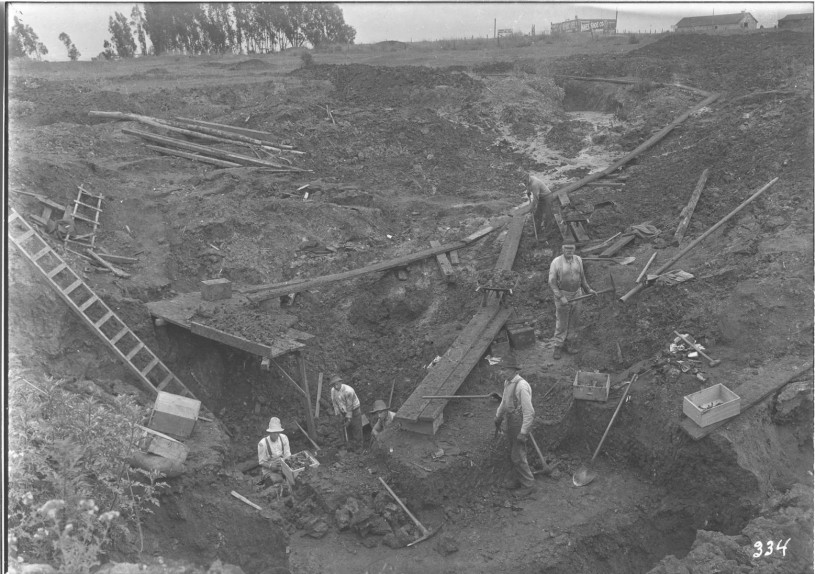
Image context: the cover uses a real archival photograph from the La Brea Tar Pits virtual field trip showing excavators working at the site in 1914.[2] It belongs here because the post is about paleontology as accumulated practice: field excavation, preparation, sorting, and re-analysis across generations.
Around 0:40, the trap is already a taphonomy lesson
The opening minutes lean into the grim appeal of asphalt entrapment, but the important concept is taphonomic. La Brea's natural asphalt did not merely hold animals in place. It created an unusual preservation pipeline: organisms were trapped, buried, stained, mixed with sediment, and later excavated as bones plus matrix.[1][2] That is why the site keeps producing more than a catalogue of large skeletons. It preserves an ecosystem signal in pieces large and small.
The virtual field trip makes this explicit at Pit 91. The site resumed excavations in 1969, and paleontologists realized that the sediment around the large fossils was packed with microfossils.[2] That detail changes the meaning of the big bones in the video. The fossil is not only the dramatic object a camera can frame. The surrounding matrix is also evidence. Teeth, small bones, seeds, insects, shells, and pollen can tell researchers about climate and habitat at a resolution a single saber-toothed cat skull cannot carry by itself.[2][4]
Around 2:00, cleaning is not cosmetic work
The most useful thing the video shows is the handoff from spectacle to preparation.[1] Asphalt makes La Brea famous, but it also makes La Brea difficult. The official fossil-lab explanation describes a staged cleaning process: hardened asphalt is removed by soaking bones in solvent, remaining clay and silt are cleaned away, and damaged material may be stabilized or reconstructed with conservation adhesive before entering the collections workflow.[2]
That work is not a museum polish pass. It is what lets a fossil become analyzable. A bone still clogged with asphalt is visually exciting, but it is a poor research object if surfaces, fractures, tooth marks, or pathology remain hidden. A cleaned and catalogued specimen can be compared, measured, scanned, dated, and revisited by later researchers asking a different question.[2][3][4] The video is strongest when it lets viewers see that preparation is part of discovery rather than an afterthought that happens once discovery is over.
Around 3:10, injury turns one bone into a behavioral question
The "paleoforensics" hook matters because La Brea has enough repeated material for injuries to become more than curiosities.[1] A single damaged bone can invite a story. A large collection can test whether injuries cluster by species, body part, life stage, or ecological role. The research page notes that La Brea maintains thousands of pathology specimens, which is exactly the kind of archive needed for cautious inference about how animals were hurt, survived, moved, and interacted.[4]
This is where the video's detective language needs discipline. Paleoforensics is not time travel. It does not show the attack, the chase, or the social scene directly. It gives anatomical traces: healed fractures, tooth damage, joint disease, infection, breakage patterns, and context. The writing around those traces must hold two ideas together. First, injuries can make extinct behavior more discussable. Second, injuries rarely prove one neat behavioral story by themselves. La Brea is powerful because it lets paleontologists compare clues at collection scale.[1][3][4]
What the video leaves behind
The article's larger point is that La Brea should be read as an evidence system. The official collections page emphasizes diversity, specimen count, preservation quality, and long time depth.[3] The research page turns those holdings toward questions about extinction, climate, disease, diet, and community change.[4] The 2023 Science study shows how far that archive can be pushed when old fossil collections meet new chronology: O'Keefe and colleagues used 172 new radiocarbon dates on megafauna from Rancho La Brea, spanning 15.6 to 10.0 thousand calendar years before present, to place local extirpation in relation to fire, vegetation change, climate, and human presence.[5]
That does not make La Brea simple. It makes it better than simple. The tar pits are not a single frozen moment and not just a death trap for famous mammals. They are a long, messy, chemically stained, repeatedly excavated archive. The Science Friday video is worth embedding because it shows the public-facing surface of that archive: the sticky bones, the forensic close reading, the lab work. The written sources complete the frame by showing why those surfaces matter. Asphalt catches the eye, but the scientific value comes from the way asphalt, matrix, preparation, cataloguing, and re-dating keep letting the same site answer new questions.[1][2][3][4][5]
Sources
- Science Friday, "Tar Noir: Paleoforensics at the La Brea Tar Pits," YouTube video.
- La Brea Tar Pits, "Tar Pits Virtual Field Trip" - official page covering Pit 91, fossil preparation, microfossils, and the 1914 archival excavation image.
- La Brea Tar Pits, "Our Collections" - official overview of the Rancho La Brea late Pleistocene fossil collections.
- La Brea Tar Pits, "Our Research" - official overview of current research questions, time depth, extinction context, and pathology holdings.
- F. Robin O'Keefe et al., "Pre-Younger Dryas megafaunal extirpation at Rancho La Brea linked to fire-driven state shift," Science 381 (2023), via PubMed record.