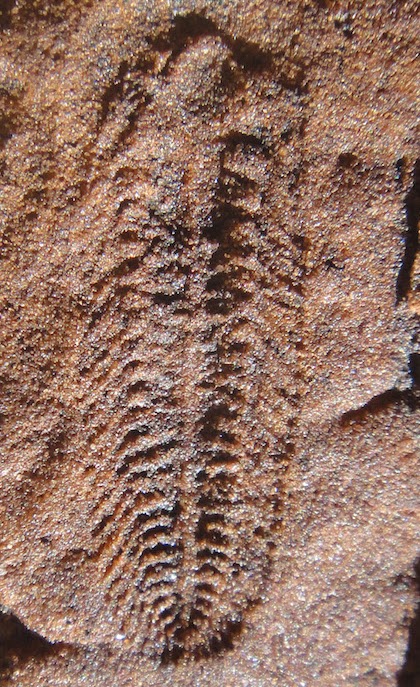
Spriggina floundersi is a fossil that seems to answer the question too quickly. A narrow front end reads as a head. Repeated ridges read as segments. The whole body tapers like something that should have had a front, a back, and a direction of travel. In a late Ediacaran seafloor impression from South Australia, that is enough to make the eye reach for familiar labels: worm, arthropod, early crawler, maybe even a distant prelude to trilobites.
The fossil becomes more important when that reflex is slowed down. The Australian Ediacaran reference site describes Spriggina as South Australia's state fossil, known only from the Rawnsley Quartzite, about 2-5 centimeters long, with a broadly segmented body plan and apparent head and tail ends, but it also warns that the preserved features may not be homologous with those of modern animals and that direct evidence of movement has not been published.[2] That combination is exactly why Spriggina deserves a close reading. It looks legible before it is settled.
Image context: the cover uses a real photographed fossil impression from the Australian Ediacaran site.[2] It belongs here because the article is about the gap between visual familiarity and evidential restraint. The fossil's repeated ridges are clear enough to tempt a modern-animal comparison, but the rock does not preserve the decisive organs, limbs, mouthparts, or trace association that would make that comparison easy.
The fossil's neatness is the trap
The older literature gave Spriggina its first scientific footing inside a broader attempt to describe the late Precambrian fossils from Ediacara, South Australia.[1] That setting matters. These were not ordinary shelly fossils with hard parts sorted into familiar Cambrian drawers. They were impressions of soft-bodied organisms in sandstone, preserved from a world just before the Cambrian animal record becomes louder and more anatomically explicit.
That is why the specimen can look more straightforward than it is. Segmentation is one of the strongest visual cues in animal paleontology. When a fossil shows repeated units along a body axis, the mind immediately compares annelids, arthropods, and other bilaterian animals. But a repeated surface pattern is not automatically the same as modern segmentation. It may record body modules, external wrinkles, preservational relief, or anatomy that has no close living equivalent.[2][5]
The head-like front end is just as risky. It gives the fossil personality, but personality is not a character matrix. Without clear eyes, antennae, jaws, walking limbs, or trace fossils tied directly to the body, the anterior end remains suggestive rather than decisive. The safe reading is not that Spriggina had no front. The safe reading is that the front alone cannot carry the whole taxonomic argument.
Ediacara preservation makes soft bodies visible, but not transparent
The Ediacara Member is one of the rare records that made animals or animal-grade organisms visible before skeletons dominate the archive. A 2020 review of the Ediacara Member describes these fossils as part of a restricted window into the Ediacaran seafloor, with the South Australian record preserving broad morphological diversity and community-level information across the Rawnsley Quartzite.[3] It also places the likely age of the Ediacara Member around 555 million years ago by comparison with dated similar assemblages in Russia.[3]
That same paper is useful because it keeps preservation in the foreground. Ediacara-style fossils commonly occur as negative impressions on bed soles and positive counterparts on underlying surfaces, shaped by microbial mats, rapid cementation, burial, and splitting of sandstone beds.[3] In plain terms, the fossil is a cast of a soft body and its sedimentary interface, not a body delivered intact into the present.
For Spriggina, that means every attractive visual feature has to pass through a taphonomic filter. The ridges may be biologically meaningful; they are not automatically modern-style segments. The head-like region may represent a real anterior differentiation; it is not automatically a preserved head with modern sensory equipment. The fossil is not weak because of this. It is strong because it shows how much can be asked from a shallow relief impression while still respecting what cannot be seen.
Apparent symmetry is not the same as easy bilaterian identity
The most consequential question is symmetry. A bilaterally organized animal with a head end, repeated units, and directed motion would be a powerful signal near the Ediacaran-Cambrian boundary. But Spriggina sits in a group of fossils where symmetry itself has been part of the debate.
Ivantsov's short treatment of Proarticulata describes a body plan in which left and right units alternate relative to the body axis rather than forming direct mirror images, a pattern called gliding reflection; it includes South Australian forms such as Spriggina among likely or possible proarticulates.[5] That is a crucial caution. Glide-like organization does not make the fossil uninteresting. It makes the familiar bilaterian reading less automatic.
This is why Spriggina is a better boundary fossil than an ancestor mascot. It may preserve an animal or animal-grade organism with anterior-posterior organization. It may preserve a body plan related to the extinct proarticulate problem. It may show that Ediacaran organisms had already evolved repeated, directional architectures that can look close to later animals without falling neatly inside them.[2][5] What it does not do is hand over a simple bridge from Ediacaran impressions to Cambrian arthropods.
The trilobite temptation is understandable, and still too strong
The trilobite comparison keeps returning because the fossil invites it. A tapered, repeated body with a head-like front looks like a pre-arthropod silhouette if seen from across the room. But modern arthropod paleontology asks for more than silhouette. It asks for articulated limbs, exoskeletal organization, appendage structure, trace evidence, and a body plan that can be placed inside the euarthropod stem or crown with defensible characters.
Daley and colleagues' review of the early fossil record of Euarthropoda is useful at this boundary because it builds the strong arthropod story from Cambrian body fossils, trace fossils, biomineralized evidence, and the timing of trilobites rather than from Ediacaran resemblance alone.[6] That does not make Spriggina irrelevant to animal origins. It only means it should not be drafted into the arthropod story before the characters are there.
The distinction matters because a weak ancestor story can make the fossil smaller. If Spriggina is treated mainly as "maybe a proto-trilobite," then every missing arthropod character becomes a disappointment. If it is treated as an Ediacaran body plan with its own evidential rules, the fossil becomes more useful. It shows that late Ediacaran seafloors contained organisms whose shapes were directional, modular, and animal-like enough to pressure old assumptions, even when their exact affinities remain open.[2][3][6]
The history of interpretation is part of the specimen
Ediacaran fossils have a long history of being made familiar too quickly. Runnegar's 2021 review of biological interpretations of the Ediacaran biotas traces how early explanations moved through jellyfish, sea pens, worms, fronds, extinct body plans, and later animal-affinity arguments as researchers rethought preservation, environment, and anatomy.[4] That history is not just background. It is the interpretive climate in which Spriggina has to be read.
The Ediacara Fossil Site at Nilpena remains important for the same reason. Australia's heritage listing describes Reginald Sprigg's 1946 discovery in the Flinders Ranges as the first abundant fossilized community of soft-bodied organisms recognized anywhere in the world, a discovery that changed assumptions about what could be preserved before hard parts became common.[7] Spriggina belongs to that shift. Its importance is not only taxonomic; it is methodological. It helped make soft-bodied, pre-Cambrian life impossible to dismiss as stains, curiosities, or misdated accidents.
That is why the fossil's uncertainty should not be treated as a flaw. A fossil this old does not become less valuable because it refuses a neat modern address. It becomes more valuable when it forces the reader to separate resemblance from homology, directionality from proven motion, segmentation-like relief from true segmentation, and animal-like form from a named living phylum.
A better way to keep Spriggina in view
The strongest reading of Spriggina is bounded but not timid. It was a small late Ediacaran organism from South Australia, preserved as a soft-bodied impression in a sandstone-mat system that could capture fine relief under unusual conditions.[2][3] It had a head-like anterior region, a tapered body, and repeated ridges that make it one of the most visually animal-like fossils in the Ediacara story.[2] It probably belongs in the broad conversation about early animal-grade organization, but its exact relationship to modern groups remains unresolved.[2][5][6]
That makes Spriggina a useful fossil precisely because it looks almost too readable. It lets the reader feel the pull of a simple story, then shows why paleontology has to resist it. The animal boundary in the Ediacaran was not a clean door swinging open into the Cambrian. It was a field of soft-bodied experiments, preservational windows, partial symmetries, and body plans that looked familiar from one angle and vanished from the modern world from another.
Spriggina still matters because it keeps that boundary jagged. The fossil looks like it is about to explain itself. The science begins when it does not.
Sources
- Martin F. Glaessner and Mary Wade, "The Late Precambrian fossils from Ediacara, South Australia," Palaeontology 9 (1966), Biodiversity Heritage Library record.
- Australian Ediacaran, "Ediacara Biota" - Spriggina floundersi overview and photographed fossil image used for the article.
- Tory L. Botha, Diego C. Garcia-Bellido, Mary L. Droser, and James G. Gehling, "The Ediacara Member, South Australia: Lithofacies and palaeoenvironments of the Ediacara biota," Gondwana Research 80 (2020).
- Bruce Runnegar, "Following the logic behind biological interpretations of the Ediacaran biotas," Geological Magazine 158, no. 11 (2021).
- Andrei Yu. Ivantsov, "Vendian Animals in the Phylum Proarticulata," Paleontological Institute, Russian Academy of Sciences, hosted by Monash University.
- Allison C. Daley, Jonathan B. Antcliffe, Harriet B. Drage, and Stephen Pates, "Early fossil record of Euarthropoda and the Cambrian Explosion," Oxford University Research Archive record for PNAS 115, no. 21 (2018).
- Australian Government Department of Climate Change, Energy, the Environment and Water, "Ediacara Fossil Site - Nilpena" (last updated 19 March 2026).