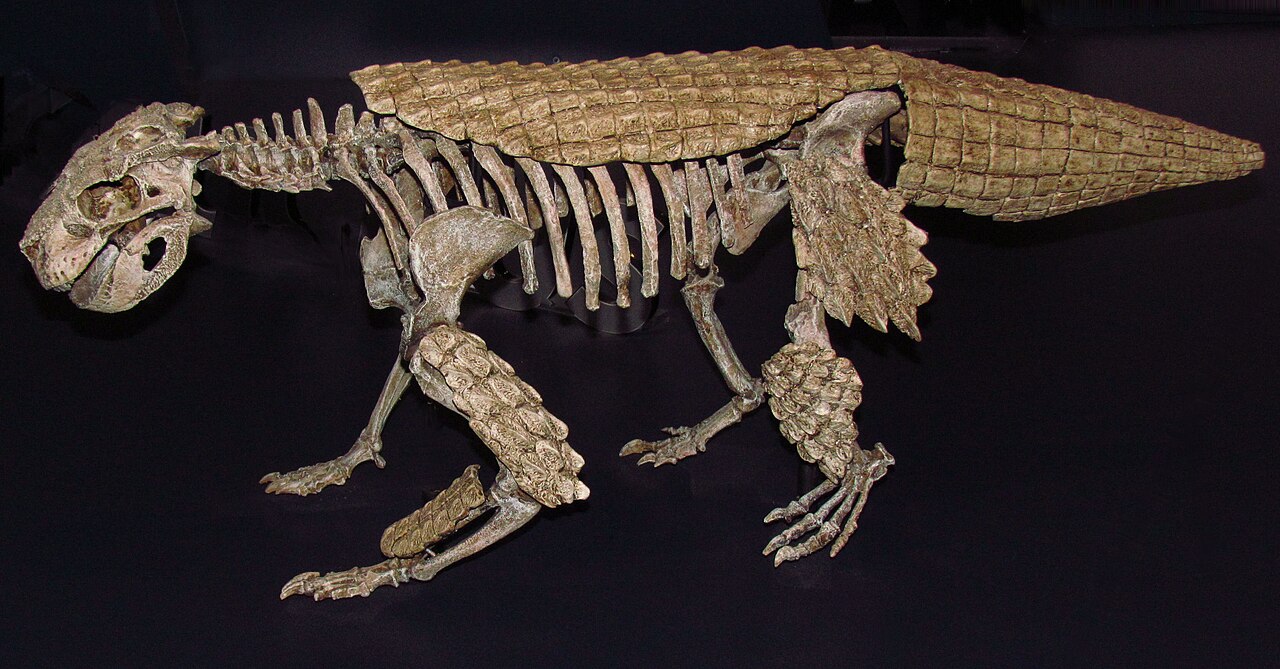
Simosuchus clarki is most useful when it is allowed to embarrass the usual crocodile template. The template says long snout, conical teeth, flattened head, river-edge ambush. The fossil says something else: a blunt, pug-like skull; multicusped teeth shaped for processing plants; a compact terrestrial body; and armor that makes the animal look less like a lurking swimmer than a low, armored browser in a seasonally dry Cretaceous landscape.[1][2][3]
That is why Simosuchus deserves an anatomy-and-method reading rather than a novelty profile. The animal is strange, but its strangeness is not random. Each odd feature asks the same question from a different angle: how much ecological variety was hidden inside crocodyliform evolution before modern crocodilians narrowed the public image of the group? The answer is not "one weird crocodile." The answer is a whole-body experiment preserved well enough that skull, teeth, posture, limbs, armor, and burial setting can be tested against one another.[2][3][4]
Image context: the cover uses a photographed Simosuchus clarki cast at the Royal Ontario Museum.[6] It is valuable here because the animal's argument is proportional. The short skull, low trunk, and compact limbs are visible before the prose explains them.
The snout breaks the first rule
The original 2000 description in Nature framed the problem directly. Crocodyliforms were often treated as conservative animals with long snouts, conical teeth, flattened skulls, and jaw mechanics suited to powerful bites. Simosuchus disrupted that package with an extremely blunt snout, a tall rounded skull, a forward-shifted jaw joint, and clove-shaped multicusped teeth.[1]
Those are not cosmetic differences. The snout changes the feeding envelope. A long-snouted predator can sweep and seize; a short-faced animal concentrates the mouth close to the head and changes how force, reach, and food handling work. The jaw joint matters because it changes the geometry of closing and processing. The teeth matter most because they are not simple prey-grabbing cones. The first description already treated their shape as evidence that the diet was probably predominantly, perhaps exclusively, herbivorous.[1]
Later craniofacial work made the case more anatomical and less headline-driven. Kley and colleagues described six specimens preserving almost the entire head skeleton, all elements except the stapedes, and treated the craniofacial skeleton as one of the best preserved among basal mesoeucrocodylians.[2] That specimen base matters. It moves the animal away from "odd skull found once" and toward "repeatable anatomy documented in enough detail to support functional interpretation."
Teeth are the diet clue, but posture keeps them honest
The temptation is to stop at the teeth: multicusped equals herbivore, case closed. Simosuchus is better than that. The craniofacial analysis used external and internal skull features to infer a habitual head posture in which the preorbital part of the skull roof tilted downward at roughly 45 degrees.[2] In plain terms, the face was not simply short. It was carried in a way that made the front of the head point down into the feeding surface.
That makes the herbivory argument stronger because the skull, teeth, and posture begin to agree. A downward-oriented, foreshortened face with weak, leaf-like or clove-like teeth is easier to read as a low browsing or cropping tool than as a miniature version of a modern crocodilian killing apparatus.[1][2][4] It also keeps the reconstruction bounded. The evidence supports terrestrial feeding and plant processing; it does not let us replay the exact plants eaten, the bite sequence, or the daily behavior.
This is the method lesson. Paleontology becomes more reliable when several anatomical systems point in the same direction. Teeth alone can overpromise. Skull posture alone can be ambiguous. Together, and inside a compact body plan, they make the herbivorous reading much harder to dismiss.[2][5]
The body refuses the riverbank stereotype
The rest of the skeleton matters because the skull could otherwise be treated as an isolated novelty. The 2010 discovery and geological overview notes that the first specimen included a nearly complete skull and lower jaw articulated with anterior and mid-trunk material, and that later discoveries added three additional partial to nearly complete articulated skeletons plus isolated elements, especially teeth.[3] In other words, Simosuchus is not known only from a face.
That fuller record changes the lifestyle question. Stony Brook's summary of the Society of Vertebrate Paleontology memoir emphasizes the short, tank-like body, short tail, blunt snout, and bony armor; it also reports the researchers' interpretation that Simosuchus lived on land and was probably neither especially fast nor built like a water-edge ambusher.[4] The craniofacial paper fits that broader reading: its skull features were consistent with a terrestrial habitus, while the then-current burrowing hypothesis was not supported by the craniofacial evidence.[2]
That last boundary is important. A short snout and sturdy body can make burrowing sound plausible, but plausible is not the same as demonstrated. The better interpretation is more careful: terrestrial, low-bodied, armored, probably plant-eating, but not securely a specialist digger on the evidence described in the head skeleton.[2][4] Simosuchus gets more interesting when the article does not force every odd feature into one tidy lifestyle label.
Armor turns the animal into a whole-body design
The armor is not decoration. It makes the body plan coherent. A low terrestrial crocodyliform with weak plant-processing teeth would have lived among other Late Cretaceous Malagasy vertebrates, including predators. Stony Brook's report describes a short, armored body and imagines the animal crouching low in a semi-arid habitat while vulnerable to carnivores such as Majungasaurus.[4] That image should be read as reconstruction, not direct evidence, but the anatomical premise is secure enough: armor belongs in the same conversation as locomotion and diet.
Armor also blocks a second lazy comparison. Simosuchus is not simply a crocodile that became a lizard-like herbivore. It is a crocodyliform solution with crocodyliform materials: osteoderms, a specialized skull, a terrestrial trunk, and a jaw system that departed from the modern crocodilian visual default.[2][4] The animal's strangeness comes from recombining parts inside its own lineage, not from borrowing an identity from another modern animal.
That is why the body feels so satisfying as evidence. The skull says the feeding system changed. The trunk and limbs say the setting was terrestrial. The armor says vulnerability and defense still mattered. None of those pieces alone makes a complete life history. Together they make a credible ecological profile.
Maevarano explains why the fossil is so complete
The environment is part of the anatomy story because it explains why paleontologists could read so much of the animal in the first place. The discovery overview places Simosuchus in the Upper Cretaceous Maevarano Formation of the Mahajanga Basin in northwestern Madagascar, in a strongly seasonal, semi-arid climate after Madagascar had become isolated in the Indian Ocean.[3] The best-preserved specimens were entombed in massive, poorly sorted, clay-rich debris-flow deposits accumulated in channel belts after exceptional rainfall events.[3]
That preservation setting matters because it turns completeness into a geological event. A compact armored animal in a flood-prone seasonal landscape could be buried quickly enough for articulated skeletons to survive. Without that depositional luck, Simosuchus might have remained a handful of strange teeth, easy to misfile as another small herbivorous crocodyliform signal. Instead, the debris-flow record let the teeth stay connected to skull, body, armor, and place.[3]
The island context sharpens the evolutionary reading. Simosuchus lived in a Madagascar that had been isolated long enough for local vertebrate communities to develop distinctive shapes.[3] Its nearest comparisons and phylogenetic position have been debated, but the large point holds: Late Cretaceous Gondwanan crocodyliforms were not one ecological type waiting for modern crocodiles to arrive. They were experimenting across body size, diet, posture, and habitat.[1][4][5]
The bigger lesson is crocodyliform range
The strongest use of Simosuchus is therefore not cuteness, oddity, or the nickname "pug-nosed crocodile." It is range. A 2019 Current Biology study on herbivorous crocodyliforms treated fossil dentitions from a wide temporal and geographic spread, including Simosuchus clarki, and argued that herbivory evolved repeatedly among crocodyliforms during the age of dinosaurs.[5] That broader result keeps Simosuchus from standing alone as an exception that proves nothing.
Read this way, the fossil does not just correct public crocodile imagery. It corrects the method behind that imagery. Modern crocodilians are a surviving slice, not the whole history of the group. If the fossil record is allowed to supply skulls, teeth, limbs, armor, posture, and depositional setting, crocodyliform evolution becomes far wider: terrestrial forms, mammal-like or lizard-like feeding systems, armored low browsers, and predators that do not all fit the riverbank silhouette.[1][2][4][5]
Simosuchus makes the crocodile body strange again because it shows how narrow the familiar body has become in hindsight. The animal was not a modern crocodile with a comic face. It was a Late Cretaceous Malagasy notosuchian whose anatomy made plant processing, terrestrial life, armor, and short-faced skull mechanics belong to the crocodyliform story at the same time.
Sources
- Gregory A. Buckley, Christopher A. Brochu, David W. Krause, and Diego Pol, "A pug-nosed crocodyliform from the Late Cretaceous of Madagascar," Nature 405 (2000) - original description of Simosuchus clarki.
- Nathan J. Kley et al., "Craniofacial morphology of Simosuchus clarki (Crocodyliformes: Notosuchia) from the Late Cretaceous of Madagascar," SUNY Research Connect record for Journal of Vertebrate Paleontology 30, supplement 1 (2010).
- David W. Krause et al., "Overview of the discovery, distribution, and geological context of Simosuchus clarki (Crocodyliformes: Notosuchia) from the late cretaceous of Madagascar," Repository of Open Access Research record (2010).
- Stony Brook University News, "Bizarre Crocodile Fossil Discovered by Stony Brook University Researchers Dispels Notion That These Reptiles are Static and Unchanging" (2010) - public summary of the SVP memoir and whole-body reconstruction.
- Keegan M. Melstrom and Randall B. Irmis, "Repeated Evolution of Herbivorous Crocodyliforms during the Age of Dinosaurs," Current Biology 29 (2019), PDF hosted by the Natural History Museum of Utah.
- Wikimedia Commons file page, "Simosuchus clarki, ROM.jpg" - photographed Royal Ontario Museum cast used as the article image.