
The Museum of Natural and Cultural History's short video on the spike-toothed salmon looks simple at first: a museum model has been corrected, the old saber-teeth no longer point downward, and a charismatic extinct fish gets a better name.[1] But the useful story is not just a funny museum repair. It is a compact lesson in how paleontology changes when a familiar reconstruction stops being supported by the specimen.
For decades, Oncorhynchus rastrosus carried a visual hook that was almost too good: the "saber-toothed salmon," an enormous extinct Pacific salmon with fangs imagined like a cat's. The 2024 PLOS ONE reassessment makes that image harder to keep. Newly prepared skulls, CT reconstruction, and comparisons with older material show that the enlarged premaxillary teeth projected laterally from the sides of the snout, more like tusks or spikes than downward sabers.[2] That is not a cosmetic adjustment. It changes the animal's mechanics, the likely use of the teeth, and the public meaning of the name.
The video matters because it lets the correction happen in public. Paleoartist Gary Staab returns to the museum's life-size fish sculpture and physically reorients the teeth after University of Oregon fossil discoveries changed the evidence base.[1][4] Viewers see a model being altered rather than silently replaced. That is rare and valuable. It makes scientific revision visible as craft, not embarrassment.
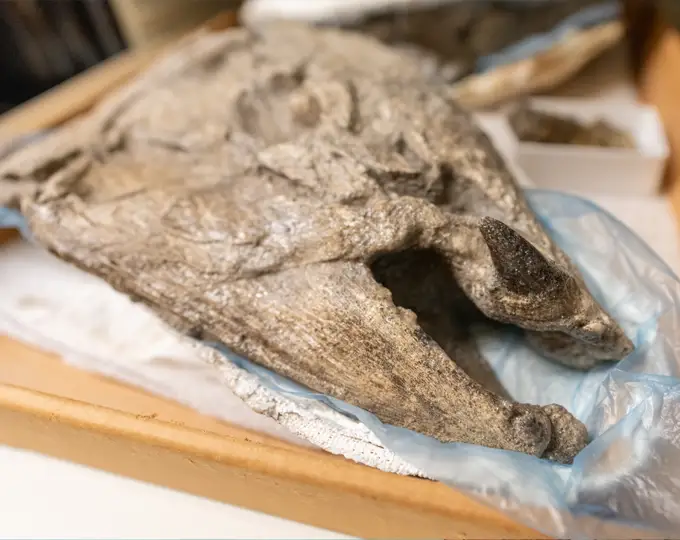
Image context: the lead image is a real photograph of a spike-toothed salmon fossil skull credited to the University of Oregon in PCOM's coverage of the 2024 paper. It is not a generated reconstruction or a diagram. The skull keeps the article anchored to the evidence that forced the old saber-tooth image to turn sideways.[2][3]
The correction is anatomical before it is theatrical
The strongest thing to watch for in the video is not the saw, the glue, or the restored display. It is the reason the museum team can justify changing the object. The 2018 Around the O story explains the hinge clearly: the 1964 skull that shaped the original reconstruction had disconnected upper jawbones, so the teeth were interpreted as downward-pointing. Later skulls from the same Madras-area quarry preserved the teeth intact in the skull, and those teeth pointed sideways.[4]
That distinction is the whole article in miniature. A loose tooth is evidence, but it is evidence without orientation. An articulated tooth in a skull is evidence with geometry. Once two skulls showed the same lateral pattern, the saber image became much harder to defend.[4] The video turns that dry evidentiary difference into something a viewer can grasp immediately: the teeth literally move from predator-poster fangs to lateral tools.
The 2024 PLOS ONE paper adds the deeper technical frame. Claeson and colleagues used CT reconstruction of the holotype and newly collected specimens to demonstrate the lateral orientation, then expanded the anatomical description of the species.[2] They also found sexual dimorphism in mature breeding individuals, especially in parts of the skull, while stressing that both males and females carried the large lateral teeth.[2][3] That is important because the spikes were not a male-only ornament in the simple peacock sense. The trait belonged to the animal's breeding-stage body plan more broadly.
Sideways teeth imply a different fish
The old name "saber-toothed salmon" pushed the imagination toward predation. It invited readers to picture a salmon version of Smilodon, all downward blades and bite drama. The revised anatomy points somewhere more interesting. PLOS ONE argues that the spikes were likely multifunctional: useful in defense against predators, in conflict with other salmon, and as practical aids in nest construction.[2] PCOM's coverage gives the behavioral setting in plain terms: the fish swam upstream to spawn, where lateral weapons could matter for defending against rivals, competing with other salmon, and building or guarding redds.[3]
That spawning frame is crucial. The fish was enormous, with estimates in the PLOS paper around 2.4 to 2.7 meters in length, and it was the largest known salmonid.[2] But size alone does not explain the spikes. Living Pacific salmon already tell us that the body changes around reproduction: jaws hook, colors intensify, and energy is redirected into migration and spawning. Riley Black's Scientific American profile of the 2016 Central California material gives the useful behavioral bridge: freshwater specimens had larger, more worn premaxillary teeth than marine specimens, consistent with developmental change before or during spawning migration and with use in territorial defense or nest construction.[5]
That makes the sideways correction richer than a label change. A downward saber would mainly be read as a killing instrument. A lateral spike on a giant migrating fish can be read as a social and reproductive tool. It belongs to the river stage, the contest stage, and the nest-building stage, not simply to a feeding fantasy.
The display repair is a method lesson
Around the moment when the sculpture is altered, the video becomes a small ethics of museum display.[1] A museum model is never just decoration. It is an argument in fiberglass, paint, and public trust. If the argument changes, the object has to change with it. The University of Oregon article makes the same point through Staab's own practice: paleoartists have to tolerate being wrong because new fossils can change the picture.[4]
That humility is not a weakness. It is the mechanism that keeps reconstructions alive. The older model was not foolish when it was made; it followed the best-known configuration from incomplete material. The problem would have been leaving the model untouched once better specimens made the old orientation misleading. The video is good precisely because it does not hide the revision. The museum lets visitors see that the past is reconstructed through present evidence, and present evidence can improve.
The same applies to language. "Saber-toothed salmon" is vivid, but vividness became a liability once it trained the eye toward the wrong orientation and function. "Spike-toothed salmon" is less mythic and more accurate. It keeps the animal strange without forcing it into a cat-shaped analogy.
What the video cannot show by itself
The video is a strong entry point, but the written sources are needed to keep the claim bounded. The clip can show a model being fixed; it cannot by itself prove the full anatomical case. That proof sits in the articulated skulls, CT data, comparative osteology, and specimen list of the PLOS ONE paper.[2] It also sits in the earlier migration-and-tooth-wear argument summarized by Black, where California material helped connect tooth size, wear, freshwater deposits, and spawning behavior.[5]
There is also a climate and ecosystem boundary. PCOM quotes Edward Davis noting that these animals went extinct with cooling oceans, and that their biology speaks to warmer Pacific Northwest habitats in the deep past.[3] That is a useful frame, but it should not become a simple climate parable. The fossil record tells us that this salmonid belonged to Miocene and Pliocene Pacific systems with different ocean productivity, river routes, and species communities.[2][5] The modern lesson is not "the fish will return." It is that salmon evolution has already explored forms and ecologies far outside the narrow set we know today.
That is why this annotated viewing earns a place in a paleontology feed. The video is brief, but the correction is substantial. One pair of teeth moves sideways, and suddenly the animal changes from a monster nickname into a better biological problem: an anadromous giant, probably planktivorous in feeding, modified around migration, and armed at the snout for the hard social physics of spawning rivers.[2][3][5] The best version of Oncorhynchus rastrosus is not less dramatic than the old saber-tooth version. It is more specific, and specificity is where paleontology gets interesting.
Sources
- Museum of Natural and Cultural History, "Spike-toothed Salmon (formerly Sabertooth Salmon)," YouTube video.
- Kerin M. Claeson, Brian L. Sidlauskas, Ray Troll, Zabrina M. Prescott, and Edward B. Davis, "From sabers to spikes: A newfangled reconstruction of the ancient, giant, sexually dimorphic Pacific salmon, Oncorhynchus rastrosus," PLOS ONE 19, no. 4 (2024).
- Philadelphia College of Osteopathic Medicine, "'Saber' No More: A Giant Prehistoric Salmon Had Spike Teeth," April 24, 2024, including University of Oregon fossil photograph used as the article image.
- Kristin Strommer, "Fish story: Museum's sabertooth salmon gets its teeth fixed," University of Oregon Around the O, October 19, 2018.
- Riley Black, "Paleo Profile: The Spike-Toothed Salmon," Scientific American, November 16, 2016, summarizing the Central California tooth-wear and spawning interpretation.