Hyoliths are small enough to be mistaken for punctuation in the Cambrian story. Many specimens look like little cones, lids, and curved rods pressed into shale. That modest scale is exactly why they are useful. A hyolith forces paleontology to do careful assembly work: decide which pieces belong to one animal, which surfaces are shell, which marks are soft anatomy, and which postures make biological sense.
The temptation is to make the fossil answer a classification question too quickly. Is it a mollusc? A brachiopod relative? A separate extinct group? The better first question is more mechanical: how did this animal sit, feed, seal itself, and keep its opening clear of the mud? Once the body is treated as a working package, the famous uncertainty becomes less frustrating. It becomes the point. Hyoliths show how a fossil can be common, shelly, and still anatomically hard.
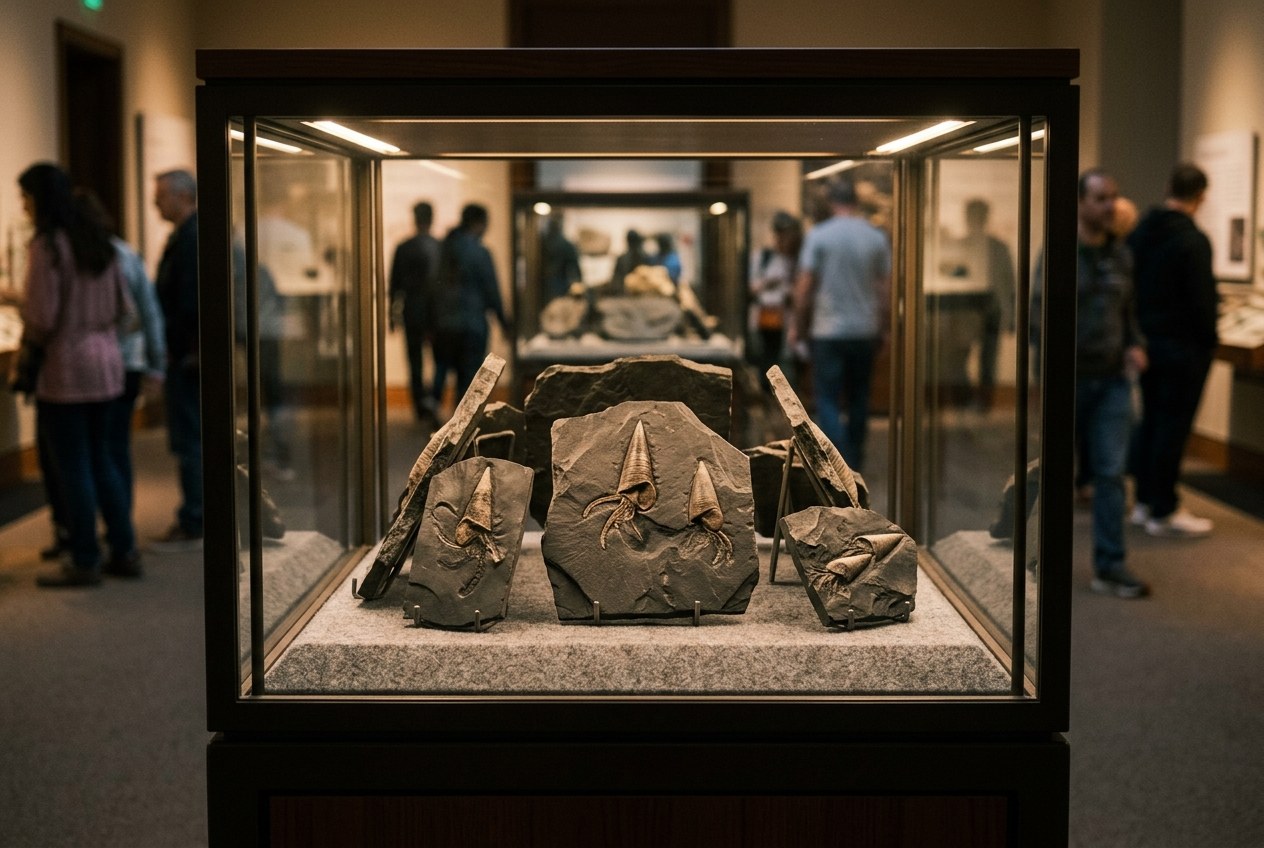
A cone is not enough
The Burgess Shale species page for Haplophrentis carinatus gives the simplest body plan: a weakly mineralized conical shell, or conch, closed at the aperture by an operculum, with two slender curved structures called helens projecting near the opening.[2] The named parts matter because the animal is easy to reduce to its cone. A cone alone can resemble a small shell, a tube, a spine, or a broken fragment. A cone plus a lid plus paired helens begins to behave like a biological system.
That is why Haplophrentis is a useful anchor. The Royal Ontario Museum summarizes it as a Middle Cambrian animal from the Burgess Shale and nearby localities, roughly 505 million years old, with specimens from Walcott Quarry, Raymond Quarry, Mount Stephen, and Stanley Glacier.[2] Some individuals reached about 40 mm, though many were smaller.[2] Those numbers are not decorative. They set the scale of the interpretive problem. Paleontologists are often reading millimetre-scale openings, grooves, rods, gut traces, and shell walls from compressed material.
The conch protected the main body and grew by accretion, adding material at the aperture as the animal enlarged.[2] The operculum functioned as a lid, but not merely as a door in a cartoon sense. Its shape, shields, muscle scars, and fit against the aperture are the evidence for how the animal closed, opened, and held soft tissue. The helens are stranger. They are laterally projecting, curved, rigid elements, and their function has been debated: they may have helped stabilize the animal or lift the aperture above the sediment-water interface.[2][4]
Read that way, a hyolith is not "a tiny cone animal." It is a shell architecture arranged around a vulnerable opening. The opening had to feed, breathe, avoid fouling, and close when needed. The helens become important because they turn the shell from a passive tube into a posture problem.
The helens change the floor
The most useful way to think about helens is not as legs. The ROM page is careful: Haplophrentis probably moved very little, and the helens appear poorly suited for locomotion.[2] That restraint matters. A pair of curved rods sticking from a shell looks ready for animation, but form does not automatically equal walking.
Their real value may have been architectural. If the conch lay directly on the seafloor with its opening low in the mud, a feeding organ would face clogging and abrasion. If the helens braced the aperture slightly upward, the animal could keep the opening positioned in cleaner water while remaining close to the sediment. National Science Review's later reassessment of hyolith anatomy makes this mechanical link explicit: if the Haplophrentis life position reconstructed by earlier authors is right, filter feeding may have evolved with the appearance of helens.[4]
That sentence carries a lot of evolutionary weight. It ties one skeletal feature to a possible feeding shift. It also marks a boundary. Not every hyolith had helens. Orthothecid hyoliths generally lacked them, and that absence changes how their feeding posture can be reconstructed.[4] The mistake would be to generalize from a familiar hyolithid like Haplophrentis to the whole group. The little stilts may have made one body plan possible without being a universal hyolith solution.
This is where anatomy becomes method. A fossil part is not simply present or absent. It changes the set of plausible behaviors. A hyolith with helens can be modeled with an elevated aperture. A hyolith without helens may need a different posture, perhaps lying more directly against the sediment. That difference then feeds back into diet, ecology, and phylogeny. One pair of small rods can reorganize the whole animal.
Soft anatomy made the argument sharper
For a long time, hyoliths were especially vexing because their hard parts preserved well while soft anatomy rarely settled the question. The 2017 Nature paper by Moysiuk, Smith, and Caron changed the debate by reporting Burgess Shale Haplophrentis specimens with soft tissues associated with the operculum, including a tentacular feeding apparatus.[3] The authors interpreted these features as evidence that hyoliths belonged with lophophorates, the broader group that includes brachiopods and phoronids.[3]
The claim was powerful because it did not rest on shell outline alone. It connected soft parts, operculum, body cavity, and feeding architecture. A tentacle-bearing organ near the opening made Haplophrentis look less like a generic problematic shell and more like an animal with a specific way of gathering food. The ROM blog announcing the work stressed the same shift: newly described internal soft anatomy and a band of feeding tentacles made the old conical-fossil mystery newly testable.[5]
But testable does not mean finished. The better result of the 2017 work was not that every question ended. It was that the argument moved onto better ground. Instead of asking whether a cone resembled a mollusc shell in silhouette, researchers could ask whether the soft organ was really a lophophore, how it was arranged, whether the helens supported suspension feeding, and whether the same model applied to hyoliths with different skeletal plans.
That is a higher-quality uncertainty. It is uncertainty anchored in parts.
The counter-reading matters
The 2020 National Science Review paper by Zhang and colleagues is useful because it resists turning the tentacular organ into a final label.[4] Drawing on orthothecid hyoliths from Chengjiang and other Chinese material, the authors argued that hyoliths were more likely basal lophotrochozoans than close lophophorate relatives, and that the feeding organ should not automatically be treated as a true lophophore.[4] They also emphasized that orthothecid body plans lacked the helens and posture logic used to reconstruct hyolithid feeding.[4]
This is not just a taxonomic quarrel. It is a lesson in comparative method. Haplophrentis had helens, an operculum, and a particular shell geometry. Triplicatella and other orthothecid forms could preserve tentaculate organs while presenting a different floor-facing arrangement.[4] If the feeding organ points toward the sediment in a reclining animal, deposit feeding may be more plausible than suspension feeding.[4]
That changes the story from "hyoliths had tentacles, therefore hyoliths were lophophorates" to a more demanding sequence: Which hyolith? Which aperture posture? Which attachment surface? Which soft organ geometry? Which feeding direction? A group can share a broad shell-and-lid architecture while still containing different ecological solutions.
The 2018 Royal Society paper on hyoliths with pedicles pushed yet another version of the problem by treating some Cambrian forms as informative for the origin of the brachiopod body plan.[6] That work argued from attachment structures, phylogenetic matrices, and the position of hyoliths relative to early brachiopod-grade forms.[6] Whether one accepts that stronger brachiopod-link reading or the later lophotrochozoan caution, the methodological lesson is the same: hyoliths cannot be classified from one part at a time.
Why the body plan still holds
The safest conclusion is not a timid one. Hyoliths were real Paleozoic animals with mineralized external skeletons, conchs, opercula, and, in hyolithids, helens. They were not random small shelly fossils waiting to be sorted into a modern drawer. Haplophrentis in particular was common enough at Walcott Quarry to matter ecologically, and ROM notes specimens in aggregates or inside the gut of Ottoia prolifica, showing that these animals were part of the Burgess food web rather than isolated curiosities.[2]
That ecological fact is easy to miss. A body-plan debate can make hyoliths feel like pure phylogeny: a puzzle about the tree of life. But the animals also had ordinary seafloor problems. They had to keep soft tissue protected, bring food to the opening, avoid being fouled by sediment, and not be eaten by larger worms. Their shells could preserve after death; their posture had to work during life.
The image above helps because it refuses exaggeration. There is no monster, no heroic predator, no dramatic reconstruction. There is a small conical fossil in stone. From that modest object, paleontologists build a living geometry: aperture, lid, stabilizers, gut, tentacles, surface, mud. Each part narrows what the animal could plausibly have done.
That is the reason hyoliths deserve attention. They make visible a hard rule of paleontology: classification should follow reconstruction, not replace it. Before the animal can be placed confidently near molluscs, brachiopods, lophophorates, basal lophotrochozoans, or an extinct branch of its own, its working body has to be assembled. In hyoliths, the small parts do not decorate the answer. They are the answer.
Sources
- Wilson44691, "Haplophrentis Burgess Shale.jpg," Wikimedia Commons file page used as a reference point for preserved hyolith fossil morphology.
- Royal Ontario Museum, "Haplophrentis carinatus," Burgess Shale fossil page with morphology, localities, ecology, and research history.
- Joseph Moysiuk, Martin R. Smith, and Jean-Bernard Caron, "Hyoliths are Palaeozoic lophophorates," Nature 541 (2017).
- Zhifei Zhang, Christian B. Skovsted, Timothy P. Topper, and colleagues, "Are hyoliths Palaeozoic lophophorates?," National Science Review 7, no. 2 (2020), open-access full text at PubMed Central.
- Joe Moysiuk, "Mystery of conical fossils solved, after 175 years," Royal Ontario Museum blog, January 20, 2017.
- Haijing Sun, Martin R. Smith, Han Zeng, and colleagues, "Hyoliths with pedicles illuminate the origin of the brachiopod body plan," Proceedings of the Royal Society B 285 (2018), open-access full text.