Odaraia alata looks at first like the kind of Burgess Shale animal that can be summarized by silhouette. It has a long body wrapped by a broad, folded carapace, a tail fan at the rear, and large eyes at the front. Public accounts often reach for the same shorthand: it is the Cambrian "taco" animal. That comparison is useful for one second, then it becomes a trap. The shell shape is only the frame. The important evidence sits inside the frame.
The better close reading begins with a problem. If Odaraia was wrapped in a tubular carapace, many of its limbs were not arranged like walking legs on an open seafloor crawler. If it had large eyes and a rudder-like tail fan, it was built for orientation and movement in the water column. If the 2024 re-study is right that it also preserved mandibles and a dense system of limb spines, then the animal was not merely a beautiful Cambrian oddity. It was an early mandibulate experimenting with a suspended feeding machine: swim, channel water, trap small prey, and bring food toward a jawed mouth.[1][2]
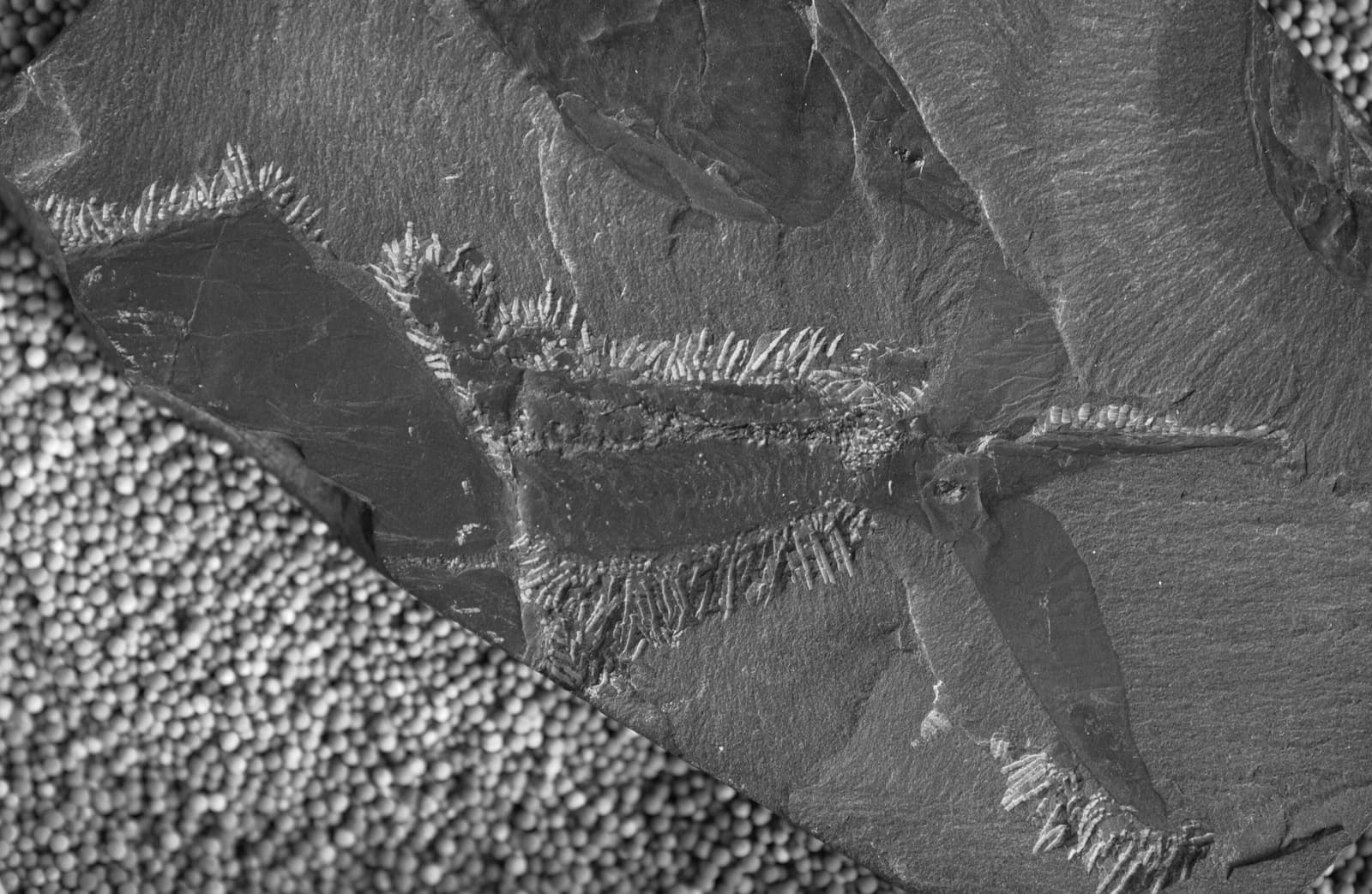
The shell is a room, not the whole animal
The Royal Ontario Museum's Burgess Shale entry places Odaraia in the Middle Cambrian, about 505 million years ago, and identifies it as a hymenocarine arthropod from the Burgess Shale of British Columbia.[1] The animal could approach 20 centimeters in length, large by Cambrian arthropod standards, and the ROM page emphasizes the tubular carapace and tail fan that make it visually distinctive.[1] Those facts make Odaraia memorable, but they also explain why it was hard to place for so long.
A carapace can conceal as much as it preserves. In a fossil compressed into shale, the broad shell draws the eye away from the parts that do the biological work: mouthparts, limb branches, spines, body segmentation, and the orientation of appendages under the cover. Older interpretations could treat Odaraia as a swimming arthropod without being able to settle exactly how it fed or where it belonged among early arthropods. The outline said "active animal." It did not by itself say "mandibulate."
That distinction matters because mandibulates are not a minor side branch. The living group includes crustaceans, insects, millipedes, centipedes, and their relatives. The 2017 description of Tokummia from the Burgess Shale framed the early history of the mandibulate body plan as one of the central problems in arthropod evolution, because modern mandibulates dominate animal diversity but their Cambrian origins require fossil evidence for mouthparts and body organization, not just general arthropod resemblance.[4]
Odaraia therefore sits at a useful threshold. It is old enough to matter for the early story, large enough to preserve a complex body, and strange enough that casual comparison to modern shrimp-like forms is not enough. The shell is not the answer. It is the room in which the answer has to be found.
Mandibles change the address
The 2024 study by Alejandro Izquierdo-López and Jean-Bernard Caron examined 150 Odaraia specimens from the ROM's Burgess Shale collections, selecting 24 for detailed anatomical analysis.[2] That sample size is important. A single spectacular slab can start a story, but a body-plan claim needs repetition: the same structures showing up across enough material to separate anatomy from accident, crack, overlap, or decay.
The key claim is that Odaraia preserves a pair of mandibles near the mouth.[2][3] ROM's news release describes them as large appendages with jagged edges, a feature that placed the animal among mandibulates rather than leaving it as an enigmatic arthropod with a nice carapace.[3] In evolutionary terms, that is a change of address. It links the Burgess animal to the broader lineage whose feeding apparatus later becomes one of the most successful animal toolkits on Earth.
The phrasing needs care. The point is not that Odaraia is the ancestor of every beetle, crab, and centipede. Fossils almost never need that kind of direct-ancestor drama to be important. The stronger claim is comparative: Odaraia shows that early mandibulates had already entered water-column niches with specialized feeding equipment by the Cambrian.[2] It broadens the ecological range of early mandibulates. They were not only benthic animals working on or near the sediment. At least some were swimming, seeing, filtering, and biting.
That is why the mandibles matter beyond naming. A mouthpart is an ecological interface. It decides what can be held, torn, processed, or rejected. Once mandibles are present, the animal's many spiny limbs no longer look like decorative fringe under a shell. They become part of a feeding sequence.
The legs make the net
The most vivid part of the new interpretation is the limb system. The 2024 paper describes more than 30 pairs of legs and documents endopod spines that could create a net-like structure.[2] ROM's release makes the functional hypothesis plain: small and large spines may have intertwined to trap small prey, much like a fishing net.[3] That does not mean paleontologists watched Odaraia feed. It means the preserved geometry makes a particular feeding mode plausible.
This is the difference between reconstruction and fantasy. The claim is built from part-to-function logic. A tubular carapace covers the limbs. The tail fan and eyes fit an animal moving through water. The spines on the limbs create a filtering or trapping surface. Mandibles near the mouth give the captured material somewhere to go. Each element strengthens the others. Remove any one of them and the interpretation weakens.
The carapace also becomes more interesting under this reading. Instead of being a simple protective wrapper, it may have helped shape the flow field around the limbs. A broad shell enclosing the body can turn the animal into a chambered feeding apparatus, guiding water and prey past the spiny appendages while the tail fan helps position the swimmer. The fossil does not preserve water flow, but it preserves the architecture that makes a flow-based hypothesis reasonable.
That is the article's central close-reading point: Odaraia should not be remembered only as a weird shell. It should be read as a set of interacting surfaces. The shell covers. The eyes aim. The tail steers. The limbs strain. The mandibles process.
Why upside-down swimming is not a gimmick
The upside-down reconstruction sometimes sounds like a public-outreach flourish, but it follows from the same mechanical problem. If the limbs are enclosed by the carapace and arranged as a capture surface, then ordinary seafloor walking becomes less convincing. ROM's account notes that the head shield enclosed much of the body, including the legs, limiting the animal's ability to walk along the seabed.[3] In that context, swimming upside down is not a joke. It is a way to put the feeding surface where water and prey can reach it.
Large eyes add another clue. Eyes are expensive structures, biologically speaking. In a swimming animal, they fit a world of orientation, light, moving particles, and predator-prey relations. The tail fan also belongs in that world. Together they make Odaraia feel less like a bottom-bound curiosity and more like a participant in Cambrian water-column ecology.
That ecological shift is the real force of the 2024 paper's title: the colonization of nektonic suspension-feeding niches by early mandibulates.[2] "Nektonic" means active swimming rather than passive drifting. "Suspension feeding" means gathering food from the water rather than simply grazing or scavenging on a surface. Put together, those words describe an animal using mobility and a capture apparatus at the same time.
The implication is not that the Cambrian sea suddenly became modern. It is that major ecological roles were being tested early. A jawed arthropod could already combine vision, swimming, a carapace, filtering limbs, and mandibles into one feeding system. The later success of mandibulates did not begin with a single finished formula. It began with experiments like this.
The fossil stays fragmentary, and that is healthy
The strongest reading of Odaraia still has boundaries. Soft-bodied preservation at the Burgess Shale is exceptional, but it is not magic. Compression, overlap, decay, and orientation can blur the exact relation between parts. The 2024 study is persuasive because it works from multiple specimens and detailed anatomical comparison, but the animal's behavior remains an inference from form.[2] We can say the spine system supports a net-like feeding interpretation. We should not pretend to know the exact stroke rhythm, prey size range, or daily path through the water.
That boundary makes the fossil more interesting, not less. Paleontology at this scale works by disciplined narrowing. The old outline gave too many possibilities. The mandibles narrow the phylogenetic placement. The spiny limbs narrow the feeding hypothesis. The shell and tail fan narrow the likely mode of life. The result is not a cartoon animal brought completely back to life. It is a tighter evidentiary envelope.
Odaraia matters because it teaches a reader how to look at Burgess Shale fossils without flattening them into icons of strangeness. The animal's famous shape opens the door, but its scientific value lies in the hidden machinery. A shell that once made the body hard to read now helps explain the whole system: a swimmer carrying its own feeding chamber through the Cambrian water column, using a net of limbs and a pair of mandibles to turn motion into food.
Sources
- Royal Ontario Museum, "Odaraia alata," Burgess Shale fossil page with morphology, classification, age, and locality context.
- Alejandro Izquierdo-López and Jean-Bernard Caron, "The Cambrian Odaraia alata and the colonization of nektonic suspension-feeding niches by early mandibulates," Proceedings of the Royal Society B 291 (2024), open-access full text at PubMed Central.
- Royal Ontario Museum, "Taco-shaped arthropod from Royal Ontario Museum's Burgess Shale fossils gives new insights into the history of the first mandibulates," news release, July 24, 2024.
- Cédric Aria and Jean-Bernard Caron, "Burgess Shale fossils illustrate the origin of the mandibulate body plan," Nature 545 (2017).
- Wikimedia Commons, "Odaraia USNM PAL 213812a.jpg," file page for the photographed Smithsonian Odaraia alata fossil used as the article image.