Solnhofen is easy to shrink into two trophies: Archaeopteryx and lithography.[1][2] Both belong to the place, and both can also distort it. The stronger field reading starts one step earlier, with the geography that made those trophies possible. Solnhofen was not one magical quarry that happened to yield beautiful fossils. It was part of a Late Jurassic archipelago of lagoons, reefs, islands, and shallow marine passages whose restricted basins kept laying down extraordinarily fine carbonate mud.[1][3][5]
That wider frame matters because the fossils are really a preservational system before they are a celebrity list. Martin Röper's short synthesis of the Solnhofen Archipelago describes more than 100 kilometers of fossil-bearing extent, up to 40 kilometers wide, spread across multiple basin structures rather than a single pocket of luck.[5] Günter Viohl's palaeoenvironmental overview makes the same correction from the sedimentary side: the fish record commonly labeled "from Solnhofen" actually comes from several plattenkalk-bearing units and basins across the southern Franconian Alb, not from one uniform setting.[3] The name has become so famous that it can hide the actual map.
That is why Solnhofen still feels alive in 2026. It is not only a place where spectacular bodies turned up. It is a place where basin architecture, water chemistry, and sediment texture combined tightly enough that paleontologists can keep asking why some organisms arrived on the floor intact, why others did not, and why the resulting archive preserves whole-body information with such unusual clarity.[1][3][4][5]
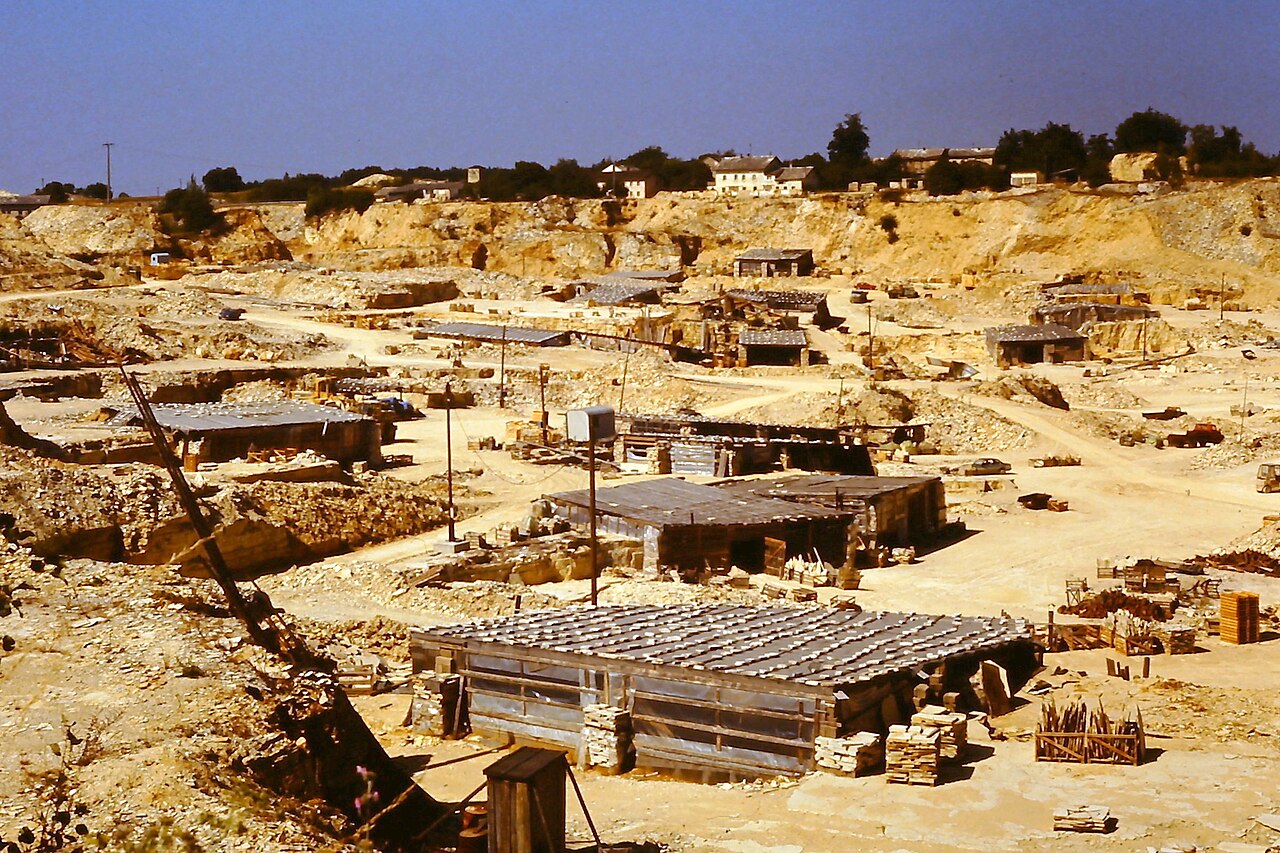
Image context: the cover uses a real Wikimedia Commons photograph of the Solnhofen limestone quarry at Maxberg.[6] It belongs here because this article is about the physical archive before it is about any one fossil. The stepped quarry walls and pale stone sheets keep attention on the medium that preserved the famous animals in the first place.
1) The site is an archipelago first, not an icon quarry
The Geo-Zentrum Solnhofen describes the place as a jurassic archipelago whose geology, stone, and cultural afterlife have to be read together.[1] Röper's basin summary gives the ancient version more shape. Around 150 million years ago, the area was not a compact landmass but a tropical island-and-lagoon world that changed over time as reefs, islands, and basins shifted across what is now Bavaria.[5] Fine-grained carbonates accumulated in lagoons behind reef belts, and different basins opened, closed, or changed relation to the sea as the archipelago evolved.[5]
That point sounds scenic, but it is actually methodological. Once Solnhofen is treated as an archipelago, the fossil record stops looking like a single still photograph of one habitat. Different basins could have slightly different ages, different openness to the sea, and different input from nearby land.[3][5] The 2018 description of the oldest known Archaeopteryx specimen uses exactly that logic, noting that eastern basins show stronger terrestrial influence and that the famous fossils are spread across separate localities within the wider palaeo-archipelago.[4]
The museum in Solnhofen understandably foregrounds the icons: four original Archaeopteryx specimens, Sciurumimus, and the famous local stone.[2] But even that museum framing quietly supports the broader reading. It groups the fossils back into the "Archaeopteryx worlds" and into a reconstructed island-and-lagoon environment rather than presenting them as detached wonders.[2] The place works best when the reader does the same.
2) The water column was divided, and that division did the preservational work
The cleanest environmental point comes from Viohl's palaeoenvironmental survey of Late Jurassic fishes.[3] The basins are described as salinity-stratified settings between bioherms, with hostile bottom waters and less saline, better-aerated surface waters above.[3] Fish, in this reading, did not live on the deadly basin floor. They lived in the upper waters, on nearby hardgrounds, and around coral patch reefs or sponge-microbial buildups that rose into more habitable levels of the water column.[3]
Röper's archipelago summary explains why that mattered after death. In the oxygen-poor bottom realm, benthic fauna were absent, and with them went the usual scavengers that tear carcasses apart on the seafloor.[5] Animals and plants that sank into this setting entered a preservational filter rather than a busy recycling system.[5] That does not mean every fossil reached the bottom pristine or under identical conditions. It means the basin floors had an unusual capacity to stop normal destruction from running to completion.
This is the field-report hinge. Solnhofen is not simply a place where organisms fossilized "well." It is a place where life and death happened in different water layers.[3][5] The upper world could still support swimmers, flyers, and reef-associated communities. The lower world was quiet enough, oxygen-poor enough, and scavenger-poor enough to let fallen bodies persist long enough for thin carbonate sediment to record them.
3) Plattenkalk is the archive format, not just the stone sold to printers
Viohl's description of plattenkalk is one of the most useful sentences to carry away from Solnhofen: flat-bedded micritic limestone with even bedding planes and laterally continuous layers.[3] That sounds technical until you stand it next to the quarry image. The archive is sheeted. Organisms were not being packed into one chaotic rubble pile. They were being laid into repeated fine surfaces that could later be split, quarried, examined, and, in a tiny fraction of the total sequence, used for lithography.[3]
That last point is also worth keeping in view. Viohl notes that stone suitable for lithography made up only about 1% of the entire sequence even in the Solnhofen area itself.[3] The cultural fame of lithographic limestone is real, but it can accidentally narrow the geological picture. The broader sequence matters because it preserves the environmental repetition behind the iconic slabs. Solnhofen became useful to printers because the limestone was fine and regular. It became invaluable to paleontology because that same fine regularity could register whole bodies, wings, fins, exoskeletons, and outlines that rougher sediment would have broken apart or blurred.
Read this way, the quarry is not a stage after the fact. It is part of the argument. The stone teaches the preservation style before the fossil even appears.
4) Archaeopteryx becomes clearer when it is put back inside the archive
No field report on Solnhofen should pretend Archaeopteryx is incidental. The museum is right to call it an icon of world importance, and the site is inseparable from the history of the animal's discovery.[2] The mistake is subtler: reading Archaeopteryx as if it were the whole environment rather than one especially famous arrival inside it.
Christopher Torres's 2026 ecology review helps here.[4] He notes that Archaeopteryx is the most common theropod known from the Solnhofen limestones, but immediately warns that this does not necessarily mean it was the most abundant theropod in the archipelago.[4] Large feathered airfoils could simply have made it more likely to end up fossilized in the surrounding marine limestones, and the preserved individuals may represent immature, inexperienced animals caught during storm events and blown out over the lagoons or sea.[4] That is a powerful correction. The fossil is famous partly because the archive selected for this kind of body and this kind of accident.
Placed back into the larger system, Archaeopteryx becomes even more interesting. It is not just the first bird in a vacuum. It is a terrestrial or near-island animal whose route into stone depended on the peculiar geometry of the Solnhofen world: islands near enough to source land organisms, waters structured enough to separate living zones from preservational zones, and carbonate mud fine enough to capture what finally settled.[1][3][4][5]
5) Why Solnhofen still matters as a field report, not just as a legend
The easiest way to flatten Solnhofen is to turn it into a museum noun. The better way is to keep it as a process noun. Reefs built barriers. Lagoons trapped fine mud. Surface waters remained habitable while deeper basin floors turned hostile to scavengers. Bodies crossed from one level into another and, in a small fraction of cases, stayed intact long enough to be written into thin limestone sheets.[1][3][5]
That is why the place still has such force. A spectacular fossil can answer one anatomical question. Solnhofen answers a stricter question about how an archive is made. It shows that exceptional preservation does not come from beauty alone. It comes from physical segregation: basin against reef, upper water against bottom water, living community against preservational trap. Once that stays in view, the famous slabs stop looking miraculous in a vague sense and start looking disciplined.
Solnhofen therefore deserves to be read as a lagoon archive before it is read as an Archaeopteryx legend. The legend is earned. The archive is the reason it exists.
Sources
- Geo-Zentrum Solnhofen, official site overview of the Jurassic Solnhofen Archipelago, museum, hobby quarry, and geotopes.
- Museum Solnhofen, "Museum-Solnhofen -- Bürgermeister-Müller-Museum" - official museum page describing the Archaeopteryx specimens, Sciurumimus, and the site's fossil and lithography exhibitions.
- Günter Viohl, "The paleoenvironment of the Late Jurassic fishes from the southern Franconian Alb" (1996) - PDF excerpt with abstract on salinity stratification, hostile bottom waters, and plattenkalk depositional setting.
- Christopher Torres, "The ecology of Archaeopteryx," Discover Ecology (2026).
- Martin Röper, "Entwicklung des Solnhofen-Archipels" - basin-and-archipelago overview PDF from Solnhofen Fossilienatlas.
- Wikimedia Commons file page for the quarry photograph used as the article image: "File:Solnhofen - cantera de calizas tableadas.jpg".