Snake origins are easiest to misunderstand when they are reduced to a slogan about legs disappearing. That version is tidy, but the fossils no longer support it. The strongest reset comes from Najash rionegrina, a Cretaceous snake from Patagonia that kept a sacrum, a pelvic girdle, and robust hindlimbs outside the ribcage.[1] That combination matters because it blocks two lazy stories at once. It blocks the old picture in which snake evolution is just a smooth shrinking of limbs until nothing is left, and it also blocks the older marine-origin shortcut that treated hindlimbed snakes from the circum-Mediterranean as the obvious template for the whole lineage.[1][3]
Once Najash enters the frame, snake evolution looks less like a straight slide toward limblessness and more like a staggered reorganization of the body plan. Body elongation, cranial specialization, habitat signal, and limb reduction do not line up as one clean package.[1][2][3][4] Some snake characters appear early, some remain primitive longer than expected, and the habitat story turns terrestrial more strongly than the old marine legend allowed.[1][3]
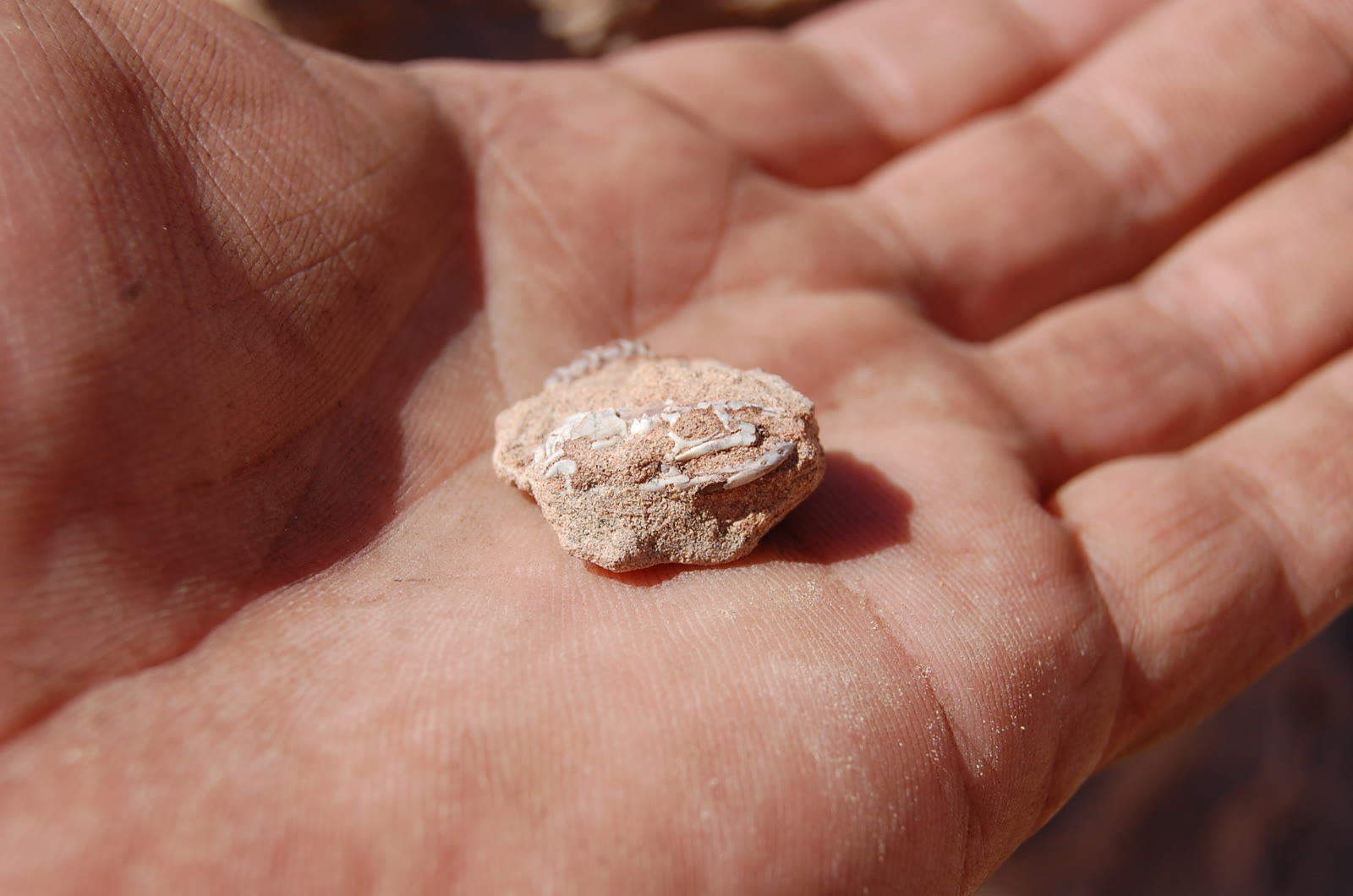
Image context: the cover uses a real Wikimedia Commons photograph of the Najash skull fossil. It belongs here because this article is about anatomical sequence. A single photographed skull in the hand is a better guide than a dramatic reconstruction: it keeps attention on preserved structure, not on the temptation to make the whole lineage feel more settled than it is.[5]
The hips matter because they sit where snakes were not supposed to keep them
The 2006 Nature paper that named Najash did not merely announce another limbed snake.[1] Its force came from where the hindlimbs were integrated. The fossil preserved a sacrum supporting the pelvic girdle, with functional legs outside the ribcage.[1] That is a very different signal from the better-known marine hindlimbed snakes such as Pachyrhachis, Haasiophis, and Eupodophis, which lack a sacral region.[1] In practical terms, Najash says that rear limbs in early snakes were not always vestigial decorations dangling from a body already committed to the fully modern condition. In at least one basal lineage, the pelvis still belonged to the axial skeleton in a meaningful way.[1]
That detail is what changes the narrative. If a snake can already be recognizably snake-like yet still keep a sacrum and robust hindlimbs, then total limblessness is not the entrance ticket to serpent identity. The transition has to be broken into stages. One stage concerns trunk elongation and the reorganization of the vertebral column. Another concerns the reduction and eventual loss of limb function. A third concerns the skull, which modern snakes transform so heavily that it is easy to assume the entire package evolved together.[1][2]
The 2006 authors were careful about habitat too. They argued that Najash retained features associated with a subterranean or surface-dwelling life and that these traits supported a terrestrial rather than marine origin for snakes.[1] That conclusion did not end the debate on its own, but it shifted the burden of proof. After Najash, a terrestrial starting point was no longer a minor counter-story. It had a fossil with hips attached.
The timeline got deeper, and the early record got messier
If Najash broke the simple leg-loss story, older fossils broke the easy timeline. In 2015, Caldwell and colleagues reported snake fossils from the Middle Jurassic to Lower Cretaceous, pushing the record of snakes back by roughly 70 million years beyond the previous oldest widely recognized finds.[4] These ancient snakes already combined features familiar from modern and fossil snakes with more lizard-like anatomy, and they appeared across a geographically broad record.[4] That matters because it means diversification was already underway long before the Late Cretaceous limbed forms became famous.
This older record sharpens the real question. The issue is not, "When did the very first snake lose its legs?" The issue is, "Which parts of the snake body plan were assembled first, and in what ecological settings did those pieces become stable?"[3][4] Once the lineage stretches back into the Jurassic, the familiar hindlimbed Cretaceous fossils stop looking like single transitional curiosities. They become later members of a deeper radiation whose early history had already explored more than one anatomical path.[4]
That is why the oldest-known-snakes paper and Najash belong together. The older fossils make the lineage older and more geographically complex; Najash makes one branch of that complexity anatomically concrete. Put them side by side, and the story stops behaving like a neat ladder from lizard to python. It starts looking like an evolutionary field full of uneven experiments, with some snake traits appearing while others still lagged behind.[1][4]
New skull material made the modern snake head look assembled in parts
The 2019 redescription of Najash pushed the reset further by adding new skulls and skeletons.[2] The headline argument was simple and important: fossils of Najash illuminate the origin of key features of the modern snake skull and body plan.[2] That phrasing matters because it does not claim Najash already had the full cranial architecture of living snakes. It claims instead that some defining features can be traced through a more primitive body than the public imagination usually allows.[2]
This is the point where many popular summaries go wrong. They treat early snakes as if they must either be half-lizards with legs or nearly modern snakes with tiny leftover spurs. Najash is more useful than either caricature. It suggests a mosaic. Some parts of the head were moving toward the snake condition while the pelvis and hindlimbs had not yet disappeared entirely.[1][2] That is a stronger paleontological lesson than any single slogan about "the first snake with legs," because it tells us that the lineage did not transform all at once.
The modern snake skull is extremely specialized for feeding and kinesis, so there is a constant temptation to read those features backward as the master key to the whole lineage. The fossil record argues for more patience. Skull evolution and limb reduction interacted, but they were not perfectly synchronized.[2][4] Once that is clear, the origin story becomes less theatrical and more biological.
The broad reconstruction now favors a terrestrial, stealth-hunting ancestor
Hsiang and colleagues approached the problem from another direction in 2015 by combining fossils, living snakes, phenomic data, and genomic context in a broad ancestral-state reconstruction.[3] Their result did not identify Najash as a direct ancestor of crown snakes, and it did not pretend that one fossil can stand in for the entire lineage.[3] What it did do was give the early snake problem a wider frame. The inferred ancestors of both total-group snakes and crown snakes were reconstructed as nocturnal, widely foraging, non-constricting stealth hunters in terrestrial settings, likely in warm, well-watered, vegetated environments.[3]
That reconstruction matters because it aligns with the terrestrial signal already sharpened by Najash.[1][3] It also helps explain why the marine-origin story lost ground. Marine hindlimbed snakes are real and important fossils, but they no longer read like the default origin template. They read more plausibly as one later branch inside a broader terrestrial history.[1][3] The lineage did reach water repeatedly and successfully. That is different from saying water is where the lineage began.
In this form, the origin of snakes becomes clearer and more interesting. Early snakes were not simply lizards surrendering limbs because a single habitat demanded it. They were part of a longer reorganization in which elongation, hunting strategy, skull remodeling, and habitat use shifted over time and at different speeds.[1][2][3][4]
What the fossils can actually support
The strongest current reading is narrow enough to trust. Najash shows that an early basal snake could retain a sacrum, pelvic girdle, and functional hindlimbs in a terrestrial setting.[1] Jurassic and Lower Cretaceous snakes show that the lineage is older and more diverse than a Late Cretaceous-only picture once implied.[4] Broader reconstruction work favors a terrestrial, stealth-hunting ancestry rather than a simple marine-origin scenario.[3] And new skull material from Najash supports the view that hallmark features of the modern snake head and body plan were assembled in stages rather than delivered as one finished design.[2]
The limits matter too. No one fossil solves the entire problem of snake origins, and the lineage still includes ecological and anatomical experimentation that refuses to collapse into a single path.[1][2][3][4] That is exactly why Najash remains so valuable. It does not tidy the story into a final answer. It forces the answer to become more realistic.
If there is one useful sentence to keep from this evidence, it is this: snakes did not become snakes only when the legs were gone. They became snakes through a longer sequence in which some parts of the body arrived early, some late, and some survived in forms the simplified legend had no room for.[1][2][3][4]
Sources
- Sebastián Apesteguía and Hussam Zaher, "A Cretaceous terrestrial snake with robust hindlimbs and a sacrum," Nature 440 (2006).
- Fernando F. Garberoglio, Sebastián Apesteguía, Tiago R. Simões, et al., "New skulls and skeletons of the Cretaceous legged snake Najash, and the evolution of the modern snake body plan," Science Advances 5, no. 11 (2019), open-access mirror via PMC.
- Ayana Hsiang, Daniel J. Field, Tim H. Webster, et al., "The origin of snakes: revealing the ecology, behavior, and evolutionary history of early snakes using genomics, phenomics, and the fossil record," BMC Evolutionary Biology 15 (2015).
- Michael W. Caldwell, Randall L. Nydam, Alessandro Palci, et al., "The oldest known snakes from the Middle Jurassic-Lower Cretaceous provide insights on snake evolution," Nature Communications 6 (2015).
- Wikimedia Commons file page for the photographed Najash skull fossil used as the lead image.