Deinocheirus mirificus spent almost half a century behaving like a dare. Paleontologists had the name, the giant forelimbs, and not much else. The holotype collected in the southern Gobi in 1965 preserved arms about 2.4 meters long with scapulocoracoids and only small associated fragments, leaving the rest of the animal open to projection.[1][2][3] In that gap, Deinocheirus became a public monster before it became a usable species profile. If the hands were that large, many readers assumed the whole animal must have been a giant hypercarnivore, perhaps something even more imposing than the theropod template already in circulation.[2][3]
The 2014 reconstruction changed the taxon by changing the silhouette. Two much more complete specimens from the Nemegt Formation showed that the giant hands belonged to an enormous ornithomimosaur, though one built on a far stranger plan than the classic ostrich-mimic body.[1] The skull was elongate and deep-jawed, the back carried tall neural spines that produced a pronounced hump, the pelvis was broad, the hind limbs were relatively short, and the feet ended in broad-tipped unguals rather than elegant running claws.[1] Fish remains and more than 1,400 gastroliths then gave the diet a similarly unsettling twist, pushing the animal toward a large omnivorous reading.[1][2][3]
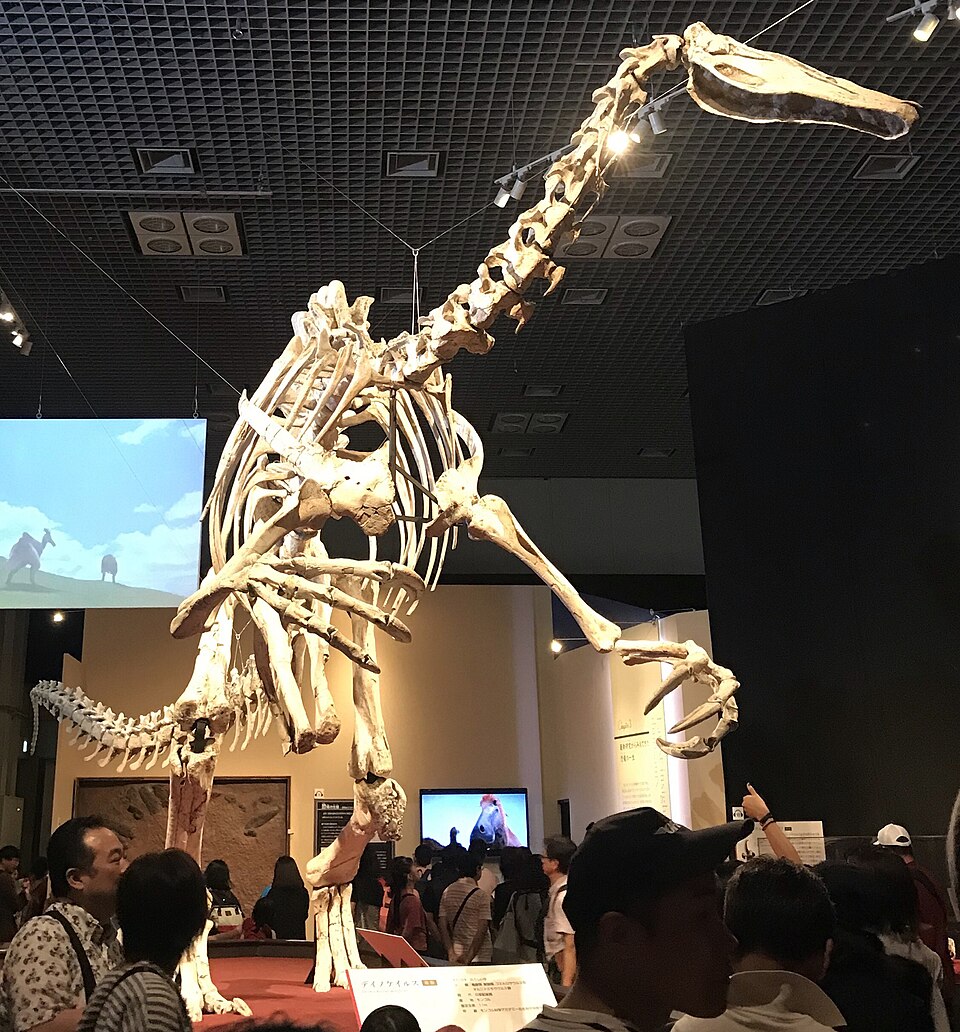
Image context: the cover uses a real photograph of a mounted Deinocheirus skeleton from Wikimedia Commons. It belongs here because the article is about body-plan recovery. A mounted skeleton does more work than a dramatic life restoration: it lets the hump, skull, pelvis, feet, and arms argue together in one frame.[5]
For decades, the species was mostly an argument built from arms
The first phase of the Deinocheirus story was a lesson in what partial fossils do to the imagination. The original material was impressive enough to secure a new family name and a permanent place in dinosaur lore, yet incomplete enough to leave locomotion, diet, head shape, and even broad ecological role unsettled.[1][4] That asymmetry mattered. Giant claws are easy to sensationalize because they look like they already explain behavior.
The trouble is that forelimbs alone do not tell you whether an animal was a sprinter, a grappler, a browser, a digger, a display specialist, or some combination that no living analog captures well. The arms of Deinocheirus were spectacular evidence, but they were narrow evidence. The public image of the animal grew around the most theatrical preserved part, and the rest of the profile hardened as conjecture.[2][3]
This is why the species remained famous for so long without becoming clear. Deinocheirus was not simply missing a skull. It was missing the anatomical context that would tell paleontologists what sort of giant hands these actually were. Until that context arrived, the taxon lived in a zone between valid name and unresolved body plan.[1][4]
The 2014 skeletons changed the whole silhouette
Lee and colleagues resolved the long-running enigma by describing two additional Mongolian specimens, one of them slightly larger than the holotype and both dramatically more informative than the original arms-only material.[1] Their reconstruction did not merely add missing pieces. It forced almost every lazy assumption to bend. The animal proved to be the largest known ornithomimosaur, yet also a heavily built and non-cursorial one, with a deep mandible, tall dorsal spines, an expanded pelvis for strong muscle attachments, and short hind limbs compared with the fleet-footed stereotype of the clade.[1]
That matters because the hump and the feet alter the entire mechanical feel of the dinosaur. This is no longer the image of a long-legged pursuit animal scaled up to absurd size. The hump implies unusual axial anatomy and soft-tissue contour, the pelvis and hind limbs imply a body carrying real mass, and the broad pedal unguals help detach the animal from the sleek cursorial look people expect from ornithomimosaurs.[1][2] The hands remain huge, but the rest of the body stops behaving like a missing background and starts imposing limits on what the hands could have meant.
The skull matters just as much. Once the head was known, Deinocheirus stopped reading like a giant theropod caricature and began to look like a broad-snouted, deep-jawed animal with a more mixed feeding profile.[1][3] In other words, the new specimens did not turn the mystery into a single clean answer. They replaced one exaggerated answer with a more anatomically crowded one.
Fish remains and stomach stones made the diet stranger and more believable
The strongest dietary signal in the 2014 reconstruction came from the abdominal region. The authors reported fish remains as stomach contents together with a very large mass of gastroliths, and Hokkaido University's release summarized the implication directly: these features suggest that Deinocheirus was megaomnivorous.[1][3] The Natural History Museum now gives the species the same broad dietary label.[2]
That is a useful correction because a dinosaur this visually odd is easy to overread in either direction. One overreading treats the claws as proof of pure predation. Another swings too far and turns the animal into an innocuous giant herbivore with a few incidental animal scraps. The evidence supports a narrower and more interesting middle. Fish remains show animal matter in the gut of at least one individual, while gastroliths suggest regular processing behavior more often discussed in relation to plant matter or mixed diets.[1][3] The combination widens the menu without making it infinite.
The diet also helps explain why the reconstructed body seems so peculiar. A deep jaw, broad snout, large gut region, unusual back profile, and massive forelimbs fit more comfortably together in an omnivorous generalist than in the old fantasy of a specialized giant hand-driven killer. The species becomes more believable once the feeding story grows messier.[1][2][3]
The reconstruction is also a recovery story
One reason the Deinocheirus profile took so long to stabilize is that the crucial specimens were entangled with poaching. The Hokkaido release describes the Bugiin Tsav material as a poached quarry where the skull and feet were initially missing, and it explains that matching elements later helped confirm repatriated material belonged to the same individual.[3] That detail is not incidental to the science. In this case, the anatomical resolution of a famous dinosaur depended partly on recovering a skeleton that had been physically broken apart and dispersed.
That history is worth keeping in the profile because it changes how we think about paleontological certainty. The problem was never only that the animal was strange. The problem was also that the record was interrupted. Deinocheirus became legible through fieldwork, comparative anatomy, and forensic specimen recovery all at once.[1][3]
This gives the species a second kind of significance. It is not only a bizarre Late Cretaceous animal from Mongolia. It is also a reminder that dramatic reconstructions often depend on slow institutional work: excavation, preparation, curation, and in some cases the return of stolen bones to the scientific record.[3]
What the species profile can actually support
The secure claims are now strong enough to hold a real profile. Deinocheirus mirificus was a giant Late Cretaceous ornithomimosaur from the Nemegt Formation of Mongolia; the famous forelimbs belong to a hump-backed, deep-jawed, broad-bodied animal with relatively short hind limbs, broad-tipped pedal unguals, and a feeding signal that includes both fish remains and abundant gastroliths.[1][2][3] That is already one of the strangest high-confidence silhouettes in theropod paleontology.
The limits matter too. No mounted skeleton can erase the interpretive distance between bone and life. Soft-tissue extent, feather covering, exact feeding proportions across seasons, and the behavioral role of those huge arms still involve inference layered on top of fossil anatomy.[1][2] The point of the modern Deinocheirus profile is not that every mystery is gone. It is that the mystery now sits inside a real body instead of floating around a pair of hands.
That shift is why the species remains memorable. Deinocheirus did not become less weird once the new fossils arrived. It became harder to simplify. Paleontology kept the claws, then made them answer to the hump, the beak, the gut, and the feet. The resulting animal is better than the old legend because it finally has enough anatomy to resist being reduced to one spectacular part.
Sources
- Yuong-Nam Lee, Rinchen Barsbold, Philip J. Currie, Yoshitsugu Kobayashi, Hang-Jae Lee, Pascal Godefroit, François Escuillié, and Tsogtbaatar Chinzorig, "Resolving the long-standing enigmas of a giant ornithomimosaur Deinocheirus mirificus," Nature 515 (2014).
- Natural History Museum, "Deinocheirus."
- Hokkaido University, "Deinocheirus mirificus, no longer an enigma" (2014 press release).
- Paleobiology Database bibliographic reference for Halszka Osmólska and Ewa Roniewicz, "Deinocheiridae, a new family of theropod dinosaurs" (1970).
- Wikimedia Commons file page for the photographed mounted Deinocheirus skeleton used as the lead image.