The Laetoli footprints are usually introduced as a triumphal headline: the oldest clear proof that an early hominin walked upright.[1][2][3] That claim is sound, but it is narrower than the fossil's real force. The trackway matters most when it is read as a moving body pressed into ash. At Laetoli, around 3.66 million years ago, volcanic material captured heel strike, weight transfer, toe-off, and the position of the hallux in a sequence of steps that can still be argued over biomechanically.[1][2][4] Species attribution is important, but it arrives after that first fact. The trackway is gait evidence before it becomes an ancestry badge.
That order matters because Laetoli is too famous for its own good. The site G tracks are commonly linked to Australopithecus afarensis, and for sensible reasons: that species is represented by body fossils in the same broader time range and region, and the footprints are widely accepted as hominin.[2][3] But tracks do not name themselves. What they preserve most directly is locomotor information. Later work from Laetoli itself has only made that point stronger by showing that the landscape may have recorded more than one kind of bipedal hominin foot.[5] If the close reading starts from movement rather than identity, the fossil becomes more precise, not less.
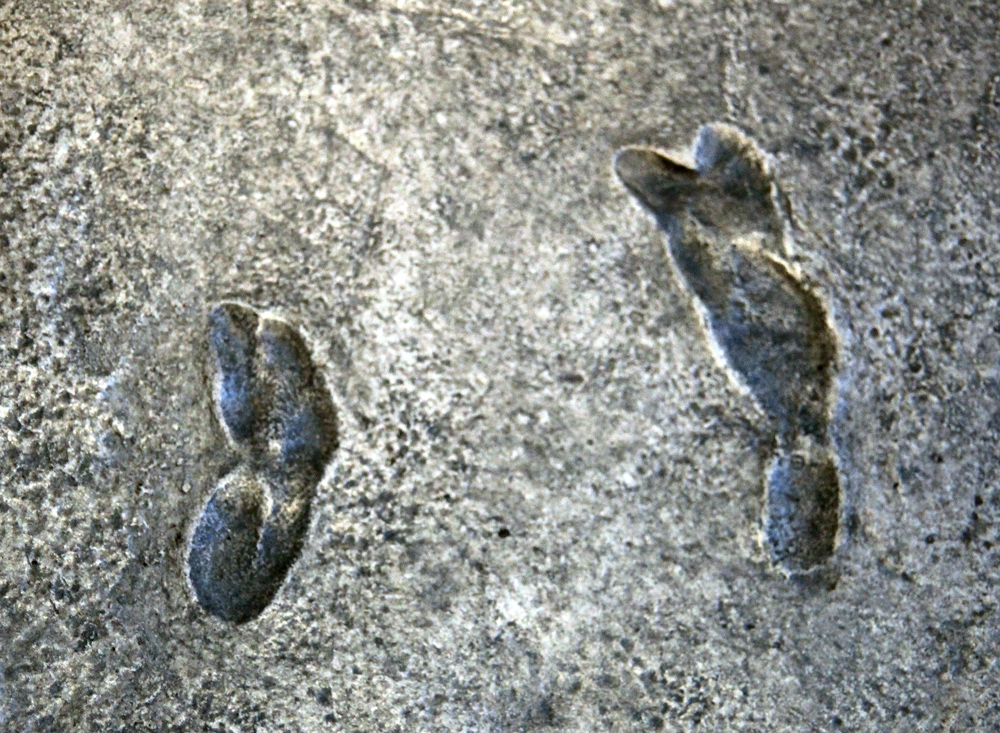
Image context: the cover uses a real photograph of a Laetoli footprint cast at the Smithsonian. It is the right image for this article because the argument begins with the print's geometry itself. The visible heel, midfoot, forefoot, and forward-pointing big toe make the article's central claim legible at a glance: Laetoli is valuable because it stores a sequence of motion in sediment.[7]
The ash preserved a walking sequence, not just a presence
Mary Leakey and colleagues described the Laetoli track-bearing surface in 1979 as part of the Laetolil Beds, where fine volcanic ash was moistened, walked across, and then rapidly buried and preserved.[1] That depositional sequence is what gives the prints their scientific bite. The tracks are not isolated impressions with no temporal relation to one another. They are a trackway: repeated steps made on a single surface, preserving stride and foot placement in order.[1][3]
That distinction matters because a single footprint can tell you something about foot shape, but a trackway tells you more about locomotion. The Laetoli prints show a clear heel-first contact pattern, a weight path carried forward through the foot, and an adducted hallux rather than the divergent grasping big toe expected in a chimpanzee-like walker.[2][3] In public terms, this is why the site still feels instantly modern. The prints do not look like random marks made by an ape occasionally balancing on two legs. They look like steps.
Yet even here, restraint improves the reading. The trackway does not give us a skeleton, a face, or a genus tag stamped into the ash. It gives us repeated contact geometry. That is enough to secure obligate bipedalism more strongly than almost any isolated limb bone could, but it is still evidence of movement first.[1][2][3]
Why "upright walking" is true but still incomplete
The 1980 Nature follow-up on Laetoli treated the prints as hominid and bipedal, and that basic interpretation has held.[2] But later biomechanical work has shown why it is a mistake to stop there. Kevin Hatala and colleagues compared the Laetoli footprints with experimental human and chimpanzee tracks and found that the Laetoli prints were not identical to either modern reference set.[4] Their analysis suggested a bipedal gait different from that of both living humans and chimpanzees: more human than ape in some respects, but still preserving a lower-limb posture and foot-loading pattern distinct from the fully modern condition.[4]
That result is exactly what a deep-time trackway should do. It should sharpen the sequence rather than flatten it. Laetoli does not merely answer yes to the question "Was this bipedal?" It lets paleontology ask a better one: what kind of bipedalism was already present by 3.66 million years ago, and what elements of later human walking had not yet fully arrived?[2][4][6]
This is where the article's title earns its emphasis. Identity can tempt a false neatness. Once readers hear A. afarensis, they often feel the case has closed and the footprints have become an illustration for a species profile. The trackway itself pushes back. It records a gait that is decisively hominin yet still not reducible to the kinematics of a modern human beach walk.[4][6]
Laetoli became more interesting once it stopped looking like one trackmaker, one answer
The 2021 rediscovery and analysis of site A changed the shape of the whole Laetoli discussion.[5] Those prints had been known since the 1970s, then drifted to the margins because some researchers wondered whether they might belong to a bear rather than a hominin.[5] McNutt and colleagues relocated, excavated, and digitally documented the trackway, then compared it with human, chimpanzee, and bear data.[5] Their conclusion was not only that the site A tracks are better read as hominin than ursid. It was that their inferred foot proportions, gait parameters, and 3D morphologies differ from the famous site G prints enough to suggest at least two hominin taxa with different feet and gaits at Laetoli.[5]
That does not automatically settle who made which trackway. It does something more valuable. It stops the site from collapsing into one canonical set of footprints standing in for all early hominin locomotion. Laetoli becomes a landscape with locomotor variation inside it.[5] In that context, the oldest and most famous trackway should be handled carefully. It is powerful evidence, but not a monopoly on meaning.
This is another reason to read gait before identity. A name can hide diversity. A footprint surface can expose it.
Tracks preserve motion as well as anatomy, and sometimes motion better
The newest work on fossil hominin footprints has made this boundary even clearer. Hatala, Gatesy, and Falkingham argued in 2023 that longitudinally arched footprints are false indicators of foot anatomy when treated too literally; they can instead reflect a specific pattern of foot motion during walking.[6] Applied to fossil tracks, that insight matters immediately. A footprint is not a perfect mold of a foot. It is a record produced by a foot moving through a substrate.[6]
For Laetoli, this means the old question "Did the trackmaker already have a modern human arch?" is not always the strongest one.[4][6] The stronger question is what sequence of contact and propulsion created the print now preserved in ash. That reframing does not weaken the fossil. It gives it a better scientific use. The footprint becomes motion capture in stone, but motion capture with sedimentary bias and interpretive limits.
That is why the Laetoli trackway still matters so much. It does not simply announce that some early hominin stood upright. It preserves a stride with enough detail to keep locomotor arguments alive across decades: how the heel landed, how the midfoot loaded, how the hallux aligned, how propulsion differed from both chimpanzees and fully modern humans, and how the same landscape may have held more than one bipedal solution.[1][2][3][4][5][6] The most durable reading is therefore also the most disciplined one. The Laetoli footprints are strongest when read as gait before identity.
Sources
- Nature, "Pliocene footprints in the Laetolil Beds at Laetoli, northern Tanzania" (1979).
- Nature, "Laetoli Pliocene hominid footprints and bipedalism" (1980).
- Smithsonian Institution Human Origins Program, "Laetoli Footprint Trails."
- Kevin G. Hatala et al., "Laetoli footprints reveal bipedal gait biomechanics different from those of modern humans and chimpanzees," Proceedings of the Royal Society B (2016), via PMC.
- Ellison J. McNutt et al., "Footprint evidence of early hominin locomotor diversity at Laetoli, Tanzania," Nature (2021), via PMC.
- Kevin G. Hatala, Stephen M. Gatesy, and Peter L. Falkingham, "Arched footprints preserve the motions of fossil hominin feet," Nature Ecology & Evolution (2023).
- Wikimedia Commons file page for the Smithsonian Laetoli footprint cast photograph used as the article image.