
The public image of paleontology still leans toward the dig. A specimen is found, jacketed, carried home, and then somehow reappears in a gallery as a skeleton or in a paper as data. Smithsonian fossil preparator Michelle Pinsdorf's lab tour is useful because it refuses that skip in the story.[1] It shows preparation as the place where a buried object is converted into something researchers can actually trust, handle, compare, and store.
That distinction matters because fossil preparation is easy to flatten into craft footage. There are tools, dust, steady hands, and satisfying before-and-after reveals, but the real intellectual work is upstream of the reveal. Smithsonian's own teaching guide frames the job as a chain that runs from field recovery through transport, cleaning, interpretation, and curation.[2] The older Florida Museum preparation guide makes the same point from the collections side: fossils are the only direct material record of extinct animals, so preparation is part of how their information is developed and preserved rather than a decorative extra.[5]
Seen that way, this is not a video about making fossils look good. It is a video about turning fragile, matrix-bound material into evidence with a future. Myria Perez, in a later Smithsonian webinar on the same subject, says the quiet part directly: preparation also conserves fossils for later methods, later questions, and later researchers, including people who may never visit the collection in person.[3] That is the angle worth watching for here. Every choice in the lab is a choice about access, reversibility, and what kinds of paleontological claims a specimen will still be able to support.
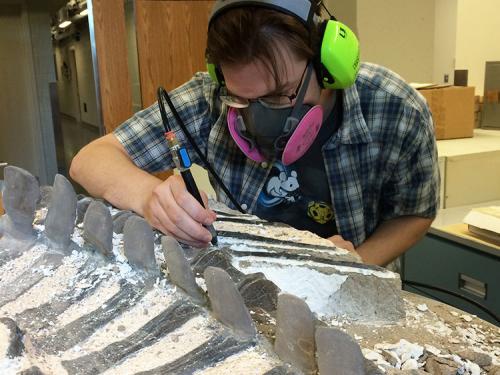
Image context: the cover photograph shows Smithsonian Collections Manager Matthew Miller using an air scribe on Ceratosaurus tail vertebrae. It works for this piece because the image captures preparation at the exact point where brute rock removal gives way to controlled interpretation: the fossil is visible, but the boundary between bone and matrix still has to be read correctly by a human hand.[2]
Around 1:10, preparation is defined as a scientific handoff, not a cosmetic one
Pinsdorf's first useful move comes early. She defines fossil preparation as a specialization within paleontology whose job is to discover fossils in the field and bring them into a state where they are most useful for scientific research or educational display.[1] That wording is more rigorous than it sounds. "Useful" does a lot of work. It implies the specimen has not yet become fully usable when it is excavated. The field discovery is only the start of a second process.
Smithsonian's subject guide reinforces the point by listing preparation alongside securing fossils for transport, cleaning them, and interpreting the data they contain.[2] In other words, the lab is not downstream from knowledge. It is one of the places where knowledge gets built. The fossil is not just cleaned so that a later scientist can begin. The cleaning, stabilization, and exposure decisions are already part of the scientific pipeline.
That framing is also a good defense against one common mistake in public paleontology: assuming that if a bone is "there," its information is already obvious. It usually is not. The fossil may be fractured, partly hidden, chemically unstable, trapped in matrix, or stored in a way that makes safe handling difficult. Preparation is the stage that makes the object available without pretending the object was ever self-explanatory.
Around 4:06 to 5:14, matrix stops being background and becomes part of the workflow
The video's best teaching sequence starts when Pinsdorf explains matrix as the host rock that protected the fossil for millions of years until it came back to the lab.[1] That is an elegant correction to the usual museum-viewer instinct. Matrix is often treated as the boring part, the stuff you remove so the real thing can appear. But the video makes clear that matrix is both protection and obstacle. It preserved the specimen, and it now has to be taken away without destroying what it kept intact.
That is why the field jacket matters. In the video, Pinsdorf describes how the fossil is wrapped with plaster and burlap in the field, transported in that protected state, and then reopened in the lab.[1] Perez gives the longer Smithsonian version: heavy or fragile fossils are cradled in field jackets, moved into a better-lit workspace, and documented with photographs as soon as the jacket is opened.[3] John Day Fossil Beds National Monument describes the same logic in institutional language, noting that each fossil receives custom preparation treatments depending on complexity and preservation before it can be safely handled by researchers.[4]
Taken together, these sources show why prep is less like polishing and more like triage. The specimen is being reintroduced to risk as soon as the jacket comes off. A preparator has to decide what can be exposed now, what needs support first, what must be documented before the next layer is removed, and how far to go before the specimen is stable enough for collections or study. The workflow is careful because the fossil is only briefly in a state where both its original burial support and its long-term museum support are absent.
Around 5:14, the air scribe scene clarifies that precision is the real subject
The air scribe is the most visibly dramatic tool in the video, and that makes it easy to misread.[1] It looks like force. Pinsdorf presents it instead as control: pressurized air drives a fine tip that can remove dense matrix while the preparator keeps reading the boundary of the specimen.[1] The Smithsonian subject guide's sidebar image of Matthew Miller in mask, ear protection, and goggles is useful here because it shows the real environment around that tool: dust, noise, and a slab that still requires delicate judgement.[2]
John Day's lab description helps explain why that judgement matters. Its preparators use air scribes, dental picks, and micro-needles for different levels of detail, and every stage is documented with notes on hours, tools, chemicals, and pre-existing damage.[4] That combination of precision and documentation is the real story. Tools do not produce good preparation by themselves. A fossil lab becomes scientific when material removal is paired with a record of what was done and why.
This is also where the video quietly rejects the fantasy that preparation is just uncovering something prewritten. A preparator is not revealing a fossil the way someone wipes dust off a finished sculpture. The preparator is deciding where the specimen boundary is, how much matrix should remain for support, and what kind of exposure best serves the next question. That is why the work looks slow even when power tools are involved. Speed is never the point. Boundary control is.
Around 8:30 and later, archival care reveals the ethics behind the technique
One of the strongest parts of the Smithsonian material sits just beyond the satisfying removal scenes. Pinsdorf explains that archival materials are used to piece fossils together and keep fragile material from degrading further.[1] Perez says the same thing from another angle when she talks about reversible glues, cavity mounts, rehousing, and the need to conserve fossils for future study methods such as CT scans, microscopes, and isotope work.[3] The object is not only being exposed. It is being given a future.
The outside written sources sharpen the conservation logic. John Day states plainly that fragile fossils are stabilized with reversible plastics dissolved in acetone and supported in storage cradles built for long-term protection.[4] Florida Museum adds the broader conservation rule that minimal intervention is best and that adhesives on museum specimens should be reversible whenever possible, because hurried fixes can damage specimens years later.[5] That is the most important thing the video implies without belaboring: good preparation is a restraint practice.
The ethic of restraint matters because fossils do not become less valuable once a first round of study is over. They often become more valuable. Perez notes that new technologies let researchers return to older specimens with new questions.[3] If a preparator uses unstable materials, removes too much support, or makes a non-reversible shortcut where a reversible one was possible, the damage is not only local. It narrows the specimen's research future.
This is why a public prep lab is such a good paleontology classroom. It lets visitors watch the exact stage where scientific usefulness, display readiness, and long-term care have to be negotiated at once.[3] By the end of Pinsdorf's tour, the best reading of fossil preparation is no longer "cleaning things up." It is the disciplined conversion of buried matter into durable evidence.[1][3][4][5]
Sources
- Smithsonian's National Museum of Natural History, "Inside the Smithsonian's Fossil Prep Lab with Michelle Pinsdorf," YouTube, published August 7, 2018.
- Smithsonian National Museum of Natural History, "Fossil Preparation from Field to Museum" (subject guide with preparation workflow, key concepts, and Matthew Miller lab photo).
- Smithsonian National Museum of Natural History, "Webinar: Expert Is Online: Fossil Preparation with Myria Perez" (transcript covering matrix removal, field jackets, reversible glues, public lab history, and future-facing conservation).
- National Park Service, John Day Fossil Beds National Monument, "Fossil Preparation Laboratory" (custom preparation, documentation, reversible plastics, and storage cradles).
- Florida Museum of Natural History, "Preparation and Conservation" (why fossils require preparation, minimal intervention, reversibility, and long-term stability guidance).