Modern birds make the tail look simple. Seen from the outside, it appears to be a neat feather fan attached to a short rear skeleton, useful for braking, maneuvering, display, and balance. The fossil record says that this compact design was assembled in stages, and the stages did not move together.[1][2][3]
That is the most useful correction to the textbook story. Early avialans did not jump straight from a long dinosaur tail to a fully modern bird tail. The record separates at least three problems: reducing the number of free caudal vertebrae, reorganizing the feathers at the rear of the body, and building the muscular control system that lets a broad tail fan work as an aerodynamic surface.[1][3][4][5]
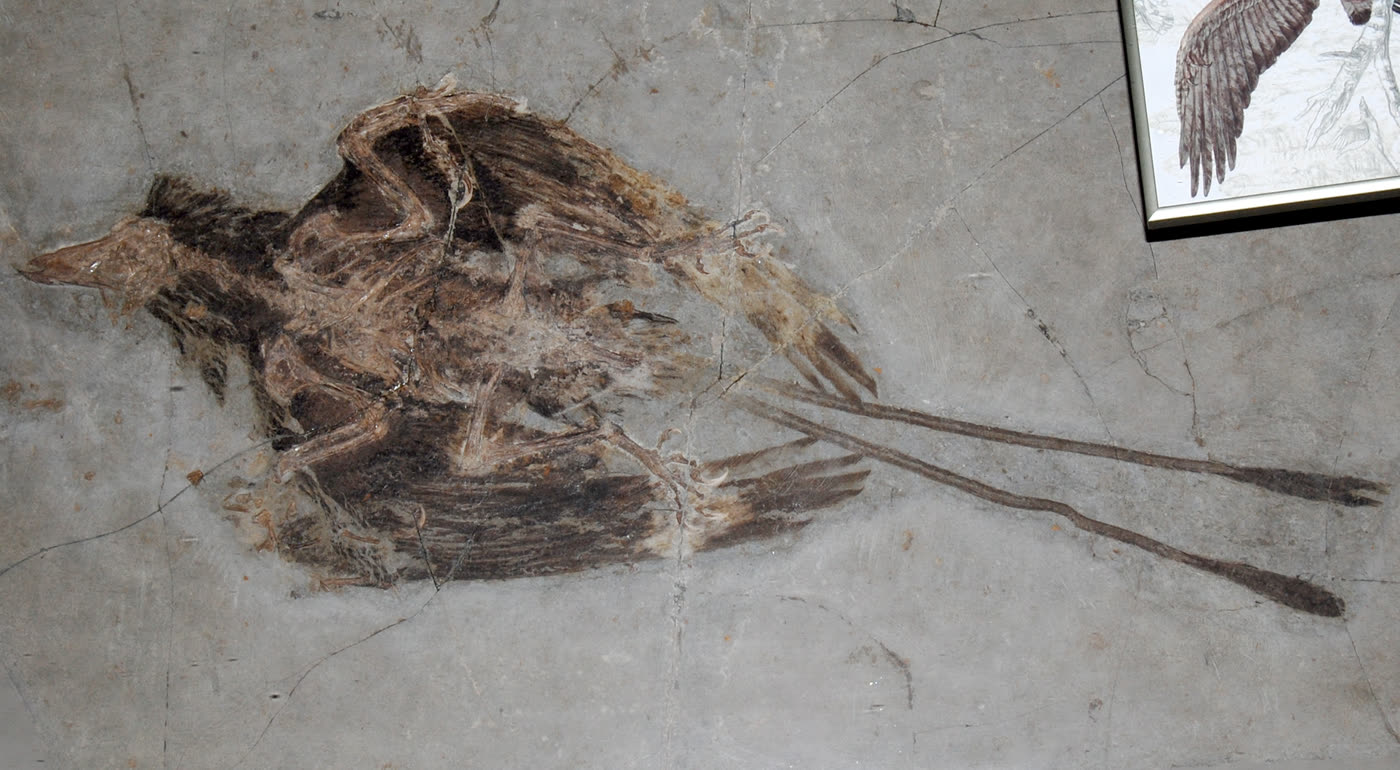
Image context: the lead image is a photographed Confuciusornis specimen from Wikimedia Commons. It is the right visual for this article because it preserves the shortened rear skeleton associated with a pygostyle, yet still advertises a tail regime very different from the broad modern fan. The paired streamers make the mosaic obvious at a glance.[6]
1) Long-tailed early birds still carried a dinosaur problem behind them
The starting point is not "birds gained a fan." The starting point is that theropod dinosaurs already had a tail under functional pressure before the modern avian tail existed. Pittman and colleagues describe the theropod tail as a structure progressively reorganized into a stiffer aerodynamic surface, with changes in vertebrae, ligaments, and feather distribution affecting balance and locomotor control.[2]
That makes long-tailed avialans easier to read. In forms around the Archaeopteryx grade, the rear of the body still carried a long series of unfused caudal vertebrae.[1][2] Feathers were already important, and flight capability was no longer a trivial question, but the skeleton had not yet been compacted into the short terminal unit familiar from living birds.[1]
This matters because a long bony tail is not just a primitive leftover. It changes mass distribution, changes how balance is managed, and changes what any feather array at the back can do. The early avialan tail therefore should be read as an active part of the locomotor package, not as a decorative preface to the modern bird condition.[1][2]
2) The pygostyle arrives before the fully modern tail fan
The central mistake in many summaries is to treat the pygostyle as if it instantly solved the whole problem. It did not. A pygostyle is a fused terminal tail element, and its appearance is a major anatomical shift, but it is only one part of the story.[1][4]
Rashid and colleagues' EvoDevo review is useful here because it frames tail evolution as a sequence rather than a single event.[1] In that sequence, early short-tailed birds such as Confuciusornis and other pygostylians show that the rear skeleton could be abbreviated well before the modern aerodynamic tail module was complete.[1]
This is where the image earns its place. Confuciusornis is famous for its paired elongated tail feathers in some specimens, a reminder that display and feather specialization were already reshaping the rear of the animal.[1][6] But those streamers are not the same thing as the broad, muscularly controlled rectricial fan of crownward birds. A short tail skeleton and impressive tail feathers could coexist without producing the modern avian solution.
That is why "short-tailed" and "modern-tailed" should not be treated as synonyms. The fossil record separates them.
3) Yixianornis shows where a recognizably modern tail module comes into focus
The strongest fossil marker for the modern tail apparatus comes later, in ornithurines such as Yixianornis grabaui. Clarke, Zhou, and Zhang argued that Yixianornis preserves evidence of a true rectricial fan and a rectricial bulb, the soft-tissue-muscular complex associated with controlling the tail feathers in living birds.[3]
That matters more than the word "fan" alone. Feathers can spread visually in many ways. What makes the modern avian tail distinctive is the integrated package: abbreviated skeleton, pygostyle, and the muscular architecture that lets the feathers open, close, and function together as a control surface.[3]
This lets the lineage be read in a much cleaner order. Long-tailed avialans had feathers and a still-extended skeletal tail. Early pygostylians shortened the skeleton but did not yet demonstrate the full modern tail-control system. Ornithurines like Yixianornis bring the package much closer to the living-bird condition.[1][3]
Once that sequence is in view, the old transition stops looking like a single dramatic leap. It reads instead as a staged assembly of a rear-body module.
4) Development in living birds explains why the fossil sequence is easy to oversimplify
Living birds offer an important warning against reading any single fossil too quickly. Rashid and colleagues' 2018 study on avian tail ontogeny shows that the pygostyle forms through postnatal fusion of distal caudal vertebrae and that this developmental timing matters when paleontologists interpret immature fossil specimens.[4]
The methodological lesson is larger than ontogeny alone. If the pygostyle is itself a formed structure with a developmental sequence, then fossil interpretation has to ask not only whether a tail is short, but also how far along the specimen is and what exactly has fused.[4]
That helps prevent a common mistake in popular retellings: turning every short tail into proof that a fully modern avian tail was already present. Development says the structure has a history even within living birds; paleontology says the broader lineage had an even longer history.[1][4]
5) Tail evolution stayed mosaic longer than the clean diagrams suggest
The mosaic did not disappear the moment pygostylians diversified. Wang and colleagues' 2017 Nature Communications paper on Cruralispennia matters here because it reported an enantiornithine bird with an ornithuromorph-like plough-shaped pygostyle.[5] That is important because pygostyle shape had often been treated as a relatively clean signal of more crownward affinities.[5]
The broader implication is that tail characters did not all travel on one conveyor belt. Skeletal shortening, pygostyle shape, feather arrangement, and flight-control capacity could be partly decoupled and could even show homoplasy.[1][5]
This is exactly why the avian tail is a good lineage-context problem rather than a one-fossil story. Each well-known taxon illuminates one part of the assembly, but no single specimen can be asked to stand in for the whole transformation.
6) A better way to remember the transition
If you want a durable reading rule, keep three questions separate.
First, how long is the free bony tail? Second, is there a pygostyle, and what kind of terminal fusion is actually preserved? Third, is there evidence for the integrated feather-and-muscle control system associated with the modern tail fan?[1][3][4][5]
Those questions keep the story from collapsing into one slogan. The avian tail did not become modern the instant it became short. The rear skeleton shortened first, display and feather specialization had their own evolutionary tempo, and the fully modern control surface came into focus only after those lines converged more tightly in later birds.[1][3]
That is the value of reading the fossil record by modules instead of mascots. It preserves the real achievement. Birds did not merely lose a dinosaur tail. They rebuilt the rear of the body into a new aerodynamic instrument, and they did it on different clocks.
Sources
- Dana J. Rashid, Susan C. Chapman, Hans C. E. Larsson, and Chris L. Organ (2014), EvoDevo: "From dinosaurs to birds: a tail of evolution."
- Michael Pittman, Stephen M. Gatesy, Paul Upchurch, and Anjali Goswami (2013), PLOS ONE: "Shake a Tail Feather: The Evolution of the Theropod Tail into a Stiff Aerodynamic Surface."
- Julia A. Clarke, Zhonghe Zhou, and Fucheng Zhang (2006), Journal of Anatomy: "Insight into the evolution of avian flight from a new clade of Early Cretaceous ornithurines from China and the morphology of Yixianornis grabaui."
- Dana J. Rashid, Kevin Surya, Luis M. Chiappe, Nathan Carroll, and colleagues (2018), Scientific Reports: "Avian tail ontogeny, pygostyle formation, and interpretation of juvenile Mesozoic specimens."
- Min Wang, Jingmai K. O'Connor, Yanhong Pan, Zhonghe Zhou, and colleagues (2017), Nature Communications: "A bizarre Early Cretaceous enantiornithine bird with unique crural feathers and an ornithuromorph plough-shaped pygostyle."
- Wikimedia Commons file page for the photographed Confuciusornis specimen used as the lead image.