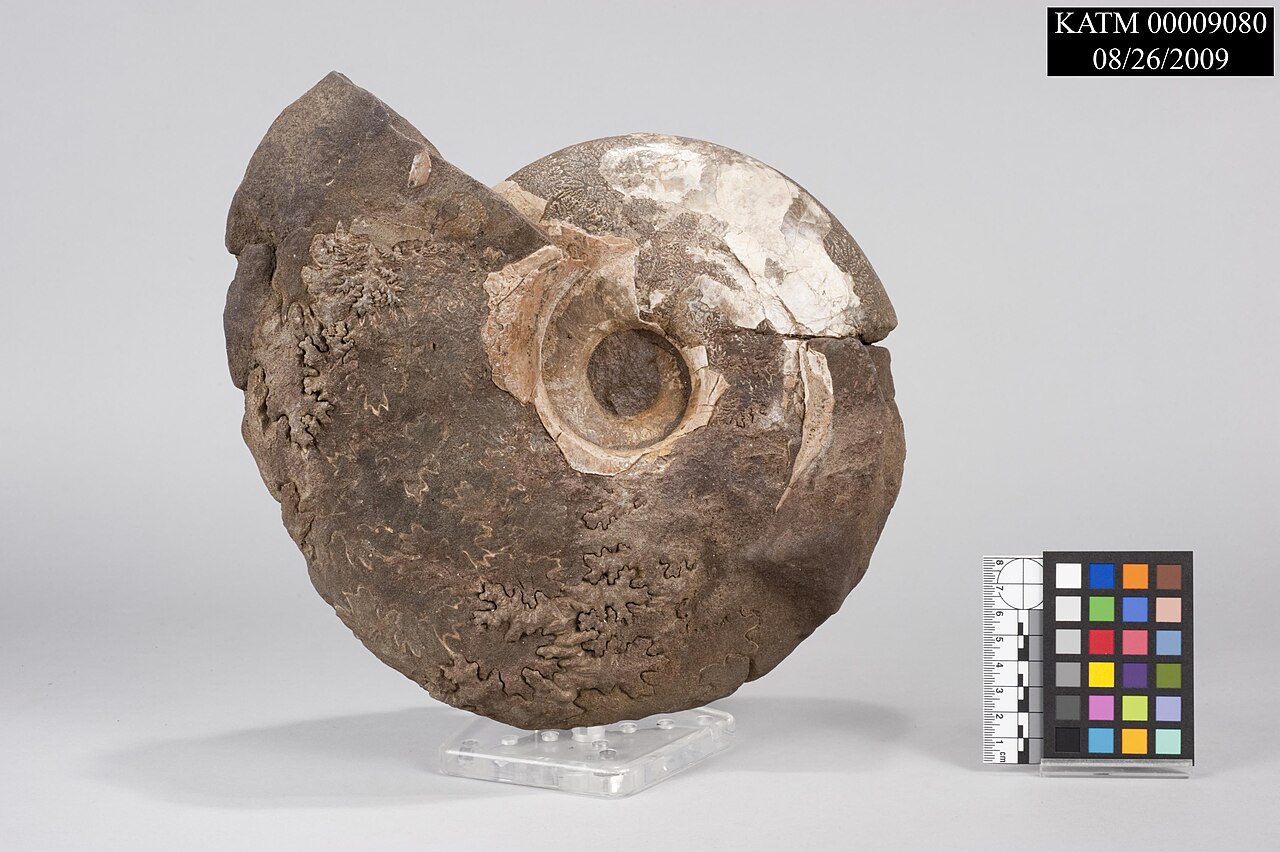
When most readers first notice an ammonite, they notice the coil. When paleontologists look closer, one of the most informative features is a much narrower line: the wavy trace where each internal wall, or septum, met the shell from the inside.[1][5] That line is the suture. It is not decorative surface pattern in the ordinary sense. It is the external record of internal architecture.
That is why ammonite sutures have remained a serious paleontological problem for more than a century. They helped classify lineages, they preserve evidence about how septa formed, and they invited repeated arguments about function: shell strength, hydrostatic pressure, buoyancy control, developmental geometry.[2][3][4][5] The best way to read them in 2026 is strict and layered. A suture is a growth map first. Only after that does it become a strength debate.
Image context: the cover uses a photographed Pachydiscus kamishakensis specimen from the Kaguyak Formation. It works for this article because the zig-zag, leaf-like frilling can be read directly on the fossil surface, which is exactly how sutures enter paleontological argument in the first place.[6]
1) A suture line is the shell's visible trace of an internal partition
Ammonites lived in chambered external shells. As the animal grew forward at the aperture, it sealed off the rear of the shell into a series of chambers with septa, leaving the occupied body chamber at the front.[1][5] The suture formed where each septum attached to the inner shell wall, and that intersection could later be read on fossils as a repeating line.[5]
This matters because a reader can see the line without seeing the whole septum. In other words, ammonite fossils often expose one of the best outward clues to the geometry of the conch's interior. That helps explain why sutures became so central in both classroom diagrams and technical taxonomy. They are a visible edge of an otherwise hidden structure.[2][3]
The evolutionary trend is familiar even to non-specialists once it is pointed out. Early forms tend toward simpler sinuous or zig-zag patterns; later ammonitic sutures can become deeply frilled, with repeated folds nested inside larger folds.[5] The temptation is to turn that trend into a one-line progress story. The literature is more careful. Increasing complexity is real. Its meaning is where the work begins.
2) Systematists valued sutures because they turned internal structure into a readable external character
One reason sutures became so important is practical. Ammonites were extraordinarily diverse, geographically widespread, and evolutionarily fast-moving. Paleontologists needed characters that could sort related forms with more discipline than shell outline alone could provide.[1][2]
Westermann's 1958 paper remains useful here because it framed the problem at the level of septa rather than only their visible traces.[2] His point was that sutures cannot be interpreted well if they are treated as flat ornament. The septum behind the line matters, because similar-looking outer traces may arise from structurally different septal patterns.[2] That is a methodological correction still worth keeping. A suture is not just a shape to match in a guidebook. It is a compressed anatomical signal.
This is also why sutures became high-value taxonomic evidence. They carry repeatable lineage information precisely because they are tied to how the interior of the shell was built.[2][3] In a fossil group where the shell is often the main archive, that is a powerful advantage.
3) The old "armor against pressure" story was elegant, but it never fully settled the case
The most famous functional hypothesis says that increasingly frilled septa helped ammonites resist stress. The intuition is easy to grasp: more folding increases contact area and might brace the shell more effectively against compression or implosion.[4][5] That explanation became popular because it translates a visually extravagant fossil trait into a mechanical payoff.
Recent work has made that single-cause story harder to defend in clean form. Johnson and colleagues used 3D-printed theoretical morphologies to test whether greater septal complexity improved resistance to shell-crushing loads.[4] Their answer was blunt: increasing complexity did not increase compression resistance in the way the classic predator-defense story would predict.[4] That does not prove strength never mattered anywhere in ammonoid evolution. It does narrow the claim. The folds are not a simple one-step answer to "why didn't the shell break?"
Peterman and colleagues' review of the functional problem says much the same thing in broader terms.[5] Pressure resistance has long dominated textbook explanation, but the evidence no longer supports treating it as the uncontested master function.[5] Once that older certainty loosens, sutures become more interesting, not less. The question shifts from one heroic adaptation to several overlapping constraints.
4) Development changed the discussion because the line also records how the septum was made
Another reason the old shell-strength story has lost its monopoly is that the developmental side of the problem became sharper. Inoue and Kondo used computed tomography and soft-tissue interpretation to argue that ammonite septal frilling can be modeled through the behavior of a previously unknown rear mantle structure during septum formation.[3]
That finding matters because it changes the baseline logic. If complex sutures can arise from the geometry and branching behavior of septum formation itself, then not every fold needs to be explained as an independent adaptation for external performance.[3] Development is not an enemy of function, but it does mean form may be channelled by how the animal built the structure in the first place.
This is the point where "growth map first" becomes the right reading discipline. The line on the fossil is evidence of fabrication before it becomes evidence of advantage. Once that order is reversed, writers start speaking as though every extra frill must have been selected because it made the shell tougher. The developmental literature warns against that shortcut.[3]
5) Buoyancy control offers a subtler function than brute reinforcement
If septal complexity is not a straightforward compression shield, what else might it have helped do? One of the strongest alternative proposals concerns liquid retention and buoyancy regulation inside the chambers.[5]
Peterman and colleagues tested 3D-printed shell archetypes and found that more complex septa could retain more liquid through surface-tension effects, especially when chamber surfaces behaved more like biological membranes.[5] That does not turn every ammonite into a finely instrumented submarine. It does, however, provide a plausible mechanism by which increasing internal complexity could improve chamber refilling and hydrostatic control.[5]
This explanation is less cinematic than the old armor theory, but better fitted to the animal. Ammonites were not just shells waiting to be crushed. They were living ectocochleates managing mass, chamber liquid, and orientation through time.[1][5] Read in that frame, sutures start to look less like fortification ridges and more like one part of a buoyancy-management system whose side effects could also touch stability and shell architecture.
6) The best modern reading keeps three layers separate
By now, the most reliable way to read ammonite sutures is to keep three layers apart.
First, there is the direct anatomical fact: sutures are the junction between septa and shell wall, visible because the shell preserved the trace.[1][5] Second, there is the developmental question: how did the animal's mantle and chamber-building process generate this degree of folding?[3] Third, there is the functional question: what did greater complexity do for buoyancy, shell behavior, or other aspects of ammonoid life?[4][5]
Most bad ammonite summaries blur those layers into one sentence. They jump from "look how intricate this line is" to "therefore the shell was stronger," as if the fossil had already answered every intermediate question. The better conclusion is narrower and more useful. The suture is a high-information fossil character because it carries anatomy, growth history, and functional possibility all at once. But those are not the same kind of evidence.[2][3][4][5]
That is why the frilled lines still matter. They do not give us one neat moral about progress or armor. They give us something better: a place where taxonomy, development, and paleobiology all meet on the same shell.
Sources
- Natural History Museum, "What is an ammonite?" overview of ammonite shell form, chambers, and fossil context.
- G. E. G. Westermann (1958), Geological Magazine: "The Significance of Septa and Sutures in Jurassic Ammonite Systematics."
- Shinya Inoue and Yoichi Kondo (2016), Scientific Reports: "Suture pattern formation in ammonites and the unknown rear mantle structure."
- Erynn H. Johnson et al. (2021), Paleobiology: "Did shell-crushing predators drive the evolution of ammonoid septal shape?"
- David J. Peterman et al. (2021), Scientific Reports: "Buoyancy control in ammonoid cephalopods refined by complex internal shell architecture."
- Wikimedia Commons file page for the Pachydiscus kamishakensis photograph used as the article image.