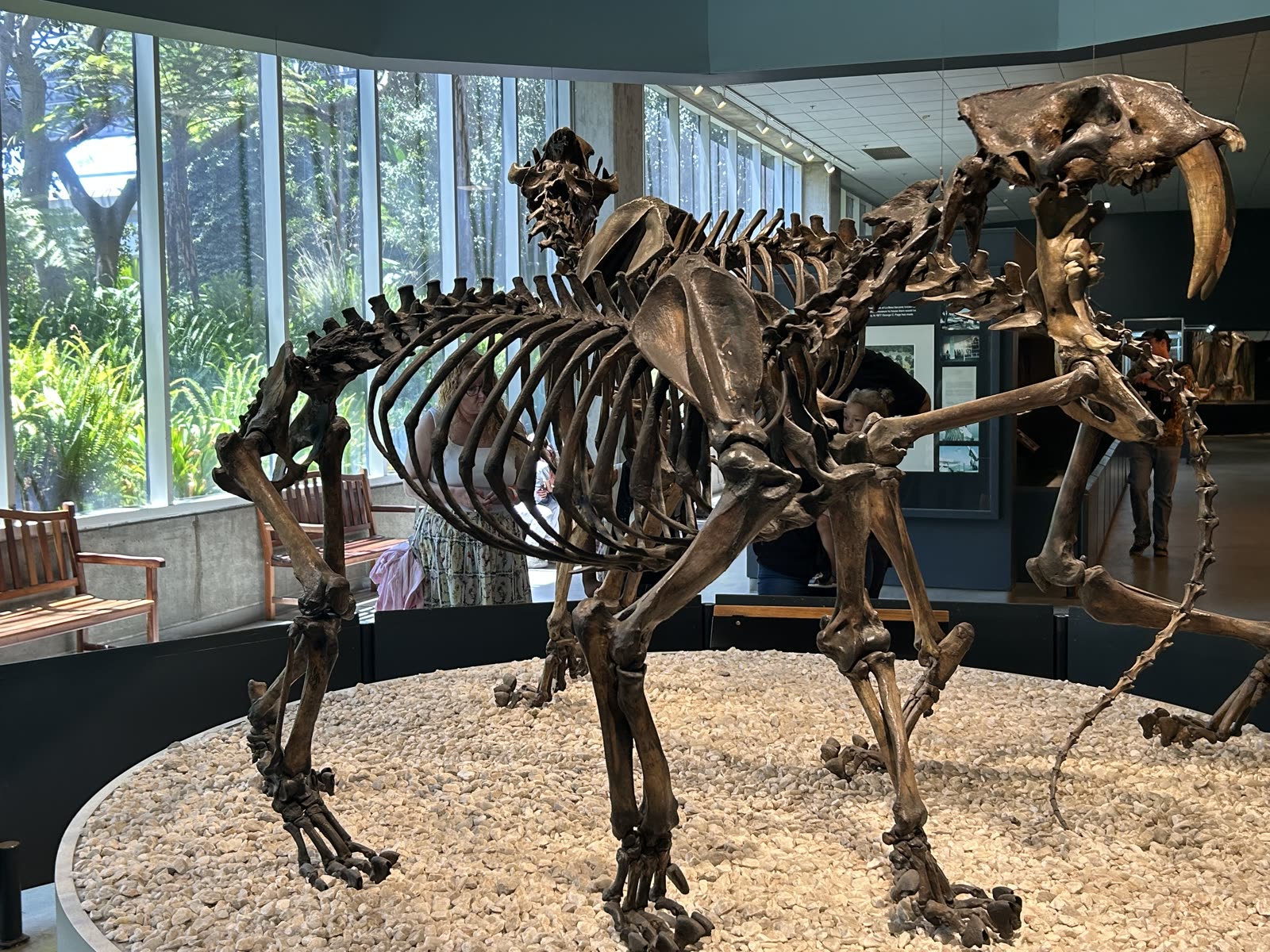
Smilodon fatalis survives in popular culture as a face first: long upper canines, a cat skull, a poster-ready snarl. Rancho La Brea forces a better reading discipline. What matters about this sabertooth is not only that it was spectacular, but that it comes to us in quantity. The tar-pit collections preserve a repeated late Pleistocene carnivore record from southern California rather than one lucky trophy specimen.[1]
That difference changes the kind of questions paleontologists can ask. A lone skull can make an animal famous. A dense sample of the same predator makes anatomy, injury, and behavior more discussable. Rancho La Brea does not remove uncertainty, but it narrows the range of fantasy. Smilodon becomes less like a logo and more like a population with recurring constraints.[1][2][3][4]
Image context: the cover image shows a mounted Smilodon fatalis skeleton. It is used here because the real interpretive payoff in sabertooth studies lives in body proportions, especially the heavy forequarters and the way the skull sits on that frame, not in the canines alone.[5]
1) Rancho La Brea matters because it gives sabertooths in the plural
The official La Brea mammal collections page describes the tar-pit record as a window onto the last 50,000 years of southern California life, with dire wolves, Smilodon, and coyotes among the most common mammals in the collection.[1] That is the first fact worth holding onto. The site does not give us a sabertooth in the singular. It gives repeated occurrence, repeated injury, repeated age structure, and repeated anatomical comparison inside one unusually rich carnivore-heavy archive.[1]
This is why Rancho La Brea is more than a scenic backdrop for extinct megafauna. It lets paleontologists stop asking only "what did a sabertooth look like?" and ask harder questions: how robust were its limbs relative to living cats, what kind of bite was mechanically plausible, and what do healed pathologies imply about survival?[1][2][3][4]
In other words, the site turns Smilodon from an icon into an evidence surface. The cat becomes legible not because one skeleton is complete enough to settle everything, but because many individuals keep repeating the same anatomical signal.
2) The forelimbs are the beginning of the animal, not an accessory to the skull
The usual public reading order starts with the teeth. Meachen-Samuels and Van Valkenburgh's radiographic study gives a good reason to reverse that order.[2] Their comparison with living large felids found that Smilodon fatalis had forelimbs with exceptional strength relative to extant cats, a result consistent with a predator built to grapple and immobilize prey with the front end of the body before delivering its killing bite.[2]
That matters because giant canines are mechanically fragile if used like oversized lion teeth. A sabertooth with a wide gape and elongate canines needs control over prey movement. The forequarters therefore are not a side note. They are part of the killing apparatus.[2][3]
Read through Rancho La Brea, that interpretation becomes harder to dismiss as overreading. The same body plan keeps returning: deep chest, powerful shoulders, and a front-heavy frame that makes more sense for restraint than for long pursuit.[1][2] The famous teeth still matter, but they start to look like the last step in a sequence that begins with the limbs.
3) The skull mechanics argue against a generic big-cat bite
McHenry and colleagues' three-dimensional simulation work sharpened the point.[3] Their study suggested that Smilodon was not simply a lion with longer canines. The cranium and jaws do not read as a design for high-force, clamp-and-hold biting in the usual big-cat way. Instead, the anatomy fits a more specialized predatory sequence in which prey restraint and neck-driven precision matter more than raw bite-force prestige at the tooth tips.[3]
This is where the population sample helps again. A spectacular sabertooth skull by itself tempts readers toward myth: maximum violence, maximum force, maximum drama. The mechanical work cuts in the opposite direction. It narrows the animal into a more specific predator, one that likely needed body position and prey control to use its canines effectively.[2][3]
That is a better paleontological sentence because it ties appearance to function without pretending function is obvious from teeth alone. The canines remain the signature. The forelimbs and neck tell you how the signature could actually be used.
4) Pathology is where behavior enters, and where caution has to stay
The most interesting recent shift in Smilodon interpretation comes from pathology. Balisi and colleagues used computed tomography to reassess a famous La Brea pelvis and femur and concluded that the abnormalities were best explained not as traumatic injury healed in adulthood, but as hip dysplasia present from infancy.[4] That changes the stakes of the specimen. An animal with a severely compromised hip from early life should have struggled to hunt or defend territory alone.[4]
The tempting leap is immediate: therefore Smilodon was social. The paper is more disciplined than that. What it argues is that prolonged survival of this individual is consistent with social assistance, food sharing, or some form of tolerance from conspecifics.[4] Consistent with is not the same thing as proven by.
That boundary matters. Rancho La Brea makes behavioral inference possible because it provides injuries, pathologies, and multiple individuals. It does not convert behavior into certainty. The strongest reading is narrower and more useful: La Brea keeps sociality on the table for Smilodon in a way that a lone sabertooth skull never could.[4]
5) The best version of Smilodon is the least poster-like one
Put the evidence streams together and a sharper sabertooth appears.
Smilodon fatalis at Rancho La Brea is not most valuable as an icon of extinct ferocity. It is most valuable as a repeated record of one predator passing through the same deposit system often enough to let anatomy, mechanics, and pathology speak to one another.[1][2][3][4] The forelimbs point to prey restraint. The skull mechanics argue against a generic lion-style bite. The dysplastic hip specimen makes solitary self-sufficiency harder to assume and keeps cooperative behavior under active discussion.[2][3][4]
That is why the La Brea sabertooth still matters. Not because it looks finished in posters, but because the fossil archive refuses to leave it there. The best read of Smilodon is population first, spectacle second.
Sources
- La Brea Tar Pits, "Mammal Collections" - official overview of the late Pleistocene southern California mammal archive and the collection's most common mammals.
- Julie Meachen-Samuels and Blaire Van Valkenburgh (2010), PLoS ONE: "Radiographs Reveal Exceptional Forelimb Strength in the Sabertooth Cat, Smilodon fatalis."
- Colin R. McHenry et al. (2007), PNAS: "Supermodeled sabercat, predatory behavior in Smilodon fatalis revealed by high-resolution 3D computer simulation."
- Mairin A. Balisi et al. (2021), Scientific Reports: "Computed tomography reveals hip dysplasia in the extinct Pleistocene saber-tooth cat Smilodon."
- Wikimedia Commons file page for the mounted Smilodon skeleton photograph used as the article image.