The K-Pg boundary is often shown as one dramatic line in rock, a geological sentence that says the dinosaurs ended here. That line is real. The problem starts when readers treat it as a single piece of evidence instead of a stack of different signals pressed into one narrow horizon.
Read carefully, the boundary layer is not one story. It is a compression chamber where chemistry, impact debris, and ecological recovery traces sit close together while still speaking about different processes and different timescales.[1][2][3][4][5]
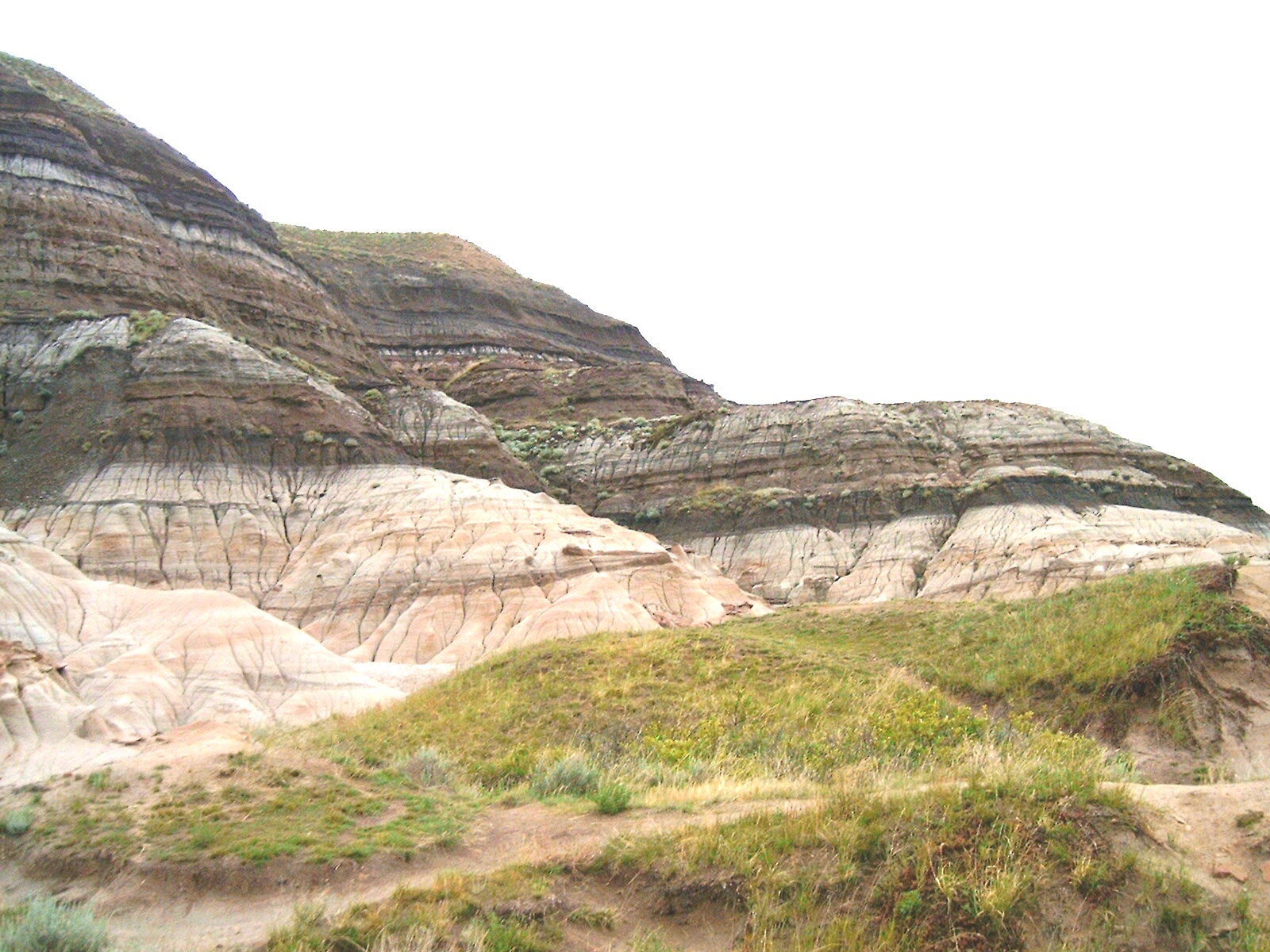
Image context: the cover image shows an exposed K-T or K-Pg boundary section near Drumheller, Alberta. It works here as a direct field photograph of the kind of thin physical layer that carries an outsized share of the extinction argument.[6]
1) The boundary horizon matters because it forces multiple arguments into one surface
The White Cretaceous is gone, the Paleogene begins, and between them sits a remarkably thin record that has to carry a great deal of explanatory weight. That is why the K-Pg boundary remains so scientifically useful. It lets paleontologists test whether different evidence streams really converge when the time window becomes tight.[2]
This is also why the layer is easy to misuse. A boundary section can look visually simple while holding signals that formed on very different clocks. Some record material delivered at planetary scale. Some record physical fallout from the impact system. Some record what plant communities did after devastation opened ecological space. If those are collapsed into one instant, the argument gets louder and weaker at the same time.
2) The iridium anomaly changed the burden of proof
Alvarez and colleagues' 1980 paper mattered because it moved the extinction debate from a loose accumulation of end-Cretaceous stress ideas toward a testable global event model.[1] Their key observation was an anomalous enrichment of iridium at the boundary, a chemical signal far easier to explain with extraterrestrial input than with ordinary surface processes.[1]
That did not solve every downstream question. Iridium does not tell you crater size by itself. It does not tell you how every food web failed. It does not describe what the first post-impact forest looked like. What it does is change the baseline: any explanation for the boundary now has to account for a global geochemical marker that is both sharp and unusual.[1][2]
In practical reading terms, iridium is the signal that says the event scale was planetary. It is the opening of the case, not the whole case file.
3) Spherules and ejecta layers turn anomaly into mechanism
If iridium tells you something extraordinary arrived, ejecta spherules and related impact debris tell you more about how that arrival moved through the Earth system. Reviews of distal ejecta layers treat these particles not as decorative fallout but as transport evidence: they record melt production, ballistic distribution, atmospheric passage, and later depositional filtering.[3]
This is where the boundary becomes more than chemistry. Glass spherules, microtektites, shocked material, and graded deposits help connect the abstract idea of an impact with an actual physical pathway from crater to distant sedimentary basin.[2][3] They also remind readers that not every boundary section is equally pristine. Reworking, bioturbation, and local sedimentary conditions can blur or sort what was originally deposited.[2][3]
So the right question is not simply "Are spherules present?" A better question is what kind of section is being read, how disturbed it is, and what the ejecta package can really constrain there.
4) The fern spike is not the impact pulse; it is the ecological afterimage
One of the most memorable terrestrial signals at the boundary is the fern spike: an interval in which fern spores dominate palynological assemblages after ecological disruption.[4] The New Zealand work by Vajda and colleagues made that pattern famous because it provided a vivid vegetation-level record of catastrophic forest loss followed by opportunistic recolonization.[4]
What makes the fern spike powerful is also what limits it. It is not a stopwatch for the impact moment itself. It is a recovery signal, a picture of what certain landscapes looked like after disturbance had already reset the competitive field.[4][5]
That distinction matters more than it sounds. A 2023 reassessment of the birthplace of the fern-spike concept asks whether the initial phase of that spike can be reconciled with current impact models and stresses that the signal has to be read with site formation, transport, and local paleoecology in view.[5] In other words, the fern spike is strongest when treated as ecological succession evidence, not as a one-number proxy for every place on Earth.
5) Why the extinction argument is strongest when the timescales stay separate
The broad consensus review by Schulte and colleagues argues that the Chicxulub impact was the principal driver of the mass extinction at the K-Pg boundary.[2] That consensus is strong not because one proxy won, but because multiple proxies line up across different domains: geochemistry, crater evidence, ejecta distribution, marine and terrestrial biotic turnover.[2]
This is the deeper lesson of the boundary layer. It works as evidence precisely because it is plural.
- Iridium speaks most directly to unusual global input.[1]
- Ejecta layers speak to impact mechanics and transport.[2][3]
- Fern spikes speak to post-impact ecological reset on land.[4][5]
When those signals converge, the extinction story becomes tighter. When a reader asks one of them to do all the work alone, the story becomes sloppier.
6) A better way to read the next K-Pg headline
The reusable method is simple.
First, ask which boundary signal is actually being discussed. Second, ask what timescale that signal belongs to: impact arrival, ejecta deposition, or ecological aftermath. Third, ask whether the section under discussion is being treated as a clean global template when it may really be a locally filtered archive.[2][3][5]
That discipline keeps the boundary from turning into iconography. A thin clay layer can carry a great deal of truth, but only if each part of the evidence stack is allowed to keep its own job.
The K-Pg boundary is therefore best read as a layered argument surface. It does not merely say that something terrible happened. It shows how paleontology separates event scale, mechanism, and aftermath without pretending those are the same thing.
Sources
- Luis W. Alvarez, Walter Alvarez, Frank Asaro, and Helen V. Michel (1980), Science: extraterrestrial iridium anomaly as a boundary-scale extinction signal.
- Peter Schulte et al. (2010), Science: review of the Chicxulub impact and K-Pg mass-extinction evidence stack.
- Bill Glass and Bruce Simonson (2012), Elements: distal impact ejecta layers, spherules, and what they can constrain about transport and deposition.
- Vivi Vajda, J. Ian Raine, and Christopher J. Hollis (2001), Science: New Zealand fern-spike evidence for global deforestation at the boundary.
- Vivi Vajda, C. J. Hollis, and J. I. Raine (2023), Review of Palaeobotany and Palynology: revisiting how the initial fern-spike phase fits current Chicxulub impact models.
- Wikimedia Commons file page for the Drumheller K-Pg boundary photograph used as the article image.