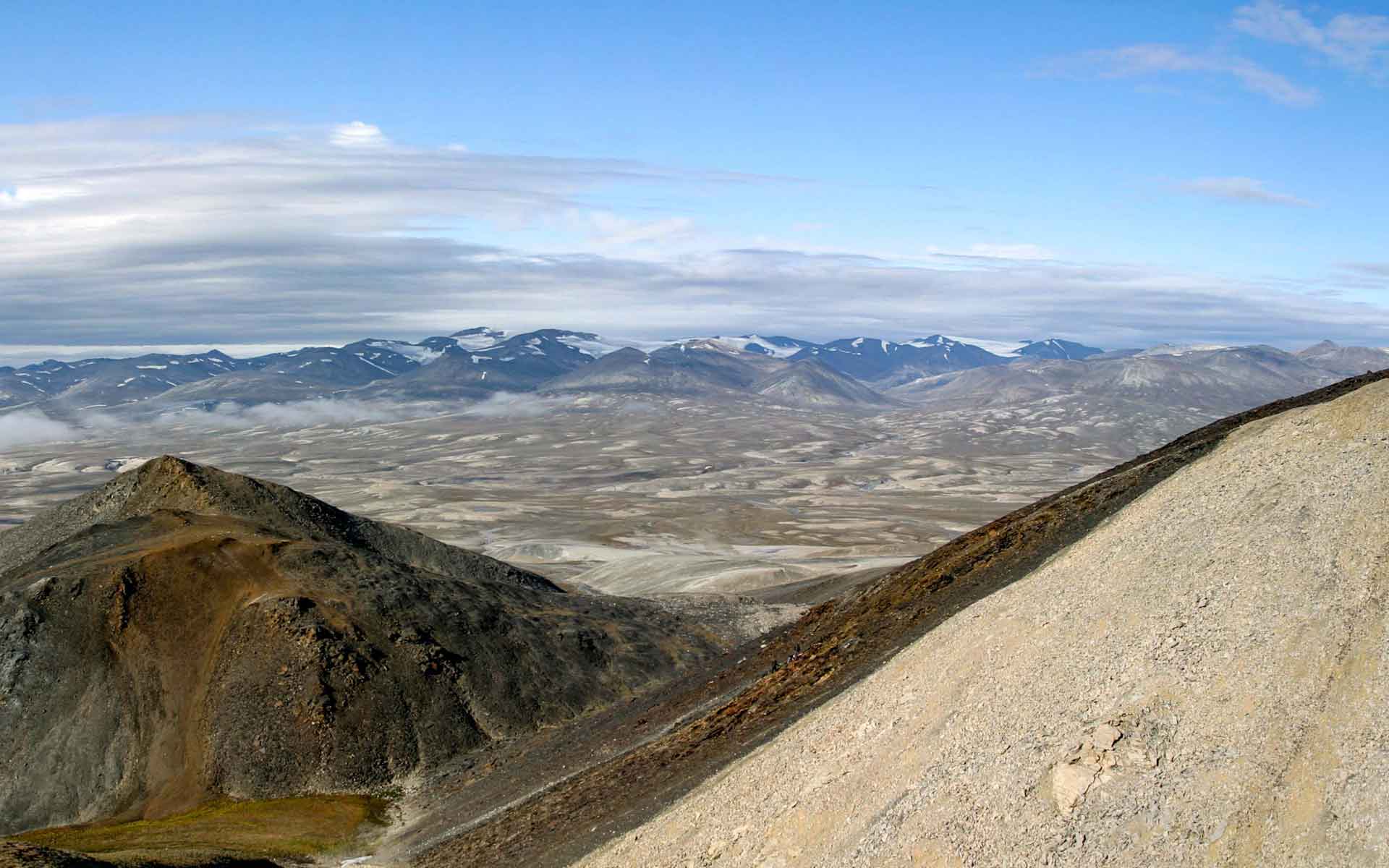
Sirius Passet is tempting to describe by distance first. It sits in Peary Land, North Greenland, on the east side of J.P. Koch Fjord, far enough north that even a field report can start sounding like expedition literature before it starts sounding like paleontology.[1][2] But remoteness is only the doorway. The scientific reason Sirius Passet matters is that it preserves an early Cambrian animal community in a setting that is not quite the familiar classroom image of the Burgess Shale, not quite the Chengjiang story from South China, and not easily reduced to one spectacular fossil.
The better frame is this: Sirius Passet is a slope archive. The fossils occur in mud-dominated Buen Formation strata near the outer shelf-to-slope transition, in rocks later caught up in folding, thrusting, and low-grade metamorphism.[1][3][5] That makes the site unusually valuable and unusually demanding at the same time. It is old enough to sit close to the early expansion of complex animal ecosystems, rich enough to include arthropods, lobopodians, sponges, worms, halkieriids, radiodonts, and other soft-bodied forms, and altered enough that preservation has to be read with caution rather than romance.[1][2][5]
The lead image shows Halkieria evangelista, one of the site's iconic fossils.[4] It is not a heroic reconstruction, and that is the point. The specimen looks like a pale, textured body on dark rock, with enough repeated surface structure to make the animal legible but not enough visual drama to let the reader forget the interpretive work. Sirius Passet is full of that kind of lesson: early animal history is visible here, but it arrives through compressed, altered, sometimes visually modest material.
A remote site became a Cambrian reference point
IUGS describes Sirius Passet as one of the most remote and least well-known major Cambrian explosion sites, discovered in 1984 during regional mapping by geologists from the Geological Survey of Greenland.[2] That origin matters because the site did not enter science as a tourist icon or an easy quarry. It became important because field geologists noticed that ordinary-looking blocks contained a partly sclerotized fauna with similarities to the better-known Burgess Shale animals.[2]
Harper and colleagues call Sirius Passet one of the oldest Phanerozoic exceptionally preserved biotas, and emphasize that it records an early Cambrian ecosystem in which new body plans and life modes were already being assembled into a functionally tiered community.[1] That phrase, "functionally tiered," is useful. It keeps the site from becoming only a checklist of strange animals. A Lagerstatte matters most when it lets paleontologists ask how a community worked: who lived on or in the sediment, who swam above it, who filtered, who hunted, and what the water column allowed.
Sirius Passet's fauna is not just a northern duplicate of another deposit. IUGS notes the presence of sponges, trilobites, a Burgess-like soft-bodied fauna, and prominent taxa such as Halkieria, Kerygmachela, and Pambdelurion.[2] The 2019 synthesis goes further, describing a fauna dominated by predators and by infaunal, benthic, and pelagic life modes, with abundant nekton and large sweep-net feeders implying a nutrient-rich ecosystem.[1] That is the first reason the site stays sharp. It records animals occupying different parts of the water-sediment system, not merely lying in one famous rock.
The slope setting changes the reading
The geology is not background scenery here. Harper and colleagues place the Sirius Passet locality in Lower Cambrian Buen Formation mudstones near the shelf-slope break, then add a crucial structural correction: the fossiliferous strata are now inverted in a thin horse of Buen Formation bounded by faults near the Buen Thrust.[1] At the time of deposition, the site lay at the outer edge of the relict platform, not simply in the modern structural position where field teams find the beds today.[1]
That distinction matters because a slope setting changes what a fossil bed can mean. A shallow lagoon, a quiet lake bottom, a deltaic mudflat, and a shelf-slope margin all preserve different ecological and taphonomic stories. Sirius Passet's fossils should therefore not be handled as if they simply dropped into a generic Cambrian aquarium. They belong to a marine margin where sediment movement, oxygen structure, bottom-water conditions, and later tectonic inversion all shaped what survived and how it now presents itself.[1][3]
This is where the "northern Burgess Shale" shortcut becomes actively unhelpful. The Burgess comparison is historically unavoidable because both deposits preserve soft-bodied Cambrian animals. But comparison is not identity. Sirius Passet is older than the classic Burgess Shale and sits in a different basin history, preservation pathway, and structural setting.[1][2][3] Its value is not that it repeats a Canadian story at higher latitude. Its value is that it supplies another early animal ecosystem under different environmental constraints.
Low oxygen made ecology and preservation meet
The geochemical work by Hammarlund and colleagues gives the site its strongest environmental spine. Their 2019 study describes the early Cambrian Sirius Passet fauna as preserved in mud-dominated Transitional Buen Formation strata and argues that the biota lived close to the boundary of an oxygen minimum zone.[3] They envisaged anoxic water-column conditions moving over the depositional site, possibly with sea-level change, while the ecosystem itself existed under very low oxygen conditions.[3]
That is a better explanation than a vague "exceptional preservation happened" sentence. Low oxygen can slow decay, limit scavenging, and change which organisms can live on or near the sea floor. But the point is not only taphonomic. It is ecological. If animals were living near a shifting oxygen boundary, then the same environmental gradient that helped preserve them may also have structured their lives.[3] In that sense, Sirius Passet is not a dead display case. It is a record of organisms occupying a stressed but productive edge.
This also helps explain why the fauna can feel simultaneously rich and selective. Exceptional deposits are not neutral windows. They overrepresent conditions that favored burial, mineralization, or delayed destruction. Sirius Passet gives rare access to soft-bodied and lightly skeletonized animals, but it does so through a filter: slope mudstone, oxygen stress, burial history, and later geological overprint.[1][3][5]
Metamorphism is not a footnote
The hardest part of reading Sirius Passet is that the fossils did not simply wait unchanged for paleontologists. Nielsen and colleagues argued in 2022 that metamorphism obscures the primary taphonomic pathway at the site.[5] Their study found that later low-grade metamorphism and mineral replacement altered the fossils enough that the original preservation mode is harder to reconstruct than earlier models implied.[5]
That sounds like a discouraging complication. It is actually one of the reasons the site is scientifically mature. A less careful account would say that Sirius Passet preserves early Cambrian soft tissues and leave it there. The better account asks what those tissues became during burial, heating, and mineral replacement. If metamorphism converged the chemistry of the fossils toward the host sediment, then visual preservation and primary biological composition are not the same thing.[5]
This boundary matters for every claim made from the site. A fossil may preserve body outline, appendages, or surface texture well enough to support biological interpretation while still having lost or transformed much of its original chemistry. Paleontology becomes stronger when those two facts stay together. Sirius Passet is powerful because it preserves animals that would usually vanish. It is difficult because the path from living tissue to visible fossil was not simple.[3][5]
Why Halkieria is a useful doorway
Halkieria evangelista is an apt visual anchor because it looks modest until the argument catches up with it.[4] The animal belongs to a wider discussion of early lophotrochozoan body plans, small shelly fossils, and the relationship between armor, repeated sclerites, and soft body organization. In a field-report piece, though, it also does another job. It reminds readers that Sirius Passet is not only a site-level abstraction.
The Cambrian explosion is often told through diagrams of branching animal groups. Sirius Passet gives that story physical texture. In the image, Halkieria is a specimen before it is a phylogenetic signal. That order matters. The site did not change paleontology because someone drew a clever tree. It changed paleontology because expeditions brought back slabs and blocks whose surfaces held animals difficult to classify, compare, and preserve in ordinary conditions.[1][2][4]
The same rule applies across the fauna. Kerygmachela and Pambdelurion matter because they sharpen questions about stem arthropods and lobopodian-grade anatomy. Radiodont and sweep-net-feeding signals matter because they make early Cambrian food webs look more active and layered than a simple seafloor mat community.[1][2] But each of those claims has to return to material specimens from a particular place. Sirius Passet's remoteness is memorable; its specimen discipline is what makes it useful.
What the field report should keep
The strongest current reading of Sirius Passet holds four scales together. At site scale, it is a remote North Greenland Lagerstatte discovered during regional mapping and now recognized as a major IUGS geological heritage site.[2] At basin scale, it belongs to early Cambrian Buen Formation slope mudstones near a shelf-slope transition, later structurally inverted and metamorphosed.[1][5] At ecological scale, it records a low-oxygen but productive ecosystem with predators, nekton, benthos, infauna, sponges, arthropods, worms, and problematic armored animals.[1][2][3] At evidentiary scale, it shows why exceptional preservation is never a transparent window; it is a filter whose chemistry and tectonic afterlife have to be understood before the biology can be trusted.[3][5]
That combination is why Sirius Passet deserves more than a label as a remote Burgess counterpart. The Burgess comparison helps a reader enter the room. It should not be allowed to arrange the furniture. Sirius Passet is its own archive: older, colder in geography, structurally more complicated in the rocks we now see, and unusually good at exposing how early Cambrian ecosystems were already tiered, mobile, and food-web rich.
The best field-report conclusion is therefore plain. Sirius Passet matters because it makes early animal life readable under hard conditions. The fossils are not easy, the setting is not simple, and later metamorphism means preservation must be argued rather than assumed. But that is exactly why the site remains valuable. It teaches that the Cambrian explosion was not one clean burst seen through one perfect window. It was a set of ecosystems, substrates, oxygen boundaries, and fossilization pathways. Sirius Passet keeps one of those windows open, even if the glass is scratched.
Sources
- Lund University publication record for David A. T. Harper et al., "The Sirius Passet Lagerstatte of North Greenland: a remote window on the Cambrian Explosion," Journal of the Geological Society 176, no. 6 (2019) - synthesis of age, setting, fauna, ecosystem structure, and structural context.
- IUGS Geoheritage, "The Cambrian Explosion in Sirius Passet - Peary Land, North Greenland" - site discovery, heritage status, fossil groups, and global significance.
- Emma U. Hammarlund et al., "The Sirius Passet Lagerstatte of North Greenland - A geochemical window on early Cambrian low-oxygen environments and ecosystems," Geobiology 17, no. 1 (2019), PMC full text.
- Wikimedia Commons, "File:Halkieria.png" - photograph of Halkieria evangelista from the Lower Cambrian Sirius Passet Lagerstatte used as the article image.
- NERC Open Research Archive PDF for Morten Lunde Nielsen et al., "Metamorphism obscures primary taphonomic pathways in the early Cambrian Sirius Passet Lagerstatte, North Greenland," Geology 50, no. 1 (2022) - later metamorphic overprint and fossil-chemistry limits.