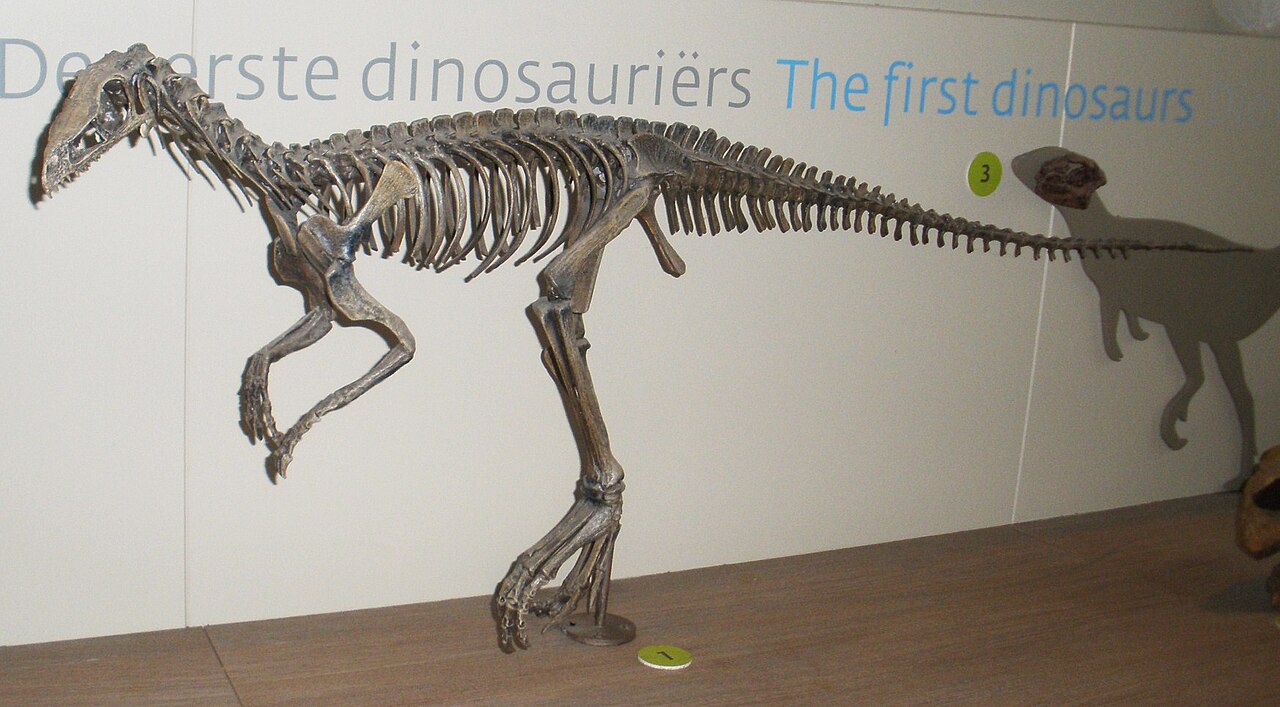
Eoraptor lunensis is useful because it makes dinosaur origins look small before they look inevitable. The animal was not a giant, a tyrant, or a miniature version of a later celebrity. The original 1993 description presented it as a roughly meter-long skeleton from Upper Triassic rocks in northwestern Argentina, close to the expected size and structure of early dinosaurs before the major lineages became visually obvious.[1] That is the right way into the fossil: not as a mascot for "first dinosaur," but as a threshold animal.
The threshold matters because dinosaur success is easy to read backward. Once sauropods, stegosaurs, ceratopsians, hadrosaurs, and theropod giants dominate museum halls, the origin story can seem preloaded with bigness. Eoraptor argues against that. In the Late Triassic Ischigualasto ecosystem, dinosaurs were present among rhynchosaurs, cynodonts, pseudosuchians, and other archosaurs rather than already owning the landscape.[2][5] The early signal was a small bipedal body, a lightly built skull, grasping forelimbs, and teeth that do not let the animal sit comfortably inside a single later feeding stereotype.[1][3]
That is why the image belongs in the article. A skeletal mount is not the holotype itself, but it shows the body plan better than a heroic painting would. The animal is narrow, long-legged, and spare. Nothing about it announces the later dinosaur empire except the architecture: hips and limbs for bipedal movement, a skull made for active feeding, and a frame that could be elaborated in several evolutionary directions.[3][6]
A small body, not a small claim
The type specimen of Eoraptor lunensis, PVSJ 512, came from the Ischigualasto Formation of Argentina. DigiMorph's specimen page identifies the scanned material as the skull of the holotype, collected from the Upper Triassic Ischigualasto Formation, with the specimen housed through the Museo de Ciencias Naturales at the Universidad Nacional de San Juan.[3] That specimen context is important because Eoraptor is not known only from a tooth or an isolated limb bone. Its scientific force comes from a relatively complete early dinosaur skeleton that lets researchers compare skull, teeth, forelimbs, pelvis, hindlimbs, and posture together.[1][3]
The original Nature paper emphasized how generalized the animal looked. Its skull had heterodont teeth, meaning different tooth shapes appeared in the same mouth, and the authors argued that it lacked the obvious specializations of the major dinosaurian clades.[1] That mixture is exactly why the fossil became famous. If a Triassic animal already looks like a late theropod, a late sauropodomorph, or an ornithischian specialist, it is less useful for thinking about the common starting condition. Eoraptor was compelling because it sat closer to the point where later categories had not yet become visually loud.
But "generalized" should not mean vague. The animal was already a dinosaur, already bipedal, already built around hindlimb-driven locomotion, and already part of a saurischian world where predatory and plant-eating trajectories were beginning to separate. The point is not that Eoraptor was primitive in a crude sense. The point is that its body preserves a combination of features before later lineages amplified different parts of the same starting toolkit.
The theropod label did not survive unchanged
The most interesting thing about Eoraptor is that its interpretation moved. Early accounts often treated it as close to theropod origins. That made intuitive sense: a light, two-legged animal with grasping hands and sharp-looking teeth feels carnivorous from across a gallery. DigiMorph's older interpretive text still reflects that history, noting an affinity with theropod dinosaurs while using the specimen to support rapid, small-bodied dinosaur divergence.[3]
Later work complicated the label. The 2011 Science paper on early dinosaurs from southwestern Pangaea described Eodromaeus as a basal theropod and reassessed contemporary Eoraptor as a basal sauropodomorph.[2] That switch is not a minor nameplate correction. It changes what the animal means. If Eoraptor is near the base of Sauropodomorpha, then one of the most famous "dawn raptor" fossils is not simply a preview of later meat-eating dinosaurs. It is also evidence that the lineage eventually leading toward long-necked herbivores began with small, lightly built animals that had not yet become heavy-bodied browsers.
That is the better lesson. Early dinosaur evolution was not a row of finished modern categories. It was a branching zone in which small saurischians could retain predatory-looking proportions, mixed dentition, and bipedal stance while their phylogenetic placement pointed toward very different later histories. The taxonomic revision does not make the fossil less important. It makes it more honest.
Teeth are the hinge
The teeth are where the animal resists a simple story. The 1993 description highlighted heterodont dentition as one of the features that made Eoraptor unusual.[1] Heterodonty matters because feeding ecology sits near the split between early theropod and sauropodomorph narratives. A mouth with different tooth shapes can suggest dietary flexibility, but it does not prove a full behavior script. It gives constraints.
That constraint fits broader early sauropodomorph work. Martinez and Alcober's 2009 PLOS ONE paper on Panphagia protos described another basal sauropodomorph from the Ischigualasto Formation and compared it with Eoraptor and other early saurischians.[4] The name Panphagia itself points toward a broad feeding signal, but the scientific value is not the catchy implication of "eating everything." It is the anatomical neighborhood: small-bodied Triassic saurischians near the sauropodomorph root show that the shift toward later herbivory did not begin as a fully assembled long-necked plan.[4]
For Eoraptor, that means diet should be written with restraint. The fossil supports a flexible early feeding apparatus, not a scene-by-scene life reconstruction. It may have eaten small animals, plant material, or both, but the article's stronger claim is anatomical: tooth shape, skull lightness, and body size make sense in a lineage before sauropodomorph feeding specializations became dominant.
Ischigualasto was not a dinosaur victory parade
The Ischigualasto Formation keeps Eoraptor from becoming too clean. UCMP's overview calls the formation one of the key Late Triassic windows into early dinosaurs and notes that Eoraptor combined primitive and specialized characters.[5] The ecosystem was not a backdrop of empty niches waiting for dinosaurs to fill them. It was a busy southwestern Pangaean floodplain world with many terrestrial vertebrates, including non-dinosaurian herbivores and predators that remained ecologically important.[2][5]
That ecological setting changes the emotional scale of the fossil. Eoraptor did not appear in a world that already knew dinosaurs would win. It lived in a mixed fauna where early dinosaurs were one experiment among several. The 2011 Science paper framed the Ischigualasto sequence as a record of faunal change rather than instantaneous dinosaur takeover, with early dinosaurs present before later dominance became obvious.[2]
This is why Eoraptor is a good origin animal. It does not make dinosaur history feel predestined. It shows a body that worked before the clade's later success could be assumed. The fossil's smallness is not a charming footnote. It is part of the mechanism: early dinosaurs could be agile, generalized, and evolutionarily close to several futures at once.
What Eoraptor can carry
The secure claim is narrow and strong. Eoraptor lunensis is a small, well-known Late Triassic dinosaur from the Ischigualasto Formation whose skeleton helped frame early dinosaur body size, posture, dentition, and saurischian relationships.[1][2][3] It was first described in a way that made it look close to the predicted common dinosaurian condition, then later reassessed as a basal sauropodomorph as other early dinosaurs and better phylogenetic comparisons entered the picture.[1][2][4]
The boundary is just as important. Eoraptor is not "the first dinosaur" in any simple trophy sense. It is not a direct ancestor that can be drawn as the root of every later branch. It is not proof that early sauropodomorphs were already miniature sauropods, nor proof that every light bipedal Triassic dinosaur belongs near theropods. Its value is subtler: it preserves a small saurischian body near the zone where later dinosaur identities were still sorting themselves out.
That makes the fossil less spectacular and more useful. Eoraptor teaches dinosaur origins by lowering the volume. Before the giant necks, plates, horns, crests, and killing jaws, there was a small animal in a crowded Triassic ecosystem, carrying enough familiar anatomy to be recognizably dinosaurian and enough unresolved mixture to keep the beginning from becoming a myth.
Sources
- Paul C. Sereno, Catherine A. Forster, Raymond R. Rogers, and Alfredo M. Monetta, "Primitive dinosaur skeleton from Argentina and the early evolution of Dinosauria," Nature 361 (1993), DOI landing page.
- Ricardo N. Martinez et al., "A basal dinosaur from the dawn of the dinosaur era in southwestern Pangaea," Science 331 (2011), author-hosted PDF.
- DigiMorph, University of Texas at Austin, "Eoraptor lunensis (primitive dinosaur)" specimen page for the PVSJ 512 holotype skull CT scan and specimen context.
- Ricardo N. Martinez and Oscar A. Alcober, "A Basal Sauropodomorph (Dinosauria: Saurischia) from the Ischigualasto Formation (Triassic, Carnian) and the Early Evolution of Sauropodomorpha," PLOS ONE 4, no. 2 (2009).
- University of California Museum of Paleontology, "Ischigualasto Formation, Argentina" overview of the Triassic fauna and early dinosaur context.
- Wikimedia Commons, "File:Eoraptor lunensis 1.jpg," museum photograph used as the article image.