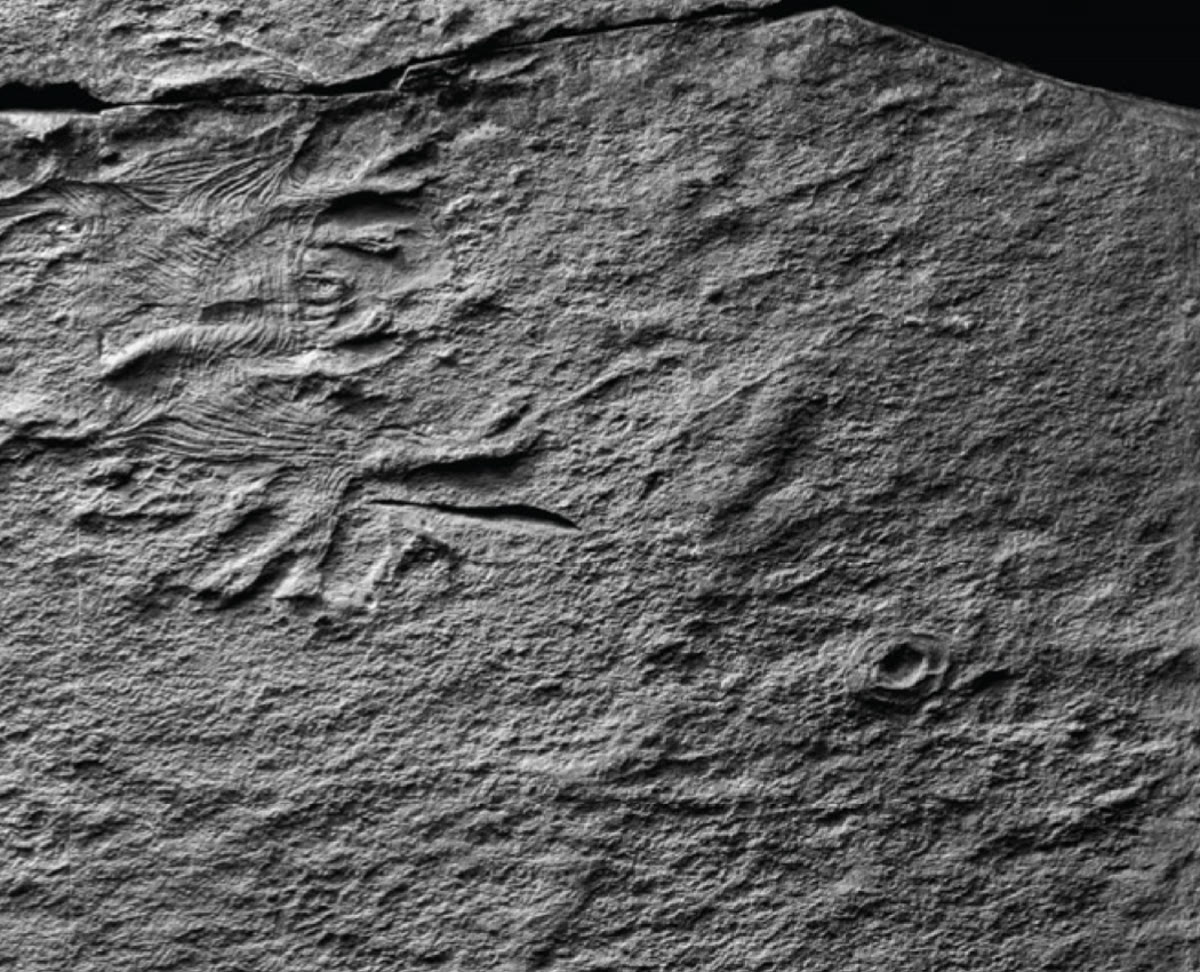
Haootia quadriformis matters because it makes one of the oldest animal claims look material before it looks obvious. The fossil is not a skeleton, shell, tooth, or trackway. It is a faint, raised-and-sunken impression on a Newfoundland bedding plane, roughly 560 million years old, whose most important feature is a set of bundled fibres arranged around a broadly fourfold body plan.[1][2] That is a difficult kind of evidence. It asks the reader to slow down before using big words like muscle, animal, or cnidarian.
The excitement is understandable. The Ediacaran Period sits before the Cambrian radiation that made many animal body plans easier to recognize in the fossil record. Cambridge's institutional summary of the 2014 description put the problem neatly: researchers expected animals before the Cambrian, but many older fossils lack features that can be confidently assigned to animals.[2] Haootia was different because the preserved fibre bundles looked anatomical rather than merely ecological. They were not only traces of a body being present. They looked like parts of a body that could contract.
That is why the lead image uses the fossil itself. A reconstruction can make Haootia look like a tidy stalked jellyfish relative. The specimen photograph is less comfortable and more useful. It shows why the claim depends on reading relief, alignment, branching, decay, and comparison rather than recognizing a familiar animal at a glance.[4]
The fossil is a body-plan argument
The original description by Liu, Matthews, Menon, McIlroy, and Brasier named Haootia quadriformis as a new genus and species from Late Ediacaran strata in Newfoundland and interpreted it as a muscular cnidarian-grade impression.[1] The key claim was not just that the fossil had a strange outline. It was that the body impression preserved bundles of fibres in a broadly fourfold arrangement, a pattern the authors compared with cnidarian musculature.[1]
That matters because many Ediacaran fossils are interpreted through overall shape, attachment structures, surface texture, or ecological position. Haootia adds a more intimate level of anatomy. If the fibres are correctly interpreted as muscle tissue, then the fossil records a body that had internal organization for controlled movement. It becomes evidence for eumetazoan-grade tissue before the Cambrian made animal anatomy more common and easier to classify.[1][2]
The scale also keeps the argument grounded. The fossil is not a hidden giant. The 2024 redescription identifies the holotype as specimen NFM F-994 at The Rooms Provincial Museum in St. John's, Newfoundland, with a plastotype at the Oxford University Museum of Natural History.[4] In other words, the animal's scientific weight rests on a specific slab, a specific cast history, and a small set of comparable material, not on a broad fossil herd.
Muscle is powerful evidence, but not magic
The phrase "earliest muscle" can sound as if the fossil settles early animal evolution by itself. It does not. The better reading is narrower: Haootia supplies rare body-fossil evidence that structures interpretable as muscular fibres existed in an Ediacaran organism.[1][3] That is strong, but it remains an interpretation of preserved morphology.
The 2015 Proceedings B reply, indexed by PubMed, is useful because its title itself keeps the pressure on the word "possible": "The arrangement of possible muscle fibres in the Ediacaran taxon Haootia quadriformis."[3] The authors defended the muscle interpretation, but the cautious phrasing is part of the scientific value. Fossil fibres are not living histology. They are patterns of preservation that must survive alternative explanations: sedimentary texture, microbial overprint, decay distortion, unrelated organic structures, or misleading lighting.
This is where the image becomes more than decoration. The fossil does not shout. The fibre bundles are visible because light, surface relief, and orientation make them readable. A reader looking at the photograph should not feel tricked by how faint the evidence is. The faintness is the point. Ediacaran paleontology often works at this threshold, where a body plan has to be separated from the rock surface that preserved it.
Fourfold symmetry made the cnidarian case plausible
The cnidarian comparison was attractive because Haootia seemed to combine fibre bundles with a tetraradial organization. Cnidarians include jellyfish, corals, anemones, and their relatives; many have body plans built around radial symmetry rather than the bilateral layout familiar from vertebrates, arthropods, and worms. The 2014 paper therefore did not merely say "this has fibres." It argued that the fibres were arranged in a way consistent with a cnidarian-grade animal.[1]
That comparison has consequences. If Haootia is close to cnidarians, then it is not just an Ediacaran oddity with muscle-like structures. It becomes part of the early record of animals with organized tissues, near a lineage whose living members can help interpret radial body architecture and contractile systems.[1][4]
The risk is that comparison can harden too quickly into identity. The 2024 paper by McIlroy and colleagues revisited Haootia alongside a new Ediacaran cnidarian, Mamsetia manunis, and argued for a more specific crown-group cnidarian reading, including a staurozoan comparison.[4] That is a sharper placement than the original public shorthand, but it also shows that the fossil did not stop changing scientifically once it was named. The best label came through re-examining the type material, reconsidering muscle groups, comparing modern staurozoans, and separating what the fossil preserves from what earlier diagrams made tempting.[4]
The disc problem keeps the animal from becoming too neat
One of the most useful parts of the 2024 redescription is its resistance to an overly tidy reconstruction. Earlier readings associated the holotype with a large disc-like structure, which could suggest a basal attachment. McIlroy and colleagues questioned whether there is reliable evidence for a direct biological association between the Haootia body and that holdfast-like disc.[4] That sounds like a small technical point, but it changes the animal.
If the disc is not confidently part of the organism, then Haootia cannot simply be drawn as a fixed stalked form attached to a large base. The authors instead considered a mobile epibenthic mode of life, partly by comparison with staurozoans.[4] That is a more dynamic possibility: an animal on or near the seafloor, with muscular arms or tentacular structures that may have helped position the body, rather than a passive emblem pinned to the substrate.
This is why close reading matters. A fossil can preserve two things near each other without proving they belonged to one organism. In Ediacaran bedding-plane assemblages, proximity can reflect life position, decay, transport, microbial surfaces, or later splitting of the rock. The disc problem forces the article to keep anatomy and association separate. The fibres may be powerful evidence for muscle. The disc is a different evidentiary question.
What Haootia can carry
The secure claim is already enough: Haootia quadriformis is an Ediacaran Newfoundland fossil whose fibre bundles and fourfold body plan support a serious interpretation as an early muscular cnidarian-grade animal, later sharpened by comparison with staurozoans.[1][3][4] That makes it one of the most important small fossils for understanding how pre-Cambrian animal bodies became anatomically legible.
The boundary is equally important. Haootia does not prove that every ambiguous Ediacaran form was an animal. It does not give a complete origin story for muscle. It does not make the Cambrian radiation disappear as a major fossil-record event. It gives one unusually anatomical datapoint before that event: a body impression in which fibres, symmetry, preservation, and comparison line up strongly enough to make muscle visible, but not so neatly that interpretation can stop.[1][2][4]
That is the real value of the fossil. It lets early animal evolution be concrete without becoming simple. The photograph shows a difficult surface; the papers show why that surface matters. Haootia is not the moment animals suddenly become obvious. It is the moment one Ediacaran body becomes readable enough to argue with.
Sources
- Alexander G. Liu et al., "Haootia quadriformis n. gen., n. sp., interpreted as a muscular cnidarian impression from the Late Ediacaran period (approx. 560 Ma)," Proceedings of the Royal Society B (2014), Cambridge repository record.
- University of Cambridge, "Animals first flex their muscles" (2014) - institutional summary of the discovery, Ediacaran context, and muscle-evidence claim.
- Alexander G. Liu et al., "The arrangement of possible muscle fibres in the Ediacaran taxon Haootia quadriformis," Proceedings of the Royal Society B (2015), PubMed record.
- Duncan McIlroy et al., "The Palaeobiology of Two Crown Group Cnidarians: Haootia quadriformis and Mamsetia manunis gen. et sp. nov. from the Ediacaran of Newfoundland, Canada," Life 14, no. 9 (2024), PMC full text and specimen-image source.