Modern sirenians look so fully committed to water that it is easy to misremember the transition as a neat swap: legs disappear, flippers arrive, and sea cows slide into the same broad story as whales.[1][4] The fossil record supports a slower and more peculiar sequence. Early sirenians did not begin as streamlined marine grazers with the modern dugong or manatee silhouette already in view. They entered shallow water carrying a body that still knew how to stand on land, while other parts of the skeleton were already shifting toward aquatic weight, feeding, and buoyancy control.[1][2][4]
That is why the lineage is worth reading through Pezosiren and Sobrarbesiren rather than through the modern endpoint alone. Daryl Domning's 2001 Nature paper on Pezosiren portelli gave sirenians an early Eocene skeleton with four well-developed legs, a multivertebral sacrum, and a strong sacroiliac articulation able to support the body out of water.[1] The 2018 Scientific Reports paper on Sobrarbesiren cardieli then narrowed the middle of the story by describing a western European form with functional pelvic girdle and hind limbs, yet a body already carrying stronger aquatic commitments.[2] Between them, these fossils show that sea-cow evolution did not race straight from land mammal to fluke-driven browser. It moved through a ballast-heavy amphibious phase in which shallow-water life was becoming the center of gravity before land competence had fully vanished.[1][2][4]
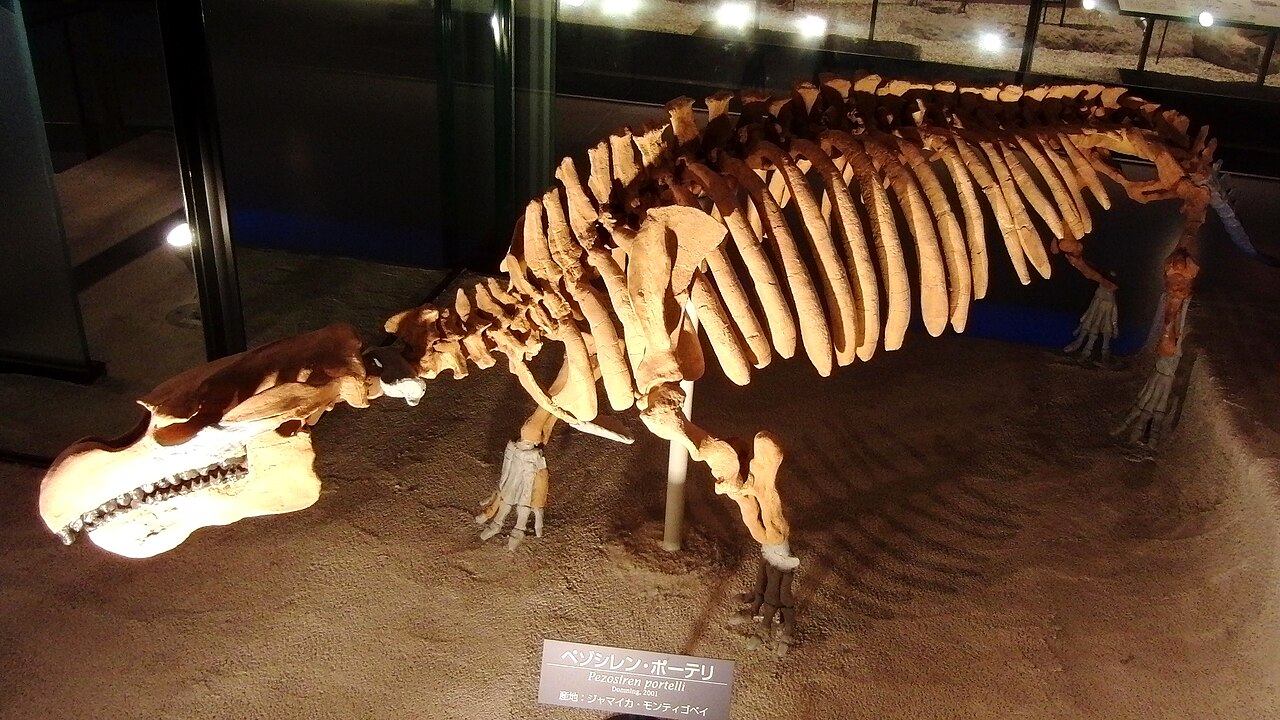
Image context: the cover uses a real museum photograph of the mounted Pezosiren portelli skeleton from Wikimedia Commons. It belongs here because this article depends on keeping an early sirenian's whole frame in view. The long trunk, grounded pelvis, and four limbs make the lineage legible before later sea-cow anatomy edits those elements away.[5]
1) Pezosiren proves that sirenian identity came before full aquatic shape
The most clarifying fact about Pezosiren is that it was not a vague "almost sea cow."[1] Domning described a new Jamaican sirenian represented by nearly the entire skeleton and emphasized that the animal was fully capable of locomotion on land.[1] Four well-developed legs, a multivertebral sacrum, and a strong sacroiliac articulation put real weight-bearing function into the hindquarters.[1] At the same time, the paper did not return sirenians to a dry-land origin story. Aquatic adaptations were already strong enough that Domning judged the animal to have spent most of its time in the water.[1]
That combination matters because it rearranges the order of the evolutionary argument. A sirenian did not first need to look like a modern sea cow before it counted as one. The clade entered the fossil record as an animal that could still stand and move on land while already participating in an aquatic life pattern.[1] In that sense, sirenian history begins with overlap rather than replacement. The feet remain useful. The water is already central.
Domning also suggested that, like primitive cetaceans, Pezosiren probably swam by spinal extension with simultaneous pelvic paddling, unlike later sirenians whose hind limbs disappeared and whose tails took over as the main propulsive organ.[1] That point is easy to miss, but it is one of the best guides to the lineage. Early sea cows were not simply waiting for a modern tail. They were solving aquatic movement with a body that still retained a working pelvis and hind limb.
2) The first big sirenian commitment was ballast, not speed
This is where sirenians begin to look unlike whales. The USGS life-history overview emphasizes that living sirenians carry dense bone for ballast and a body system tuned to maintaining horizontal posture while feeding in the water column.[4] That functional package helps explain why sirenian transition does not read as a pursuit-predator story. The line was moving toward slow, controlled, shallow-water herbivory, where holding position and managing buoyancy mattered as much as raw locomotor speed.[4]
The 2018 Sobrarbesiren paper sharpens that reading by describing aquatic features alongside retained land competence.[2] The animal combined terrestrially functional hind limbs with pachyosteosclerotic bones, retracted nares, and a cranial package more aquatic than that of the older Jamaican prorastomids.[2] In other words, the skeleton shows weight and feeding commitments accumulating before the classic sea-cow silhouette is complete.
That makes "ballast-first" a better phrase than "flipper-first." A lineage adapting to shallow seagrass worlds needed to stay down, feed steadily, and move between aquatic patches with control.[2][4] Dense ribs and heavy bones do not produce a dramatic outline in the way a fluke or flipper does, but they help explain why sirenians could become successful benthic herbivores. The route into water here was not built around chase. It was built around stability.
3) Sobrarbesiren narrows the middle of the transition
Sobrarbesiren cardieli matters because it prevents the transition from collapsing into a simple before-and-after picture. The Scientific Reports study calls it the first adequately known quadrupedal sirenian from Eurasia and places it as a transitional stage between amphibious quadrupedal prorastomids and more aquatic quadrupedal protosirenids.[2] The animal preserved a pelvis with a large femoral acetabulum, a well-formed fibula, and hind-limb evidence consistent with a mobile foot.[2] Those are not leftovers without function. They imply an animal that could still use the hind limb actively in walking, swimming, or both.[2]
Yet the same paper also stresses the aquatic side of the body. The unfused sacrum, rod-like ilium, relatively short femur and fibula, retracted nares, and heavy bones together suggest a lifestyle centered in shallow water, with the authors interpreting Sobrarbesiren as amphibious and capable of moving over land between water masses.[2] That bounded conclusion is exactly what makes the fossil valuable. It does not force a false choice between "land mammal" and "sea cow." It shows a genuine middle body plan.
This is the point at which sirenian evolution becomes especially legible. Pezosiren shows that the lineage began its aquatic turn without giving up terrestrial support.[1] Sobrarbesiren shows that once shallow-water specialization deepened, the hind limb could remain meaningful even as the rest of the body grew heavier, shorter-limbed, and more aquatic in emphasis.[2] The transition was not a cliff. It was a graded structural reallocation.
4) The wider Eocene record shows sea cows spreading through seagrass worlds
The broader map matters because early sirenians were not isolated curiosities. The Smithsonian review of North American Eocene sea cows describes a record stretching across multiple middle Eocene localities and emphasizes that North American material from Florida and North Carolina is referable to Protosiren species.[3] That distribution, together with the wider world record summarized there, suggested a homogeneous middle Eocene Tethyan fauna and made sirenians a useful guide to the former distribution of seagrasses.[3]
That is a deeper point than a simple list of fossil places. Once sirenians appear in multiple shallow marine settings across the Eocene, the lineage stops looking like an accident of one island or one basin.[1][3] It looks like a marine-herbivore experiment finding ecological room around warm coastal systems. The heavy bones, feeding adaptations, and later propulsion changes belong to that setting. Sea cows were not just entering water in the abstract. They were entering a seagrass geography.[3][4]
The safe conclusion is therefore strong enough without overreach. The fossil record does not let us script the exact gait of every early sirenian on shore or recover the full stroke cycle of each transitional form.[1][2] It does let us say that sirenian evolution into water followed a distinctive order. First came an amphibious body still able to stand and move on land.[1] Then came a stronger shallow-water package of ballast, retracted nares, and more aquatic trunk-and-limb proportions.[2][4] Only later did the lineage settle into the fully aquatic sea-cow design that makes the early stages seem surprising in retrospect.[1][3]
That is why these fossils matter. They keep the route visible. Before sea cows had the modern answer, they had a workable intermediate one: feet, supported hips, heavy ribs, and a body learning how to stay in the shallows long enough for land to stop being home.
Sources
- Daryl P. Domning, "The earliest known fully quadrupedal sirenian," Nature 413 (2001).
- Elia Diaz-Berenguer, Rodolfo Delclòs, Alejandro Badiola, and colleagues, "First adequately-known quadrupedal sirenian from Eurasia (Eocene, Bay of Biscay, Huesca, northeastern Spain)," Scientific Reports 8 (2018).
- Daryl P. Domning, Gary S. Morgan, and Clayton E. Ray, North American Eocene Sea Cows (Mammalia: Sirenia), Smithsonian Contributions to Paleobiology 52 (1982).
- Robert K. Bonde, "Sirenian life history," U.S. Geological Survey publication page for a 2018 book chapter on sirenian adaptations, feeding, and life history.
- Wikimedia Commons file page for the photographed Pezosiren portelli skeletal mount used as the article image.