
The American Museum of Natural History's short film on foraminifera begins with wonder, and that is the right entrance. Under magnification, the shells look ornate, architectural, almost excessive for something that could disappear on a fingertip.[1][2] But the deeper reason to watch the video is stricter than beauty. It shows how paleontology often works when the most important fossils are not giant skeletons or dramatic trackways. Sometimes the decisive archive comes in dust-sized shells that accumulate by the millions on the seafloor and later become a readable record of ocean change.[1][4][5]
Foraminifera, or forams, are single-celled organisms with tests that can persist in marine sediments for extraordinary spans of time.[2][4] The Smithsonian Ocean overview notes that their fossil record extends for more than 500 million years, and that their shells are used to study Earth's changing climate.[4] NASA's paleoclimatology explainer makes the same point from the side of method: in deep-sea cores, some of the most valuable fossils are foraminifera because oxygen isotopes and species turnover in those shells help reconstruct past water temperature, ice volume, and circulation.[5] That combination is what gives the video its real weight. It is not merely a museum vignette about tiny objects. It is a compact lesson in how microscopic fossils become one of the long baselines for climate history.
What the AMNH film understands especially well is that this archive does not interpret itself.[1][2][3] Tiny shells only become climate evidence when institutions keep their taxonomy stable, their locality data attached, and their physical specimens accessible to later researchers. The Museum's microfossil conservation project page makes that practical point explicit: the collection matters because of its importance to foraminifera taxonomy, its broad geographic and stratigraphic range, and its usefulness for paleoceanographic and paleoclimate studies.[3] In other words, the video is really about infrastructure. Deep time becomes legible only after curators, interns, scanners, and databases do a great deal of quiet work.
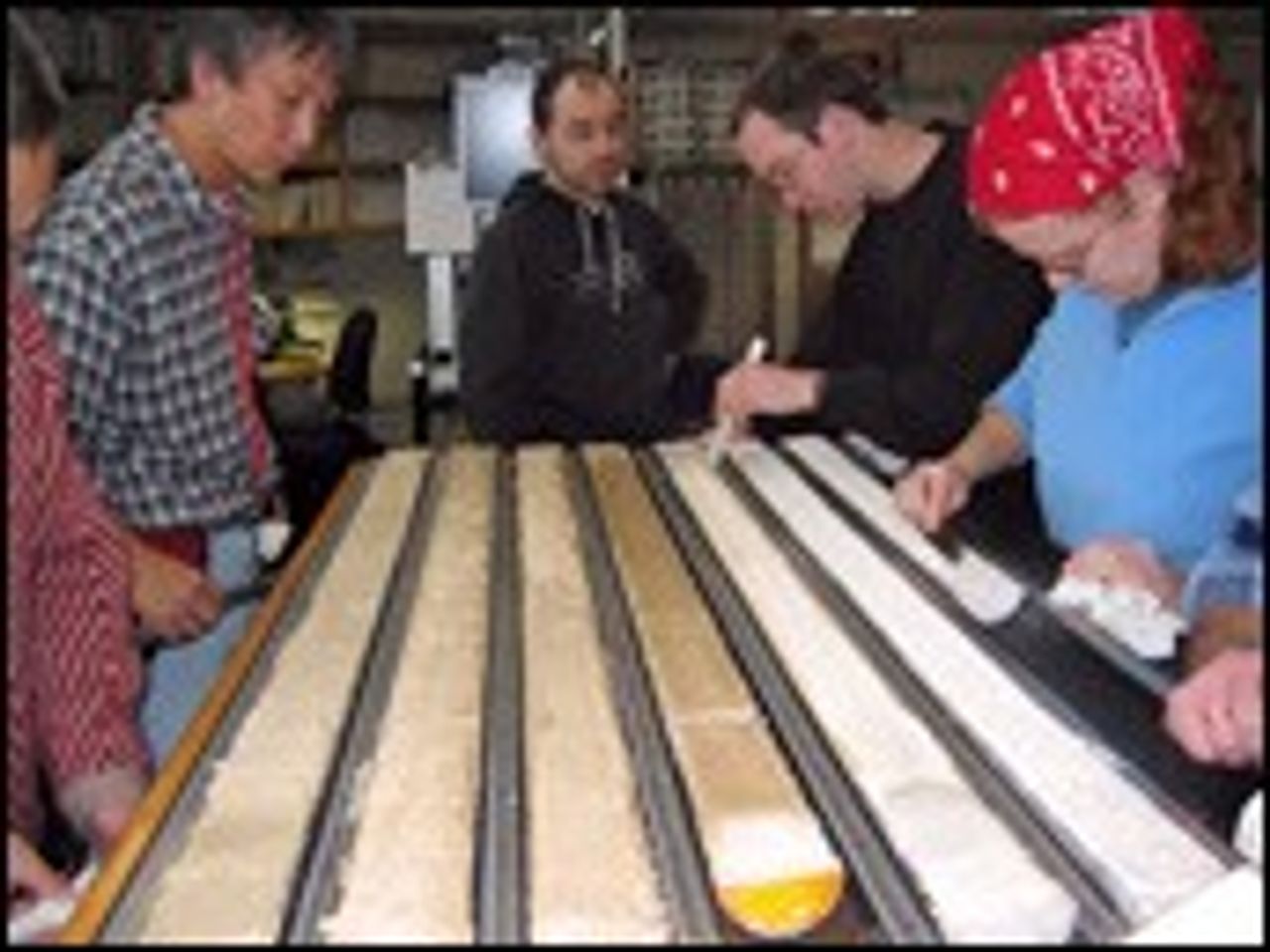
Image context: the cover uses a real NASA Earth Observatory photograph of researchers working over ocean sediment-core sections.[5] It belongs here because the article's main claim depends on that scale jump: individual foraminiferal shells are tiny, but their scientific force comes from being gathered, labeled, sampled, and compared inside long core archives that preserve ocean history layer by layer.
Around 0:15, aesthetics are the hook, but scale is the real argument
The opening lines dwell on fascination under the microscope, and that is not ornamental.[1] The shells are striking because they compress complexity into a nearly invisible size class. Later in the film, one speaker emphasizes that something the size of a grain of rice can contain a hundred chambers that are not obvious at first glance.[1] That is the first important correction the video makes. Small does not mean simple. In paleontology, the tiniest specimens often carry the densest repeatable information, because they occur in enormous numbers and can be tracked across layered sediments far more continuously than rare large vertebrate bones.
The AMNH companion page frames this well by saying the fossils could be mistaken for flecks of dust even though they hold major insights about Earth's climate.[2] That sentence is the article's hinge. A huge dinosaur specimen can transform one anatomical debate; a microfossil group can underpin a whole climatic chronology. The point is not that one kind of fossil is better than the other. It is that forams operate at a different evidentiary scale. Their abundance and continuity make them especially powerful for correlation through time and across oceans.[3][4][5]
Around 1:50, the collection history matters because climate evidence depends on curation
Midway through the video, Ellen Thomas and Neil Landman shift the focus from the shells themselves to the AMNH collection that houses them.[1] One of the most useful remarks in the transcript is that the Museum was a major center of foram science in the mid-twentieth century.[1] The scientific implication is larger than institutional pride. Legacy collections preserve taxonomic decisions, type material, geographic breadth, and older sampling campaigns that current researchers would struggle to reproduce quickly or cheaply.
The Museum's conservation-and-digitization page pushes that point further.[3] It describes the collection as valuable not only for taxonomy but also for its wide geographic and stratigraphic coverage and its utility in paleoceanographic and paleoclimate work.[3] That wording matters because climate archives are only as strong as their metadata. A shell with no reliable label is a curiosity. A shell tied to a horizon, locality, and species concept can be slotted into a much larger history of ocean conditions. The video therefore treats rehousing as scientific maintenance, not storage housekeeping.[1][3]
Around 2:10, "environmental indicator" means shells can stand in for vanished oceans
When Landman says forams are sensitive indicators of environmental change, the film moves from museum craft to paleoclimate logic.[1] The Smithsonian Ocean page explains why this works: the shells of forams settle to the seafloor, persist in sedimentary archives, and can be used to study a changing planet.[4] NASA's deep-ocean explainer adds the geochemical side. Oxygen isotopes in foraminiferal shells help researchers infer temperature and ice-volume shifts, while changes in the kinds of forams present can signal different water masses or ecological conditions.[5]
That is why these fossils are more than tiny clocks. They are also tiny samplers. Each shell forms in a water column with a particular temperature, chemistry, and ecological structure. One shell by itself says little. Vast stacked populations, dated and compared through cores, become climate history. Zachos, Quinn, and Salamy's deep-sea isotope study is a good example of the scale jump: benthic foraminiferal isotope records help constrain the timing and magnitude of major cooling and glaciation at the Eocene-Oligocene transition.[6] The video does not need to rehearse that whole literature. It only needs to show the material basis of it. These are the shells from which those large climate narratives are built.[1][5][6]
Around 3:30 and after 4:30, rehousing and CT scanning turn fragility into usable evidence
The last third of the film is the strongest part because it shows how much technical mediation is required before a tiny fossil can circulate safely through research.[1] Bushra Hussaini describes rehousing slides, building a digital catalog, photographing specimens, and creating CT scans.[1] Shaun Mahmood then explains the physical difficulty of handling them: push too hard with a brush and a specimen can shatter.[1] This is the point at which fragility stops being a romantic detail and becomes a methodological limit.
CT scanning, as the video presents it, is not a futuristic add-on. It is a way of recovering structure without demanding destructive preparation.[1] The example of an externally eroded specimen whose internal architecture turned out to be beautiful after scanning is especially telling.[1] For climate work and taxonomy alike, internal chambers and wall structure can matter as much as outward silhouette. A shell that looks damaged to the eye may still preserve meaningful morphology in section or in volume. By making a three-dimensional model available for measurement and comparison, the Museum effectively enlarges both the object and the audience that can study it.[1][3]
That is the lasting value of this short film. It teaches that paleontology is not only the science of spectacular finds. It is also the science of disciplined custody over small, numerous, and easily overlooked remains. Foraminifera matter because they turn repetition into evidence. Their shells accumulate in deep time, museums stabilize and catalog them, and climate researchers read them as a layered archive of oceans that no longer exist. The video begins with beauty under a microscope and ends, correctly, with infrastructure. That is the path by which dust becomes climate history.
Sources
- American Museum of Natural History, "The Tiniest Fossils - Shelf Life #6," YouTube video.
- American Museum of Natural History, "Foraminifera: Tiny Fossils & Climate Data."
- American Museum of Natural History, "Microfossil Conservation and Digitization."
- Smithsonian Ocean, "Foraminifera."
- NASA Science, "Paleoclimatology: A Record from the Deep."
- James C. Zachos, Terrence M. Quinn, and Karen A. Salamy, "High-Resolution Deep-Sea Foraminiferal Stable Isotope Records of the Eocene-Oligocene Climate Transition" (1996).