Eurypterids are usually introduced through size, claws, and the nickname "sea scorpions."[1] That framing is vivid and incomplete. The harder and more revealing problem sits lower in the body. How did these Paleozoic chelicerates breathe, and what does that answer say about how close they came to life out of water?[1][2][3] Once that question is asked, eurypterids stop looking like a generic aquatic prelude to arachnids and start looking like a boundary case in their own right.
That boundary matters because the fossil record does not offer a clean yes-or-no terrestrial verdict. It offers pieces: lamellae, ventral plates, CT data from an exceptionally preserved Carboniferous specimen, and trackways that show some eurypterids could move on land.[2][3][4][5] The strongest reading in 2026 is therefore narrow. Eurypterids were not simply horseshoe crabs with bigger claws, and they were not fully terrestrial arachnids in waiting. Their respiratory anatomy and trace-fossil record fit a more disciplined claim: at least some forms were amphibious enough to breathe during excursions onto land, while still remaining creatures whose main story was written in water.[2][3][4][5]
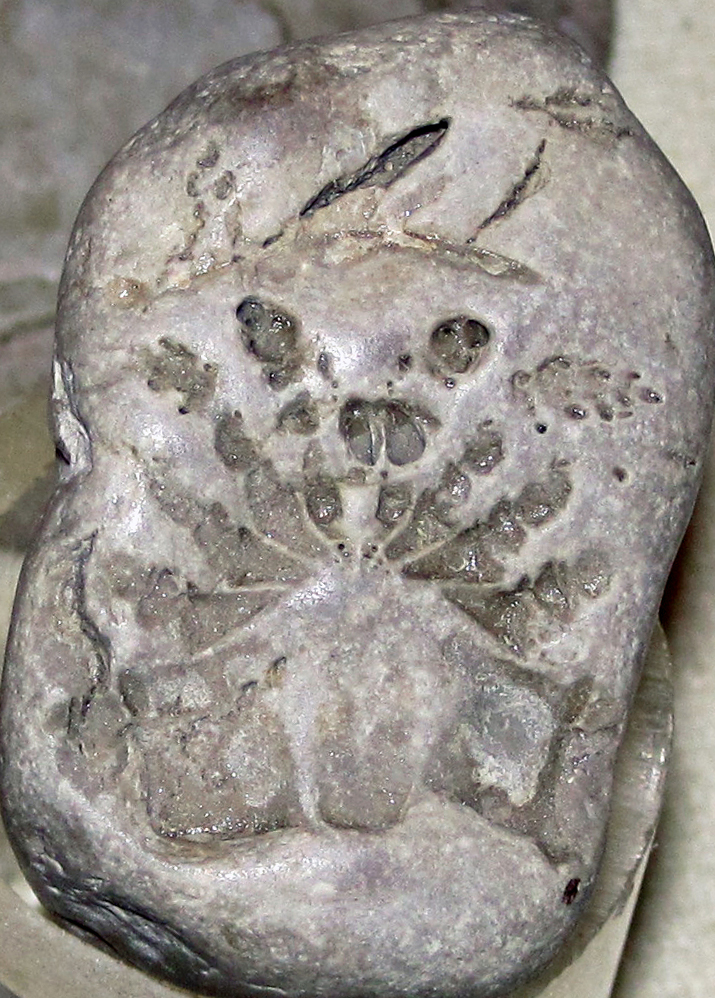
Image context: the lead image uses a real fossil photograph of a eurypterid ventral head and appendages from Ohio. It belongs here because the article depends on keeping the anatomy close to the slab surface. Respiratory structures are inferred from cuticle, plate relationships, and internal comparisons, not from the popular dorsal silhouette alone.[6]
1) The old question was never just "gills or lungs?"
The modern discussion still pivots on the 1995 paper by Phillip Manning and Jason Dunlop, because it refused a simplistic either-or choice.[2] Working from cuticle fragments from the upper Silurian of south Shropshire together with whole-body evidence, they argued that eurypterids had a dual respiratory system: lamellate book gills plus an additional structure, the Kiemenplatten, on the true sternite forming the roof of the branchial chamber.[2] That mattered immediately because it changed the problem from a search for one perfect analogue into a search for functional division.
The key move in that paper was methodological. Manning and Dunlop did not claim that every part of the system behaved like a modern book lung, nor that eurypterids had already solved full terrestrial respiration in the arachnid manner.[2] Instead, they argued that the Kiemenplatten could have acted as an accessory aerial respiratory organ, analogous in broad function to the branchial lungs of certain terrestrial crabs, while cuticular projections may have helped retain moisture during excursions onto land.[2] That is a bounded claim, and it remains useful precisely because it is bounded.
The article is still worth reading because it keeps the anatomy tied to habitat discipline. A structure that helps an animal survive short subaerial intervals is not the same as evidence for a permanently terrestrial lifestyle. In paleontology, those are often collapsed into one another far too quickly. The 1995 paper gave eurypterid respiration a more careful vocabulary: mixed system, moisture dependence, excursions rather than emancipation.[2]
2) The 2020 CT result made the amphibious reading much harder to dismiss
For years, the strongest counterweight to the older respiratory interpretation was preservational caution. Eurypterids are often flattened, and soft or fine cuticular details can be easy to overread. That is why the 2020 Current Biology paper on Adelophthalmus pyrrhae mattered so much.[3] The authors used computed tomography on an exceptionally preserved 340-million-year-old specimen and identified pillar-like trabeculae on the dorsal surface of each gill lamella, structures they interpreted as evidence that the animal was capable of subaerial breathing.[3]
That does not mean the case suddenly became unlimited. The specimen is one taxon, one moment, and one preservational gift.[3][4] But it did something powerful for the broader argument. It moved the discussion away from surface analogy alone and toward internal structural evidence. Jason Dunlop's accompanying Current Biology dispatch put the implication clearly: the respiratory organs of this fossil eurypterid resemble arachnid book lungs closely enough to support the hypothesis that eurypterids, and perhaps arachnid ancestors, were amphibious.[4]
The reason this matters is not that it lets us rewrite every eurypterid as a land animal. It matters because it strengthens the middle category. The respiratory system no longer looks like a vague suggestion that someone once made by comparing fossil plates to living chelicerates. It looks like a real anatomical pathway by which at least some eurypterids could continue gas exchange out of water for meaningful periods.[2][3][4]
3) Trackways matter because breathing claims need behavior on the ground
Respiratory structures alone do not settle lifestyle. An animal may be able to tolerate air and still spend nearly all of its life in water. That is why the trackway evidence belongs in the same conversation. In 2005, Martin Whyte described a gigantic Carboniferous arthropod trackway from Scotland and identified it as the first record of locomotion on land for a species of Hibbertopterus.[5] The trackway suggested a huge eurypterid using its walking limbs across land and surviving out of water at a time when early tetrapods were themselves negotiating the water-land boundary.[5]
This is exactly the kind of evidence that improves a respiratory debate. The 1995 work proposed structures compatible with short terrestrial excursions.[2] The 2020 CT study strengthened the case that at least one eurypterid possessed gill anatomy capable of subaerial function.[3][4] The 2005 trackway showed that a giant eurypterid could actually move on land.[5] None of these pieces alone proves a fully terrestrial ecology. Together they make a narrower claim very hard to escape: eurypterids were not trapped by a strictly water-only respiratory regime.
The behavioral caution still matters. A trackway is an event, not a census of daily life. It tells us what an animal did at least once under a particular substrate and moisture regime.[5] The right reading is therefore ecological, not triumphalist. Eurypterids could leave the water. The evidence does not say they had stopped needing it.
4) The best conclusion is amphibious tolerance, not terrestrial victory
That distinction is the real payoff of the whole topic. Yale Peabody's overview reminds readers that eurypterids were a diverse, long-lived chelicerate group distributed across many habitats over more than 200 million years.[1] Diversity alone should make us skeptical of one universal lifestyle label. Some forms were open-water swimmers, some were benthic or marginal, and not every respiratory solution had to be identical across the order.[1][4]
The most defensible 2026 view therefore has three layers. First, the older anatomical work remains valuable because it argued for a dual respiratory interpretation instead of a false gill-versus-lung binary.[2] Second, the 2020 CT evidence gives that older idea new support by identifying trabeculae consistent with subaerial breathing in Adelophthalmus.[3][4] Third, trace fossils such as the Scottish Hibbertopterus trackway show that leaving water was not just anatomically imaginable but behaviorally real.[5]
What this does not justify is the easy movie version in which eurypterids become fully land-dwelling proto-arachnids marching triumphantly onto shore. The better picture is stranger and more useful. These animals occupied a physiological middle ground. They could carry water's architecture into air long enough to cross, forage, or reposition, yet their bodies and ecological range still belonged primarily to aquatic worlds.[1][2][3][5]
That is why eurypterid breathing matters. It clarifies that one of the major chelicerate stories was not written as a clean break. The path toward arachnid-style life was explored through mixed structures, partial tolerances, and repeated contact with shore. Eurypterids are strongest not as giant curiosities, but as fossils that keep the amphibious boundary visible.
Sources
- Yale Peabody Museum, "Eurypterids, Giant Ancient Sea Scorpions" - official overview of eurypterid relationships, diversity, size range, and habitat breadth.
- Phillip L. Manning and Jason A. Dunlop, "The respiratory organs of eurypterids" - 1995 Palaeontology article page describing a dual respiratory system with lamellate book gills and Kiemenplatten.
- James C. Lamsdell, Simon J. Braddy, Kenneth McNamara, and O. Erik Tetlie, "Air Breathing in an Exceptionally Preserved 340-Million-Year-Old Sea Scorpion" - PubMed record for the 2020 Current Biology paper on trabeculae and subaerial breathing.
- Jason A. Dunlop, "Evolution: A Breath of Fresh Air for Eurypterids" - PubMed record for the 2020 Current Biology dispatch interpreting the CT evidence in an amphibious chelicerate context.
- Martin A. Whyte, "A gigantic fossil arthropod trackway" - 2005 Nature report on the first land locomotion record for a species of Hibbertopterus.
- Wikimedia Commons file page for the lead image, showing a eurypterid ventral head with appendages from South Bass Island, Ohio.