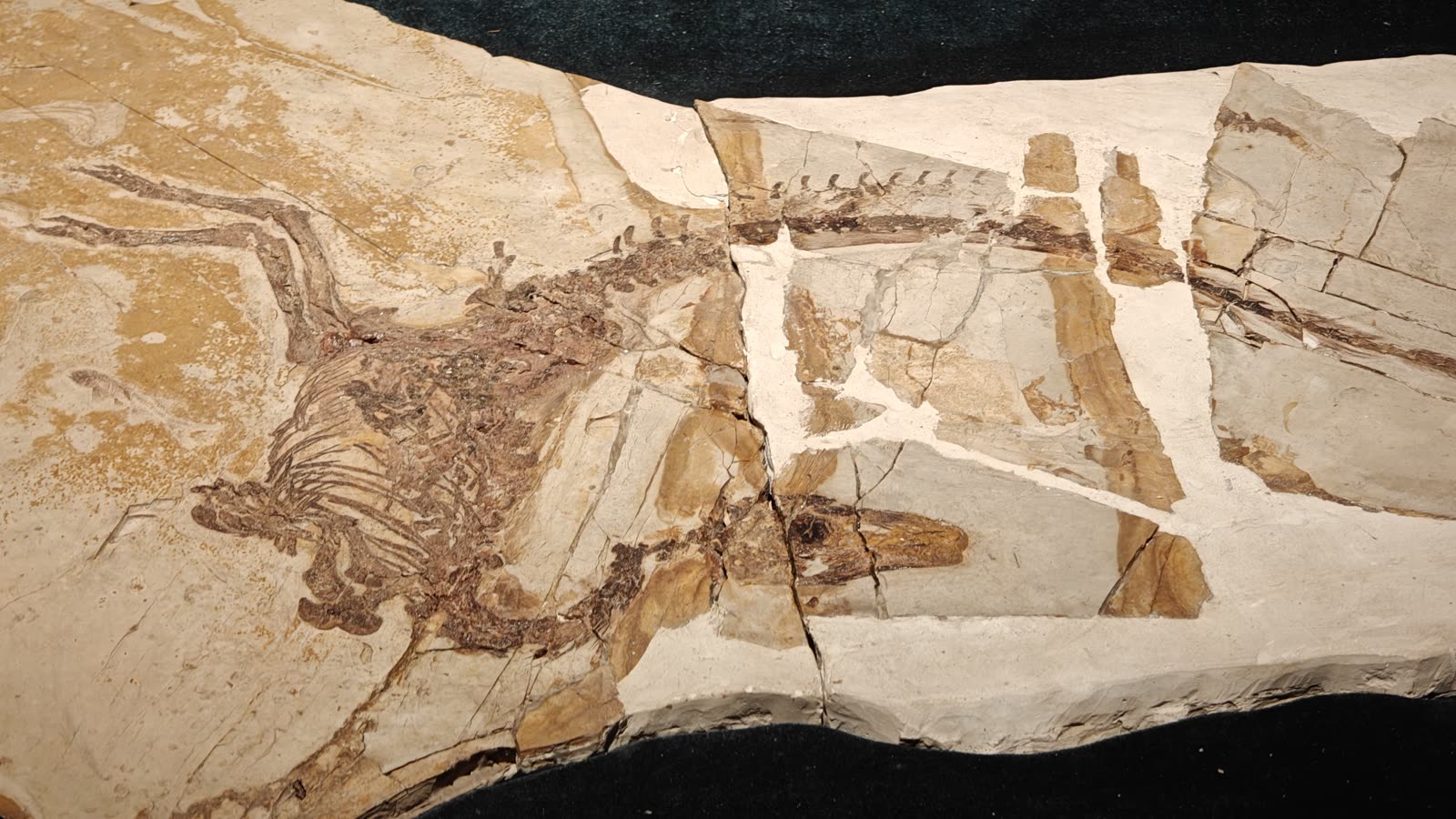
Most summaries of Sinosauropteryx still flatten the fossil into a slogan: first feathered dinosaur, fuzzy dinosaur, proof that birds are dinosaurs. Each phrase catches part of the story and misses the more useful paleontological lesson. The real importance of Sinosauropteryx is not that it handed researchers a fully modern bird plumage deep in the Early Cretaceous. Its importance is that it changed the evidentiary threshold for what a non-avian dinosaur covering could look like in the fossil record.[1][2]
That shift matters because the argument was never only about one small theropod from Liaoning. It was about burden of proof. Before Sinosauropteryx, a filament halo around a dinosaur body could be dismissed more easily as preservational mess, degraded collagen, or preparation artifact. After the Sinosauropteryx material and its later analysis, that dismissal became much harder to sustain across the specimen as a whole.[1][2][3]
Image context: the cover image shows a Sinosauropteryx fossil on display. It is used here as a direct visual anchor for the specimen-centered argument in this article: the anatomy matters, but so does the patterned halo of preserved body covering around it.[5]
1) What the 1998 find actually established
The 1998 Nature paper described an exceptionally preserved small compsognathid theropod from the Yixian Formation of Liaoning, China, with a distinct fringe of filamentous integumentary structures extending beyond the skeleton.[1] The key point is easy to understate. The paper did not claim that a fully modern flight-feather system had suddenly appeared on a ground-running dinosaur. What it established was more disciplined and, for paleontology, more disruptive: a non-avian theropod body could preserve extensive filamentous covering that tracked the body outline rather than random sediment noise.[1]
That distinction is the center of the close reading. If readers treat Sinosauropteryx as a headline about "the first feathered dinosaur," the next decades of argument can look like endless semantic cleanup. If they read the fossil as an evidentiary event, the later literature becomes much clearer. The question was not whether this animal had pennaceous wings. The question was whether the fossil record had now crossed a line where dinosaur integument had to be modeled as a real anatomical dataset.[1][2]
The original paper also anchored the specimen in a broader moment: the Jehol biota had already begun showing that soft-tissue and fine-structure preservation in northeastern China could preserve signals that many classic dinosaur localities rarely offered.[1] Sinosauropteryx became important because it was small enough, well preserved enough, and visually legible enough to force that fact into the center of the dinosaur-feather discussion.
2) Why the 2001 distribution paper mattered more than popular memory admits
The 2001 paper by Currie and Chen strengthened the case by focusing on the distribution of the integumentary structures across the body.[2] This was a critical move. A vague halo can always invite vague objections. A patterned distribution, tied to specific anatomical regions and reproduced across the specimen in a coherent way, is much harder to wave away.[2]
That paper argued that the structures were not random decay fringes and were not composed of collagen fibres from skin decomposition.[2] The force of the claim was anatomical. The filaments tracked where body covering should be and tapered away where body covering should end. In close-reading terms, the specimen stopped being a single dramatic photograph and became a map.
This is where Sinosauropteryx changed the field's argumentative geometry. Once the covering is read as a body-wide, anatomically patterned signal, debate shifts upward a level. Researchers can still argue about homology, branching, developmental pathway, and the distance between these filaments and later feather architectures. What becomes harder is the older fallback move of treating the whole envelope as a preservational accident.[2]
3) The collagen challenge narrowed the argument rather than restoring the old skepticism
The later collagen-based challenge is worth taking seriously because it tests whether the famous fossil has been oversold. Smithwick and colleagues addressed one version of that challenge directly in 2017, examining the claim that the structures in Sinosauropteryx had been misidentified as feathers when they were actually degraded collagen fibres.[3] Their conclusion was blunt: the collagen interpretation rested on low-quality images, problematic sampling, and features that could be explained by damage from preparation rather than true tissue identity.[3]
That does not mean every question about early dinosaur coverings was instantly closed. It means the argument got narrower and better. The live debate could still concern evolutionary relationship among filament types, preservational filtering, and how far one taxon can be generalized across Dinosauria. What it could no longer do, at least not convincingly, was reset Sinosauropteryx to square one as a famous mistake.[2][3]
This is an important boundary to keep intact. Sinosauropteryx did not prove that every non-avian dinosaur had the same covering, and it did not collapse all integumentary structures into a single developmental recipe. Its real contribution was to make filamentous covering in at least some non-avian theropods a serious anatomical proposition that later work had to refine, not erase.[1][2][3]
4) Color patterning added ecological resolution, not just visual spectacle
The 2017 Current Biology study added a new layer by reconstructing countershading and tail striping in Sinosauropteryx from preserved melanin-associated structures.[4] Popular retellings often reduce this to a charming image: the dinosaur had a banded tail and a masked face. The stronger paleontological point is ecological. Color patterning only becomes legible at this level if the integumentary signal is already real enough, structured enough, and well preserved enough to carry fine-grained pattern information.[4]
That is why the paper matters beyond paleoart. The authors argued for a complex environment with open habitats and patchy light, using the countershading model as part of the habitat interpretation.[4] In effect, Sinosauropteryx moved from a fossil that said "body coverings existed here" to a fossil that also carried clues about how that body was visually organized in life.[4]
The boundary remains important here as well. Color reconstruction does not turn the animal into a fully known visual object. It does, however, show how quickly the scientific value of the fossil expands once the integument is treated as evidence instead of noise.
5) A better way to read the fossil now
The strongest way to read Sinosauropteryx in 2026 is therefore cumulative.
The 1998 specimen established that a non-avian theropod from the Yixian Formation preserved a conspicuous filamentous body fringe.[1] The 2001 distribution study strengthened the case that those structures were genuine integumentary features organized across the anatomy, not random decomposition products.[2] The 2017 collagen rebuttal showed that one prominent attempt to reverse that conclusion did not hold up well under scrutiny.[3] The 2017 color-pattern study then demonstrated that the same fossil record could carry ecological and behavioral signal at a finer scale than the original headline ever suggested.[4]
Taken together, those steps explain why Sinosauropteryx mattered so much. It did not end every discussion about feather origins, and it did not deliver a finished modern plumage in one stroke. It shifted the field from "can this kind of signal be trusted at all?" to "what exactly is this signal, how is it distributed, and what else can it tell us?" That is a much more valuable scientific legacy than the slogan version.
Sources
- Qiang Ji, Shu-an Ji, "An exceptionally well-preserved theropod dinosaur from the Yixian Formation of China," Nature 393 (1998).
- Philip J. Currie, Pei-ji Chen, "Anatomy of Sinosauropteryx prima from Liaoning, northeastern China," Canadian Journal of Earth Sciences 38, no. 12 (2001) — includes the argument that the integumentary structures are not degraded collagen fibres.
- F. M. Smithwick et al., "On the purported presence of fossilized collagen fibres in an ichthyosaur and a theropod dinosaur," Palaeontology 60, no. 3 (2017).
- Jakob Vinther et al., "Countershading and stripes in the theropod dinosaur Sinosauropteryx reveal heterogeneous habitats in the Early Cretaceous Jehol Biota," Current Biology 27, no. 21 (2017).
- Wikimedia Commons file page for the Sinosauropteryx fossil photograph used as the article image.