Otodus megalodon is the most famous giant shark in paleontology, but fame has a way of flattening the evidence. Posters and documentaries usually hand readers a fully finished sea monster: fixed length, fixed silhouette, fixed prey list, fixed place in the ocean. The literature supports a more disciplined profile. Megalodon is secure as a gigantic macropredatory shark. It is much less secure as a single settled full-body shape.[1][3]
That asymmetry comes from the archive itself. The species is known primarily through teeth, and a surprising amount of what the public thinks it “knows” about the shark is really a chain of anatomical and ecological inference built outward from those teeth.[1][3] The right way to read megalodon is not as a solved giant, but as a teeth-first animal whose ecology is becoming clearer even while its exact outline remains model-heavy.
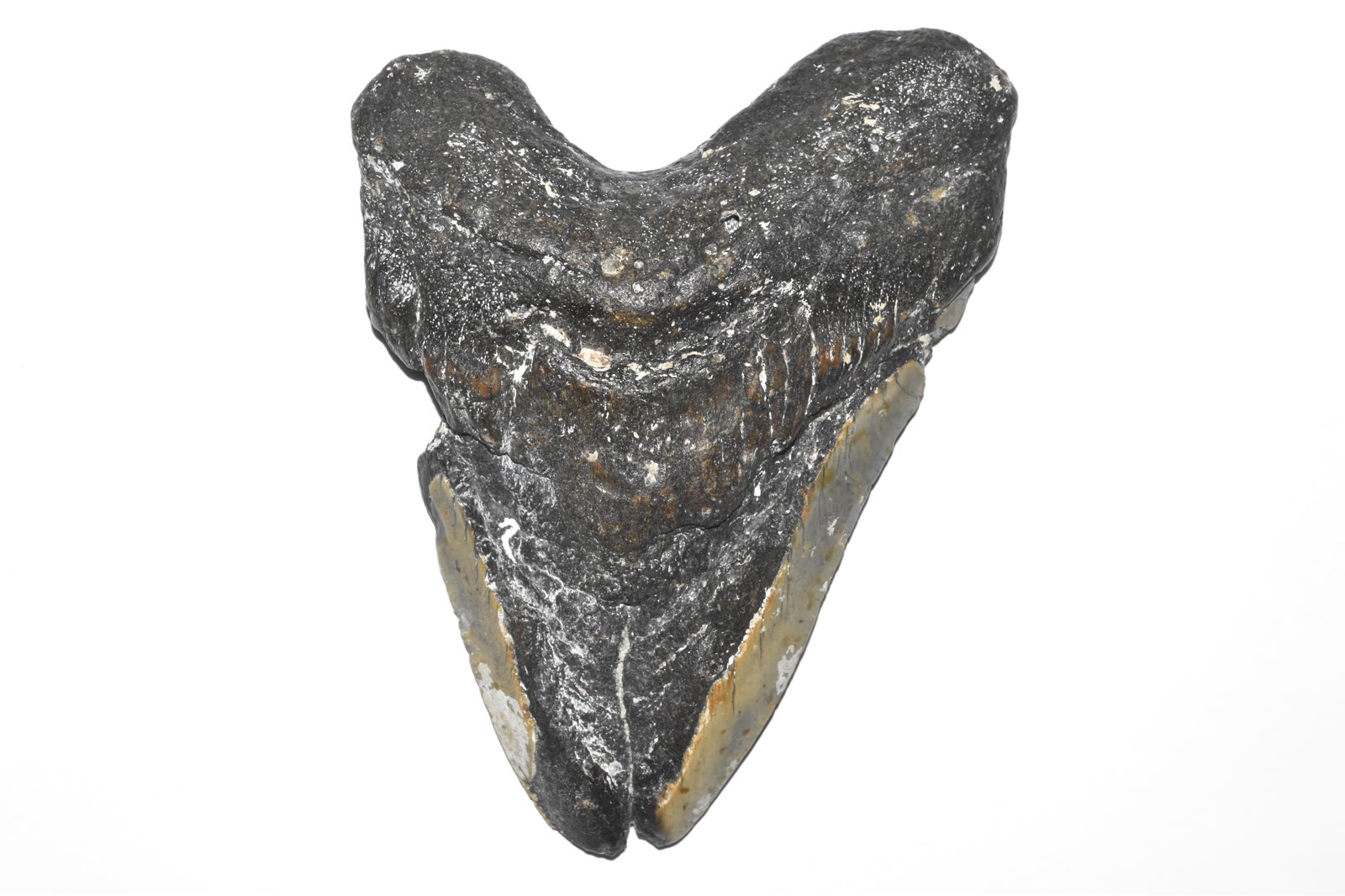
Image context: the cover image shows a fossilized Otodus megalodon tooth from South Carolina. It is used here because the tooth record is the real evidentiary foundation of almost every serious claim made about the animal's size, diet, and life history.[5]
1) The teeth are not a minor part of the story; they are the story's center
The first thing to keep in view is that megalodon did not leave paleontologists the kind of skeleton that would settle every body-form argument cleanly. As Cooper and colleagues note, the shark is known almost exclusively from fossilized teeth.[1] That matters because sharks are built largely from cartilage, and cartilage does not preserve with the reliability of bone.
This does not make the record weak. It makes it uneven. Teeth are extremely informative structures. They preserve shape, size, wear, serration pattern, and chemical signatures. They can be sampled across geologic time and across multiple basins. But they do not by themselves hand over an uncontested body plan.[1][3]
That is why megalodon should be read through a confidence map.
High confidence
- It was an enormous lamniform shark with cutting dentition built for large prey.[1][3]
- It occupied a very high trophic position in marine ecosystems.[3]
- It used coastal nursery grounds, at least in some regions and likely repeatedly through time.[2][4]
Lower confidence
- Exact maximum body length.
- Exact body mass.
- Precise fin proportions and cruising envelope for any one “definitive” reconstruction.[1]
The teeth support big conclusions. They do not support every dramatic conclusion equally well.
2) The body reconstructions are valuable, but they remain reconstructions
The strongest modern body-form paper in this source set is Cooper and colleagues' 2020 reconstruction study.[1] Its importance is methodological. Earlier popular estimates often leaned too hard on the great white shark as the single modern analogue. Cooper and coauthors widened the comparative frame to five ecologically and physiologically similar living lamniform sharks rather than one celebrity comparison.[1]
That shift made the argument more defensible. It also made the uncertainty easier to see. Their paper suggests that a 16 m megalodon would have had a head around 4.65 m long, a dorsal fin around 1.62 m tall, and a tail around 3.85 m high.[1] Those are useful anchors because they translate a giant length number into a whole-body geometry.
The boundary is just as important as the anchors. Those numbers describe a modeled animal, not a fully preserved one. They are constrained by tooth-based length estimates and by the choice of living analogues.[1] In other words, the reconstructions are good scientific tools for bounding plausibility. They should not be mistaken for direct photographs of the extinct shark's final silhouette.
That distinction is exactly where many megalodon summaries fail. The scientific literature is trying to tighten a parameter space. Popular culture keeps converting that parameter space into a single monster image.
3) The ecology is starting to look firmer than the silhouette
If body shape remains partly open, trophic position is now clearer than it used to be. McCormack and colleagues' 2022 Nature Communications paper is one of the strongest examples of how the tooth record can carry more than body-size estimates.[3] Their zinc-isotope work showed that fossil shark tooth enameloid can preserve dietary signal over deep time, making tooth chemistry a usable proxy for trophic level.[3]
That matters because it turns megalodon from a generic “top predator” into a more measurable ecological actor. The paper found that Otodus megalodon and early Pliocene great white sharks could occupy a similar mean trophic level in some sympatric settings.[3] That does not solve the shark's extinction in one move, but it does sharpen the ecological picture: megalodon was operating at the top of the marine food web, and in at least some intervals it shared that upper feeding space with another major lamniform predator.[3]
This is a useful correction to the usual cinematic framing. The interesting question is no longer “was it scary?” The better question is how a gigantic shark partitioned prey, habitat, and life history inside a crowded marine apex-predator system.
4) Nursery grounds make the life history harder to mythologize
The most human-scale evidence in the megalodon record comes from juveniles.
Pimiento and colleagues' 2010 Panama paper offered the first definitive evidence of an ancient megalodon nursery area in the late Miocene Gatun Formation.[4] The key result was not just that small teeth existed. The assemblage was dominated by very small teeth, and the authors argued that the site captured mostly juveniles and neonates, with estimated body lengths between 2 m and 10.5 m in a shallow, productive marine setting.[4]
Ten years later, Herraiz and colleagues widened the frame.[2] Instead of a single site argument, their 2020 Biology Letters paper compared population size-class structure across multiple formations and supported five potential nursery areas spanning from the middle Miocene to the Pliocene.[2] That is a major change in how the species should be imagined. Nursery use stops looking like a one-off local habit and starts looking like a recurring life-history strategy.[2][4]
This is where megalodon becomes more than a giant jawline. A shark that depends on suitable nursery grounds is not just large. It is ecologically organized. Its survival depends on shallow-water spaces that can hold vulnerable young through their earliest size classes.[2][4]
5) The strongest profile is narrower than the myth, and better because of it
Put the current evidence together and a sharper species profile emerges.
Megalodon was a giant shark known primarily from teeth, not from a complete skeleton.[1] Those teeth are still powerful evidence. They let paleontologists model body dimensions, track trophic position, and identify nursery use across both individual sites and larger time intervals.[1][2][3][4] What they do not permit is lazy certainty about every spectacular detail.
The highest-value reading discipline is therefore simple: trust the ecology before you trust the poster art. The tooth record now supports a top predator with measurable trophic standing and a nursery-dependent life history. The exact body outline remains a more conditional exercise in comparative anatomy and scaling.[1][2][3]
That is not a disappointment. It is what makes megalodon a good paleontological subject rather than a fantasy animal. The evidence is strong enough to tell a real story, and uneven enough to remind us where the story still has edges.
Sources
- Jack A. Cooper et al. (2020), Scientific Reports: "Body dimensions of the extinct giant shark Otodus megalodon: a 2D reconstruction."
- Josep A. V. Herraiz et al. (2020), Biology Letters: "Use of nursery areas by the extinct megatooth shark Otodus megalodon (Chondrichthyes: Lamniformes)."
- Jeremy McCormack et al. (2022), Nature Communications: "Trophic position of Otodus megalodon and great white sharks through time revealed by zinc isotopes."
- Catalina Pimiento et al. (2010), PLoS ONE: "Ancient Nursery Area for the Extinct Giant Shark Megalodon from the Miocene of Panama."
- Wikimedia Commons file page for the megalodon tooth fossil photograph used as the article image.