Popular summaries reduce Parasaurolophus to one irresistible idea: the dinosaur with the giant tube on its head that probably made a loud sound. That image is not exactly wrong, but it is too narrow for the anatomy. The crest was not a bolt-on instrument. It was part of the animal's respiratory architecture, routed through elongated nasal passages, reshaped across growth, and varied enough between species that any one-line explanation starts to collapse under the skull itself.[1][2][3][4]
That is why Parasaurolophus works better as an anatomy-and-method case study than as a mascot for "dinosaurs with weird ornaments." The real question is not whether the crest made noise. The stronger question is how paleontologists decide what the crest could do when the evidence comes from internal passageways, endocranial anatomy, ontogeny, and a small number of unusually informative skulls.[1][2][3]
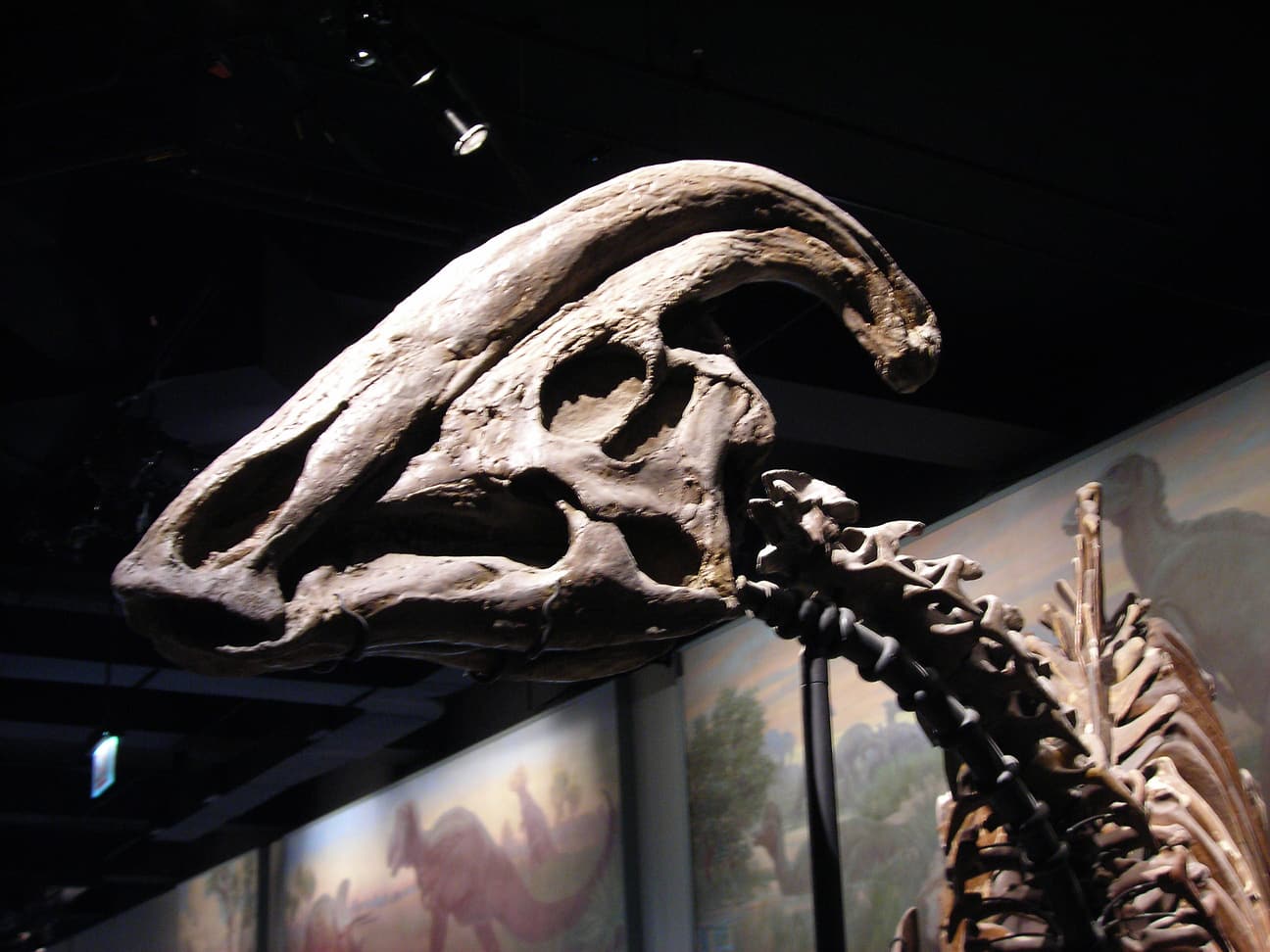
Image context: the cover image shows a photographed Parasaurolophus skull at the Field Museum. It is used here because the article's main argument depends on real skull architecture, especially the crest's external curve and the internal airway space it implies.[6]
1) The first correction: the crest is hollow anatomy, not solid decoration
The simplest misconception is to treat the crest as a solid ornament, something added on top of the skull for visual effect. Evans's 2006 study of lambeosaurine nasal cavity homologies makes clear that this is the wrong starting point.[1] In lambeosaurines, including Parasaurolophus, the crest houses elongated nasal passages. Air did not ignore the crest; air moved through it.[1]
That matters because function changes once a structure becomes part of a living airway. A hollow crest can alter resonance, visual silhouette, and perhaps even aspects of heat or moisture exchange, while still remaining primarily a display structure.[1] The important methodological point is that paleontologists do not have to choose instantly between "ornament" and "instrument." The same anatomy can plausibly support more than one role.
For Parasaurolophus, that multi-role reading is stronger than the old cartoon in which the crest becomes a single-purpose trumpet. The skull does not present a simple horn. It presents rerouted anatomy.
2) CT and endocranial work keep the sound story from turning into fantasy
Once the crest is understood as an airway, the next temptation is overconfidence. Readers often jump from "air passed through the crest" to "we know exactly what this dinosaur sounded like." Evans, Ridgely, and Witmer's 2009 endocranial study is useful precisely because it sharpens the discussion without pretending to settle every detail.[2]
Their work approached lambeosaurine crest function from a sensorineural perspective, examining the braincase and associated anatomy rather than only the outer skull profile.[2] That broader frame matters. Cranial display structures are not just geometry; they sit inside an animal with sensory systems, balance requirements, and behavioral constraints.
The paper supports the idea that the crest was involved in visual and acoustic signaling, but the strength of the article lies in boundary discipline.[2] It does not turn Parasaurolophus into a solved sound file. It shows why resonance is plausible, why display remains central, and why any reconstruction should stay conditional on anatomy rather than drift into cinematic certainty.[2]
In method terms, this is the right way to read famous fossils: not "one paper proves the answer," but "multiple anatomical windows narrow the answer space."
3) Growth is the real key to reading the crest correctly
Farke and colleagues' 2013 study of ontogeny in Parasaurolophus is one of the most important correctives to the flattened public image of the genus.[3] The paper showed that crest development was tied closely to growth and that the genus followed a distinctive ontogenetic path among hadrosaurids.[3]
This is more than a juvenile-versus-adult detail. It changes how the crest should be interpreted at every stage. If crest proportions and skull geometry shift substantially as the animal matures, then function cannot be read from one size class alone.[3] A short crest in a younger individual does not simply mean "a weaker version of the adult crest." It may represent a different balance between display, species recognition, and acoustic capacity during development.
That growth story also helps explain why Parasaurolophus feels so visually singular. The genus did not just have a crest; it invested heavily in it early and then elaborated it through ontogeny.[3] In evolutionary terms, the crest was not a superficial flourish added at the end of skull construction. It was part of the developmental program.
4) Species differences make the old male-versus-female shortcut look weak
The public habit of explaining crest variation with an easy sex distinction has aged badly. Gates, Evans, and Sertich's 2021 rediagnosis of Parasaurolophus cyrtocristatus matters because it re-centers species-level anatomy and specimen quality.[4]
The genus is rare, and the best-known named species do not simply differ by one being a longer or shorter copy of the others.[4][5] P. tubicen is known for a long crest and substantial internal passage complexity; P. cyrtocristatus carries a shorter, more curved profile; and those differences sit inside a limited fossil sample where preservation and maturity have to be weighed carefully.[4][5]
That is methodologically important. A structure that varies by species and by growth stage should not be forced into a simple binary story unless the evidence really demands it. At the moment, the stronger reading is that crest form in Parasaurolophus tracks taxonomy and ontogeny at least as much as any unproven sexual-dimorphism script.[3][4]
This is one of the broader lessons of dinosaur paleontology: the most intuitive explanation is often the one that collapses first when better skull material arrives.
5) The best profile is a multi-function animal with clear evidentiary limits
Put the evidence together and a sharper picture emerges. Parasaurolophus is not best understood as a dinosaur that "had a horn for making sound." It is better understood as a lambeosaurine whose crest integrated airway length, visual display, and species- and age-specific morphology into one structure.[1][2][3][4]
That profile is narrower than pop culture, and better because of it.
What is strongly supported:
- the crest housed elongated nasal passages rather than acting as a solid ornament,[1]
- acoustic and visual signaling are both plausible parts of crest function,[1][2]
- growth changed crest proportions in ways that matter for interpretation,[3]
- named species differences should be treated as real anatomical signals, not erased into one generic silhouette.[4][5]
What remains conditional:
- the exact sound envelope of any one individual,
- the relative weight of display versus resonance in day-to-day behavior,
- how much apparent crest variation in fragmentary material reflects species, maturity, or individual variation.
That boundary is the real value of Parasaurolophus in 2026. It is an excellent fossil for learning how paleontology works when a structure is spectacular enough to invite myth, but well preserved enough to resist it. The crest does not give us one answer. It gives us a disciplined way to rank answers.
Sources
- David C. Evans (2006), Paleobiology: "Nasal cavity homologies and cranial crest function in lambeosaurine dinosaurs."
- David C. Evans, Ryan Ridgely, and Lawrence M. Witmer (2009), The Anatomical Record: "Endocranial Anatomy of Lambeosaurine Hadrosaurids (Dinosauria: Ornithischia): A Sensorineural Perspective on Cranial Crest Function."
- Andrew A. Farke et al. (2013), PeerJ: "Ontogeny in the tube-crested dinosaur Parasaurolophus (Hadrosauridae) and heterochrony in hadrosaurids."
- Terry A. Gates, David C. Evans, and Joseph J. W. Sertich (2021), PeerJ: "Description and rediagnosis of the crested hadrosaurid (Ornithopoda) dinosaur Parasaurolophus cyrtocristatus on the basis of new cranial remains."
- Natural History Museum: "Parasaurolophus."
- Wikimedia Commons file page for the Field Museum Parasaurolophus skull photograph used as the article image.