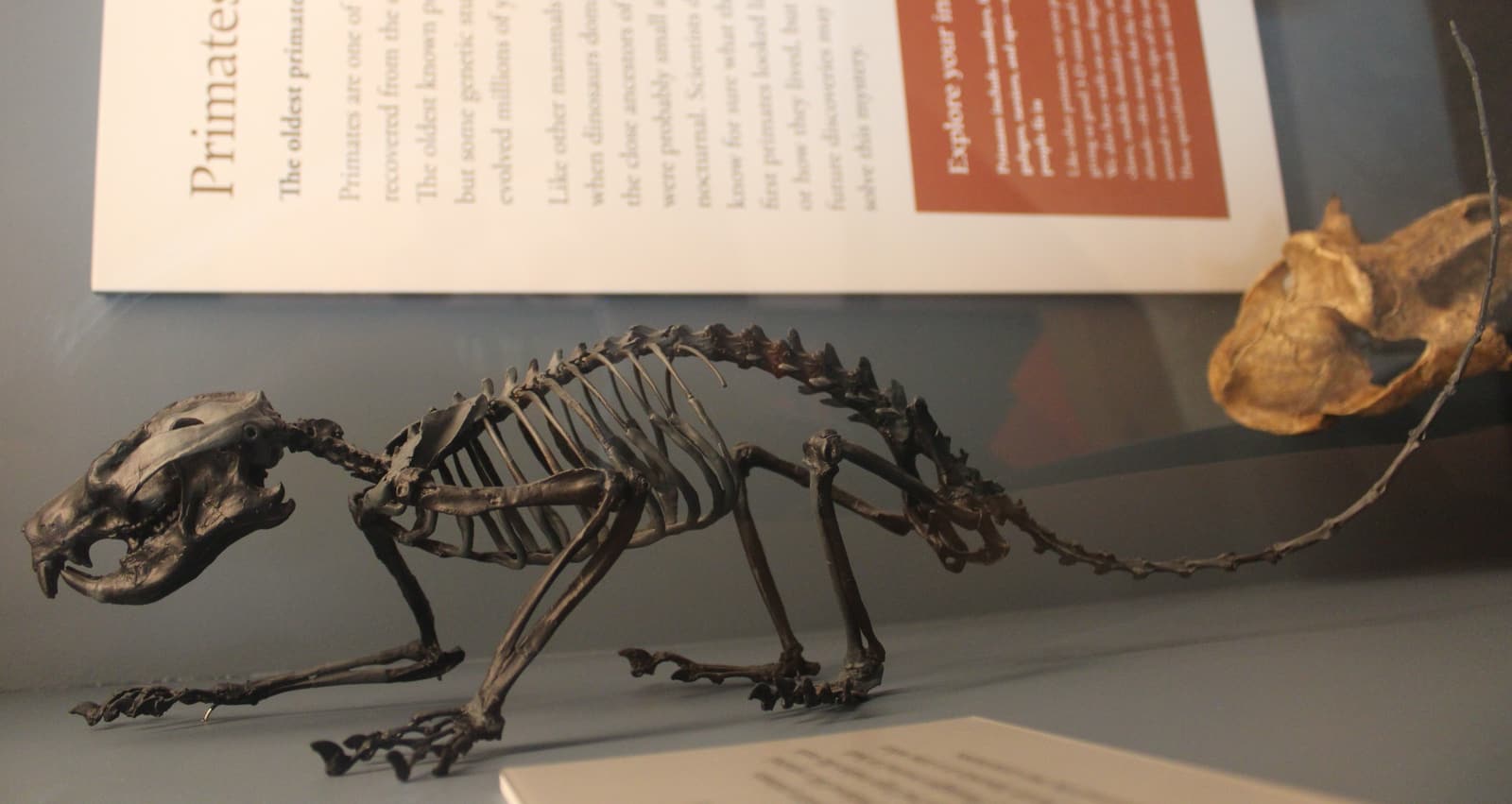
Plesiadapis is a useful fossil precisely because it refuses to behave like a neat origin mascot. It sits close to primate history, but it does not look like a tiny lemur waiting for the Eocene. It has enlarged, forward-projecting incisors, a relatively small brain, a long tail, and digits ending in claws rather than the broad nails that dominate modern primate imagination.[1][4] Yet it also belongs in the Paleocene world where primate-line traits were being assembled: tree use, grasping experiments, dental specializations, and a contested boundary between stem relatives and crown-like primates.[2][3][4]
That makes Plesiadapis best read as a lineage-context fossil, not as a yes-or-no answer to the question "was this a primate?" The more interesting question is sequence. Which parts of the primate package arrived early, which stayed absent, and which were shared unevenly across related plesiadapiforms before definite euprimates appear? The answer is not a straight ladder. It is a branch system: some animals show arboreal grasping, some retain claws, some develop specialized teeth, and none of the known plesiadapiforms fully carries the visual skull architecture of living primates.[3][4]
Image context: the cover uses a real photograph of a skeleton cast of Plesiadapis cookei (UMMP 87990) displayed at the University of Michigan Museum of Natural History.[5] The image matters because this article turns on whole-body evidence. A skull-only story would overstate the teeth; a life reconstruction would make the animal too finished. The cast keeps the argument where it belongs: on preserved proportions, limbs, claws, and the uneasy transition between generalized arboreal mammal and primate-line specialization.
The teeth are the obvious clue, but not the whole animal
The University of Michigan's 2019 publication page for the Plesiadapis cookei skeleton makes clear why the genus has been so important: Plesiadapis was a Paleocene mammal, known from many middle Clarkforkian localities in northwestern Wyoming, and most specimens historically were jaws and teeth.[1] That matters because teeth are durable, numerous, and good for sorting fossil mammals through time. Michigan's news summary notes that the distinctive jaws and teeth of Plesiadapis are important for biochronology of the North American middle and late Paleocene.[2]
But teeth can also trap the story. If Plesiadapis is treated mainly as a set of primate-like molars and unusual incisors, the animal becomes a taxonomic puzzle without a body. UM 87990 changes the emphasis. The relatively complete skeleton preserves the skull, much of the axial skeleton, forelimbs, hind limbs, ribs, and many hand and foot elements, letting researchers ask how the animal moved, not only how it chewed.[1][2]
That move from teeth to body is the core of the lineage argument. Primate origins were not just a dental event. They involved where animals moved, what supports they used, how they gripped, what sensory regime they emphasized, and how feeding anatomy connected with arboreal ecology. Plesiadapis does not solve all of that. It makes the question anatomical enough to handle.
A tree animal, but not a modern primate in disguise
UM 87990 gives Plesiadapis cookei a concrete body envelope. The Michigan publication estimates body mass at about 1,799 to 2,052 grams and interprets the animal as a forest-dwelling arboreal climber adapted mainly to large vertical and horizontal supports.[1] The same description emphasizes long, distinctly falciform distal phalanges: claw-bearing end bones rather than flat primate nails.[1] In the public news account, those fingers and toes are described as ending in long curved phalanges that bore sharp claws, with headfirst descent probably helped by claw-clinging and a reversed foot.[2]
That is a very different image from a small leaping primate with big forward-facing eyes. It is also more informative. The animal is arboreal, but its arboreality is not the full modern primate version. It climbed with claws. It probably used larger supports rather than specializing in the fine-branch world implied by some primate-origin models.[1][2] It had a brain estimated at only about five grams, with an encephalization quotient just over one quarter of the expected average for a living mammal of comparable size, according to the Michigan publication summary.[1]
Those details keep the fossil honest. Plesiadapis can sit near the primate line without becoming a disguised lemur. The branch was being used; the whole primate sensorimotor package had not arrived.
Plesiadapiforms make the boundary wider
The wider plesiadapiform record is why the fossil matters beyond one genus. Mary Silcox's Nature Education overview frames the problem clearly: living primates share traits such as heavy reliance on vision, convergent orbits, a postorbital bar, grasping hands and feet, and nails rather than claws on most digits.[4] Plesiadapiforms complicate that definition. They include a diverse Paleocene and Eocene radiation, with more than 140 named species across 11 families, appearing near the beginning of the Paleocene and persisting into the Eocene.[4]
They also mix signals. Silcox notes that plesiadapiforms share some primate-like skeletal and dental traits, including long grasping fingers in some taxa and broad talonid basins, but known plesiadapiforms lack the specialized visual features of living primates and retain claws on most digits.[4] That mixed pattern is not a failure of classification. It is the evidence. It shows that primate origins cannot be reduced to one switch that turns a mammal into a monkey-like animal.
The 2007 PNAS study summarized by Scholars@Duke pushed the argument further by analyzing cranial, postcranial, and dental evidence from Paleocene plesiadapiform skeletons. Its reported result placed plesiadapiforms with euprimates in a broad primate sense and argued for a divergence of Primates from other euarchontans before or just after the Cretaceous-Tertiary boundary.[3] The same summary notes that specialized pedal grasping, including a nail on the hallux, and a petrosal bulla likely evolved by about 62 million years ago in the common ancestor of Plesiadapoidea and Euprimates.[3]
That does not mean every plesiadapiform had the same anatomy. It means the origin zone was already a mosaic. One lineage can preserve claws while another related form helps show nail-bearing grasping. One fossil can clarify teeth while another clarifies the foot. The history becomes clearer when those pieces are allowed to remain uneven.
Carpolestes shows why the ladder model fails
The best comparison is Carpolestes simpsoni, another Paleocene plesiadapiform. Bloch and Boyer's 2002 Science abstract, available through Ovid, describes a skeleton with long fingers and an opposable hallux with a nail, but without orbital convergence or an ankle specialized for leaping.[6] Their inference is important because it breaks two older origin templates at once: the early primate was not necessarily first a visual predator, and it was not necessarily first a specialized leaper.[6]
Instead, Carpolestes supports an arboreal grasping model tied to terminal branch feeding.[6] Read beside Plesiadapis, that result gives the group its real texture. Plesiadapiforms were not simply "almost primates" in a single degree of progress. They were a set of related experiments in trees. Some evidence points to grasping. Some points to claws. Some points to dental specializations. Some points to the absence of the visual skull traits that later make euprimates easy to recognize.[3][4][6]
This is why Plesiadapis should not be forced into a verdict. If the question is "does it look like a modern primate?", the answer is no in several important ways. If the question is "does it help show the conditions under which primate-line anatomy was assembled?", the answer is yes, and the answer is stronger because the fossil is awkward.
The useful origin story is uneven
The clean origin story says primates began when grasping hands, nails, forward-facing eyes, enlarged brains, and fruit-adapted teeth arrived together. The fossil record says something less cinematic and more useful. In the Paleocene, animals near the primate line were living in trees, using varied supports, experimenting with grasping, retaining claws in many cases, and developing dental patterns that made them both ecological actors and biochronological tools.[1][2][3][4]
Plesiadapis is powerful because it keeps those clocks from synchronizing too neatly. Its teeth connect it to primate-origin debates and Paleocene time. Its skeleton makes it an arboreal climber. Its claws and small brain hold it outside any easy modern-primate silhouette. Its relatives show that grasping and nail-bearing could appear before the full visual package that defines later euprimates.[3][4][6]
That is the better lineage context. Primate origins were not a staircase with Plesiadapis on one lower step and humans at the top. They were a Paleocene canopy problem: small mammals using branches in different ways, preserving some old mammalian tools while assembling new ones. Plesiadapis matters because it lets that transition stay transitional.
Sources
- Douglas M. Boyer and Philip D. Gingerich, "Skeleton of Late Paleocene Plesiadapis cookei (Mammalia, Euarchonta): Life History, Locomotion, and Phylogenetic Relationships," University of Michigan Museum of Paleontology publication page (2019).
- University of Michigan Museum of Paleontology, "New Skeleton of Plesiadapis" - public summary of the 2019 monograph and UM 87990 skeleton.
- Scholars@Duke, publication record for Bloch, Silcox, Boyer, and Sargis, "New Paleocene skeletons and the relationship of plesiadapiforms to crown-clade primates," PNAS 104, no. 4 (2007).
- Mary T. Silcox, "Primate Origins and the Plesiadapiforms," Nature Education Knowledge 5, no. 3 (2014), archived Scitable overview.
- Wikimedia Commons file page, "Plesiadapis UMMNH.jpg" - photographed skeleton cast of Plesiadapis cookei used as the article image.
- Jonathan I. Bloch and Doug M. Boyer, "Grasping Primate Origins," Science 298, no. 5598 (2002), abstract via Ovid.