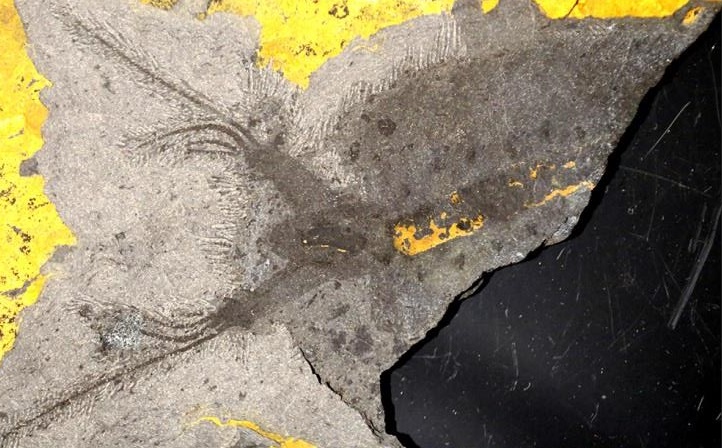
Kerygmachela kierkegaardi is the kind of Cambrian animal that becomes less strange when it is treated as an engineering problem. The outline is dramatic: a soft-bodied swimmer from Sirius Passet in North Greenland, with forward appendages, lateral flaps, gill-like structures, a long trunk, and a tail region. But the scientific force of the fossil is not that it looks like a transitional monster. It is that so many parts of the body point at the same difficult question: how did the arthropod head and swimming body assemble before fully jointed arthropods became obvious?[1][2]
That question is easy to flatten into a family tree. Kerygmachela asks for a slower method. Start with the slab. The fossil comes from the Buen Formation at Sirius Passet, a lower Cambrian Lagerstatte that the IUGS summary places in a relatively deep-water, low-oxygen shelf-slope setting and correlates with Cambrian Stage 3.[4] The site was discovered in 1984 during regional mapping, then built into a major collection through later expeditions.[4] That setting matters because exceptional preservation is doing the argument. Without soft-tissue fidelity, Kerygmachela would mostly be a suggestive outline. With it, the animal becomes a map of appendages, flaps, gut, eyes, and nervous tissue.
The head is not a finished arthropod head
Graham Budd's 1993 description introduced Kerygmachela as a new lobopod-like animal from Sirius Passet and emphasized a combination that was already awkward for neat categories: lateral lobes along the body, dorsal gill-like structures, and a possible link between lobopod-grade animals and the arthropod line.[1] That first framing is still useful because it keeps the fossil out of two bad readings. It is not merely a worm with appendages. It is also not a crown arthropod wearing a primitive costume.
Budd's later anatomical treatment sharpened the same point. The cephalic region was described as bearing a pair of stout, unsegmented appendages with long spinose processes and an anterior mouth, while the trunk carried repeated annulations, lateral lobes, and gill-bearing structures.[2] In practical terms, the front of the animal is already specialized for interacting with the world, but it is not yet the familiar arthropod head with a settled suite of antennae, mouthparts, and clearly segmented head appendages.
That is why Kerygmachela is a method fossil. It prevents the origin of the arthropod head from being argued only by comparing living insects, crustaceans, spiders, velvet worms, and tardigrades. Living groups are too modified by their own histories. The fossil puts a stem-line body in the middle of the argument. Its head region is not an abstract node. It is a preserved anatomical surface.
Flaps and gills make the trunk do more than crawl
The trunk is just as important as the head. In a simple retelling, lobopodians are walking or crawling animals, radiodonts are swimming predators, and arthropods arrive later with jointed limbs and hardened bodies. Kerygmachela blurs that sequence. Its lateral lobes and gill-like structures suggest an animal already using the body sides as functional surfaces, not just carrying soft legs beneath a worm-like trunk.[1][2]
The Sirius Passet context helps here. The IUGS site describes the fauna as preserving early complex ecosystems and notes that many of the arthropods and related forms include predators, guts, gut contents, muscles, brains, and nervous systems.[4] Kerygmachela fits that world as a swimming or near-swimming animal whose body plan sits between categories that later become easier to separate. The flaps are not decorative. They are the part of the animal that makes locomotion, respiration, and body organization overlap.
This is a good place to be precise about inference. The fossil does not show a modern crustacean limb plan waiting to be unfolded. It shows a body in which lateral surfaces, frontal appendages, and soft anatomy were already being divided into jobs. That is stronger than a vague missing-link claim because it is narrower. The question is not "was this the first arthropod?" The better question is: which pieces of the arthropod operating system are already visible, and which are still being carried by a lobopodian-grade body?
The nervous tissue raises the stakes
The 2018 Nature Communications study changed the reading because it brought the head inside the body. Park and colleagues worked from unweathered Sirius Passet material and described carbonaceous reflective films in the head region that conform to eyes and nervous tissue.[3] The study's sample included 15 specimens, and its central claim was not simply that a brain was present. It was that the preserved brain and eyes help reconstruct the ancestral condition of the panarthropod head.[3]
That is the method breakthrough. Once nervous tissue enters the evidence stack, the frontal appendages are no longer just external grasping structures. They can be discussed in relation to innervation. Park and colleagues interpreted the brain as protocerebral and described it as innervating both the eyes and the frontal appendages.[3] That matters because debates over the arthropod head often turn on which appendages belong to which brain segments. A fossil that preserves both appendages and nervous anatomy can constrain that debate in a way living-animal comparison alone cannot.
The point should not be overstated. Preservation of Cambrian nervous systems remains difficult, and every interpretation depends on anatomy, chemistry, position, and comparison. But Kerygmachela is powerful because several lines of evidence converge in one animal: head structures, eyes, frontal appendages, body flaps, gut traces, and preservation context.[2][3][4] The fossil turns a theoretical question into a physical one. Where are the nerves? What do they connect to? Which external structures sit in front of the mouth? Which parts of the trunk are paired, repeated, or respiratory?
Why the fossil stays useful
The best reading of Kerygmachela is disciplined rather than heroic. It does not make the origin of arthropods simple. It makes the problem better posed. Budd's original description already saw that gilled lobopodians could sit near the route from soft lobopod-grade animals toward arthropodized bodies.[1] The 1998 anatomical treatment gave the animal enough body-part detail to compare it seriously with Opabinia, Anomalocaris, Pambdelurion, and other Cambrian forms near the arthropod stem.[2] The 2018 neuroanatomical work then made the head question more concrete by tying eyes and frontal appendages to preserved brain tissue.[3]
That sequence is the real story. A fossil is not valuable only when it resolves a controversy. Sometimes it is valuable because it forces the controversy to become anatomical. Kerygmachela does that especially well. It keeps the reader from imagining an arthropod head appearing fully formed, and it also keeps the reader from treating Cambrian lobopodians as generic soft-bodied background.
In the photograph, the animal is modest: a flattened impression on a broken slab, with the body emerging through contrast, texture, and careful preparation.[5] That modesty is useful. The fossil's importance lies in the exact match between visible parts and evolutionary questions. The frontal appendages ask where the head begins. The flaps ask how swimming and respiration were organized. The preserved nervous tissue asks how a sensory front end was wired before the later arthropod head became familiar. Kerygmachela matters because it makes the origin of a major animal body plan answer to a single difficult specimen.
Sources
- Graham E. Budd, "A Cambrian gilled lobopod from Greenland," Nature 364 (1993), article page.
- Graham E. Budd, "The morphology and phylogenetic significance of Kerygmachela kierkegaardi Budd (Buen Formation, Lower Cambrian, N Greenland)," Earth and Environmental Science Transactions of The Royal Society of Edinburgh, Cambridge Core page.
- Tae-Yoon S. Park et al., "Brain and eyes of Kerygmachela reveal protocerebral ancestry of the panarthropod head," Nature Communications 9 (2018).
- International Union of Geological Sciences, "The Cambrian Explosion in Sirius Passet - Peary Land, North Greenland," geoheritage site profile.
- Wikimedia Commons, "File:Kerygmachela kierkegaardi. MGUH 32054.jpg," fossil photograph extracted from the Park et al. 2018 supplementary image set.