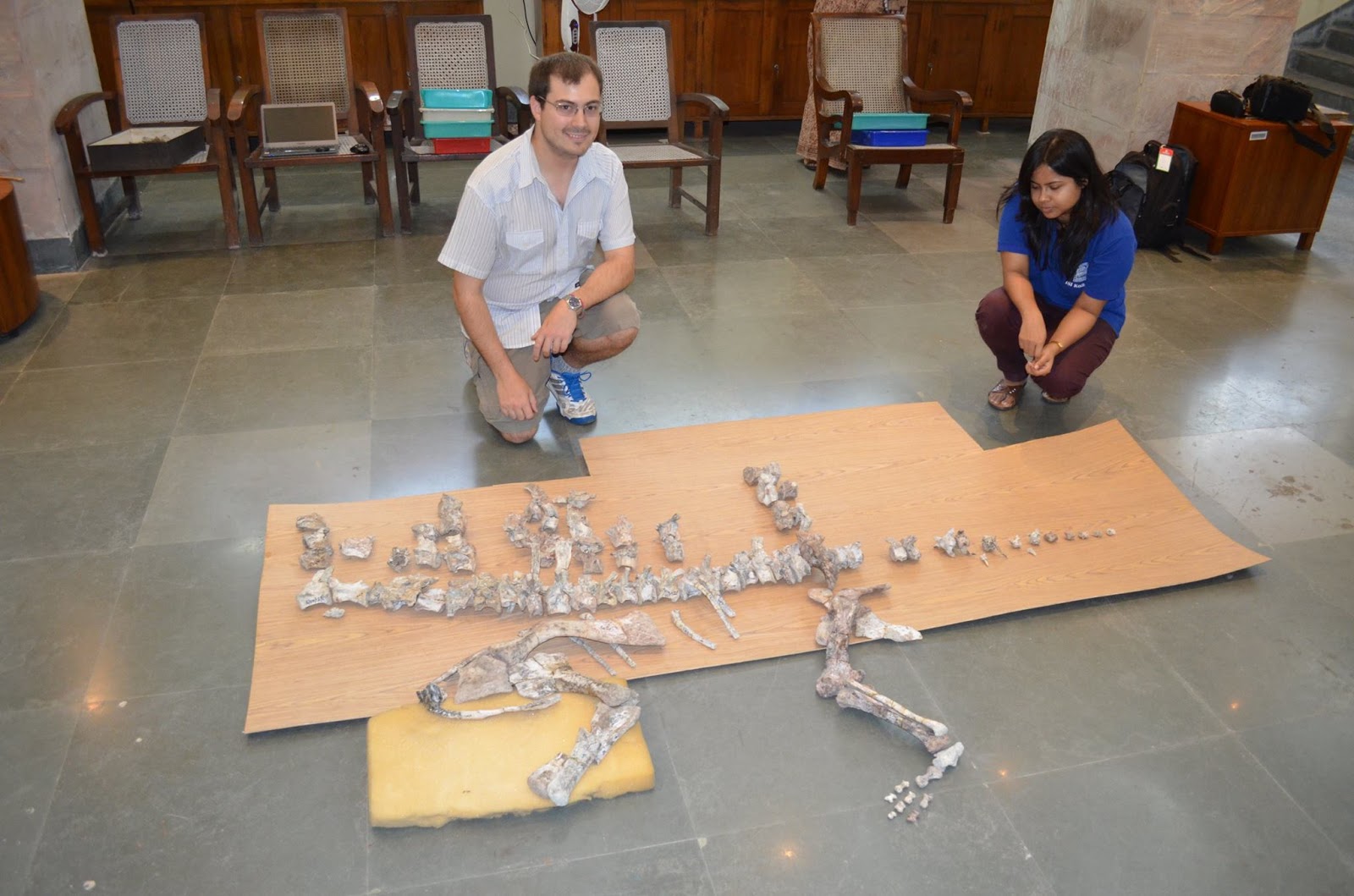
The animal in the cover photograph has been made orderly. Vertebrae run down the wooden boards. A shoulder girdle, forelimb, pelvis and hind limb recover something like their positions in life. Two paleontologists kneel at either end of the arrangement, and the empty floor around them lends the bones the clean outline of one long-necked body.[5]
The quarry was not orderly. In a five-by-five-metre patch of red mudstone near Tekapar village in central India, bones from at least seven Shringasaurus indicus individuals lay disarticulated, admixed and sometimes piled together. Only one skeleton retained partial articulation. Adults, subadults and juveniles shared the deposit.[1][2]
That difference—between the arranged individual and the mixed bonebed—is the key to reading the find. The anatomy makes Shringasaurus recognizable: a three-to-four-metre herbivorous reptile with a small head, a long neck and, on many skull roofs, a pair of great forward-curving horns. The deposit supplies a second argument about how several of those animals died and were buried together. The strongest interpretation is a mixed-age herd overwhelmed beside a Triassic river, but the same bones do not preserve a horn fight, a mating season or a social hierarchy.[1][2][3]
The spectacular inference and the secure observation are not the same thing. This bonebed is valuable precisely because it lets us see where one ends and the other begins.
One square of mud, several biographies
The holotype of Shringasaurus indicus, ISIR 780, is not a complete skeleton. It is a partial skull roof carrying two supraorbital horns. The rest of the named material, catalogued across hundreds of numbers, includes cranial and postcranial bones from the same compact bonebed in the upper Denwa Formation. When Saradee Sengupta, Martín Ezcurra and Saswati Bandyopadhyay described the animal in 2017, they estimated a minimum of seven individuals occupying just 25 square metres.[1]
Minimum is an important word. Paleontologists establish a minimum number of individuals by counting repeated elements that cannot belong to one body—too many left femora, for example, or skull roofs representing animals at different growth stages. A pile of vertebrae does not become a head count merely because the pieces are numerous. The count of seven is therefore a conservative floor built from anatomical duplication and age variation, not a claim that every animal in the deposit was recovered.[1][2]
The bones preserve individual histories even after bodies came apart. Some skull-roof bones are fused and heavily built, signs of relative maturity. Other elements belong to smaller or younger animals. The later taphonomic study found more adult and subadult remains than juvenile ones, a mixed-age composition rather than a nursery dominated by young animals.[2] This is the first reason the assemblage can be read socially: several members of the same taxon, at different life stages, entered one small burial system.
But association alone does not prove that they walked together. A river can repeatedly collect carcasses from a landscape, and a channel can sort durable bones into a concentration long after death. To move from “many animals in one rock” to “one herd in one event,” the sediment and the damage on the bones have to agree.
Not a dinosaur wearing dinosaur hardware
The horns make comparison almost unavoidable. They rise above the eyes, curve forward and resemble the supraorbital weapons of horned dinosaurs that evolved much later. Shringasaurus also had leaf-shaped, denticulate teeth and a long-necked herbivore's proportions. Those features can make the animal look like an early draft of a ceratopsian crossed with a sauropodomorph.[1][4]
Phylogeny refuses that visual shortcut. The detailed osteological work places Shringasaurus among azendohsaurid allokotosaurs, outside Archosauria proper. It was an archosauromorph—a member of the broader reptile branch that also contains crocodilians, dinosaurs and birds—but not a dinosaur and not even a crown archosaur. Its closest tested relationships lie with other peculiar Triassic allokotosaurs such as Azendohsaurus, not with Triceratops or the long-necked dinosaurs its silhouette happens to recall.[1][4]
That placement turns resemblance into evidence of convergence. Long before ceratopsids, a different herbivorous lineage arrived at large bony projections above the eyes. Long before sauropods dominated high browsing, a non-dinosaurian archosauromorph combined a relatively small head, elongated neck and bulky plant-eating body. The Middle Triassic, in the aftermath of the end-Permian extinction, was not a waiting room for dinosaurs. It was already producing large-bodied experiments whose familiar-looking parts belonged to unfamiliar evolutionary packages.[1][4]
The cover photograph helps here. The arranged bones recover a quadruped, but large gaps remain. The clean black-and-white skeletal silhouette often reproduced for Shringasaurus is a reconstruction built from this incomplete population sample, not a single perfect body lifted from the ground. The fossil evidence securely establishes the animal's broad architecture; soft tissues, posture in motion and the finished external appearance remain reconstructed.
The horns make a strong case, not a witnessed behavior
The horns themselves contain more than shape. Their surfaces bear grooves and rough texture consistent with attachment of a cornified sheath, so the living structures were probably larger than their bony cores. Horned skull roofs occur at more than one growth stage, and the horns become more robust in larger, more mature individuals. Their size, cost and positive growth trajectory fit expectations for structures used in display or combat.[1]
Variation adds another line of evidence. The bonebed includes skull-roof material with no horns even though it is similar in size to a specimen carrying slender, developed horns. The 2017 authors interpreted this presence-or-absence pattern as probable sexual dimorphism and proposed that the horns functioned as sexually selected weapons, drawing cautious comparison with living horned reptiles and mammals.[1]
“Probable” has to remain attached. Fossils rarely preserve sex directly, and there is no single anatomical signature that proves sexual selection. A rigorous case combines growth, variation, mechanical plausibility and the rejection of alternatives; even then, a weapon can also signal, and a signal can serve more than mate competition.[3] The hornless skull roof could represent one sex, but the skeleton carries no independent marker that tells us which sex it was.
The apparent ratio also resists a tidy story. At least six individuals in the original sample were represented by horned material, while only one or two lacked horns. The authors explicitly warned that thick, fused, horn-bearing skull roofs may have survived or been concentrated differently from lighter hornless bones.[1] A six-to-one count in a fossil deposit is not automatically the living herd's sex ratio.
Most importantly, no described horn preserves the act for which it may have evolved. The bonebed has no paired skulls locked in combat, no documented impact wound tied to another Shringasaurus horn and no spatial arrangement that stages a duel. Sexual weaponry is a well-supported functional hypothesis. A fight scene would be fiction layered on top of it.
The mud makes drowning more plausible than transport
The 2021 taphonomic study shifted attention from the animal's head to the ground around the whole assemblage. The bones occur in fine-grained mudrock within a crevasse-splay deposit: sediment spread across the floodplain when a nearby channel breached its levee. Channel complexes bracketed the burial area, and repeated overflow built the splay incrementally.[2]
That setting matters because mud and large bones behave differently in moving water. A current energetic enough to carry and concentrate many heavy bones over a long distance would normally leave a coarser sedimentary signature and stronger hydraulic sorting. Instead, the Shringasaurus remains are patchy and admixed but stayed closely associated in fine sediment. Several bones were piled; most bodies disarticulated; yet one retained partial articulation and the assemblage shows little post-mortem modification.[2]
Together, those observations support a short sequence. A group living near the perennial channel was overwhelmed during flooding. Carcasses became trapped in muddy floodplain sediment. Soft tissues decayed enough for most skeletons to come apart, but continued sediment input buried the bones before scavenging, weathering or current transport could scatter them far.[2]
This sequence explains an otherwise awkward combination: disarticulation without wholesale dispersal. It is stronger than a generic “mass death” label because it predicts the sediment grain size, the limited bone damage and the survival of some anatomical association. It also makes the mixed-age, single-taxon cluster harder to explain as a river's long-term collection of unrelated carcasses.[2]
The herd interpretation is therefore reasonable, but it remains an interpretation of co-occurrence and burial. “Monotaxic” means the identified vertebrate concentration is dominated by one taxon; it does not prove that no unrecognized small animal ever entered the deposit. “Mixed-age” makes a social group plausible; it does not reveal stable family units. “Mass mortality” narrows the deaths into one episode or a very short interval; it does not identify the exact flood hydrograph or the animals' behavior in their final minutes.
Two arguments meet in one bonebed
The find becomes more interesting when its two stories are allowed to touch without being fused. The skull roofs support probable variation between horned and hornless adults and a sexually selected role for the horns.[1][3] The sediment and skeletal associations support a mixed-age group that died together beside a river.[2] Because both signals come from the same bonebed, it is tempting to animate a herd with horned males competing among females and young.
The deposit does not license that full scene. It shows that differently aged Shringasaurus individuals were together at death and that horn expression varied within the population sample. It does not tell us whether the group was permanent or seasonal, whether hornless individuals were female, whether the flood struck during courtship, or whether any two animals ever met horn to horn.
That boundary is not a failure of paleontology. It is the achievement. A fossil find close reading should recover the maximum story the evidence can bear while leaving its joins visible.
The arranged skeleton in the photograph performs the same honest work. It gives scattered bones a body without pretending the gaps have vanished. The Denwa bonebed gives that body a setting, a population and a likely final event. Shringasaurus emerges not as a horned-dinosaur preview, nor as a frozen combat tableau, but as something sharper: a distinct Triassic herbivore whose anatomy and burial happened to preserve two rare clues about life together—one in the skull, the other in the mud.
Sources
- Saradee Sengupta, Martín D. Ezcurra and Saswati Bandyopadhyay, “A new horned and long-necked herbivorous stem-archosaur from the Middle Triassic of India,” Scientific Reports 7 (2017)—original description, bonebed sample, horn variation and initial phylogenetic interpretation.
- Saradee Sengupta and Dhurjati P. Sengupta, “Taphonomy and depositional setting of the Shringasaurus indicus bonebed,” PALAIOS 36 (2021), Indian Statistical Institute repository record—assemblage structure, crevasse-splay setting, transport limits and mass-mortality interpretation.
- Robert J. Knell, Darren Naish, Joseph L. Tomkins and David W. E. Hone, “Sexual selection in prehistoric animals: detection and implications,” Trends in Ecology & Evolution 28 (2013)—methodological limits on inferring sexual selection from fossil ornaments and weapons.
- Saradee Sengupta and Saswati Bandyopadhyay, “The osteology of Shringasaurus indicus,” Journal of Vertebrate Paleontology 41 (2022), Indian Statistical Institute repository record—detailed anatomy and placement as a non-archosaurian azendohsaurid allokotosaur.
- Species New to Science, “Shringasaurus indicus: A New Horned and Long-necked Herbivorous Stem-Archosaur from the Middle Triassic of India” (2017)—contemporaneous article page preserving the real specimen photograph used as the cover image.