
Open a drawer of fossil shark teeth and abundance seems to promise certainty. Serrated triangles, needle-like cusps, low crushing crowns, and tiny hooked teeth can survive where almost every other part of a shark has disappeared. They are recognizable, collectible, and often beautiful. It is easy to let them stand for the whole animal.
The Natural History Museum's episode “Mighty megalodon and the fascinating world of fossil sharks” makes a more interesting choice. Presenter Conor and fossil-fish curator Emma Bernard begin with teeth, including the outsized teeth that sustain megalodon's fame, but the collection tour keeps widening. Dermal denticles bring skin into view. Fossil egg cases bring reproduction into view. Rare specimens in which more of the body remains bring anatomy back into relation. The episode is therefore best watched not as a parade of spectacular objects, but as a lesson in how different fossils perform different evidentiary jobs.[1][2]
That distinction matters because the fossil record of sharks is both rich and radically uneven. Teeth may answer questions about feeding, tooth position, age, chemistry, and evolutionary relationship. They cannot, by themselves, supply an unbiased census, reveal every feature of the body, or show where eggs were laid. A useful collection does not ask one kind of object to do all the work.
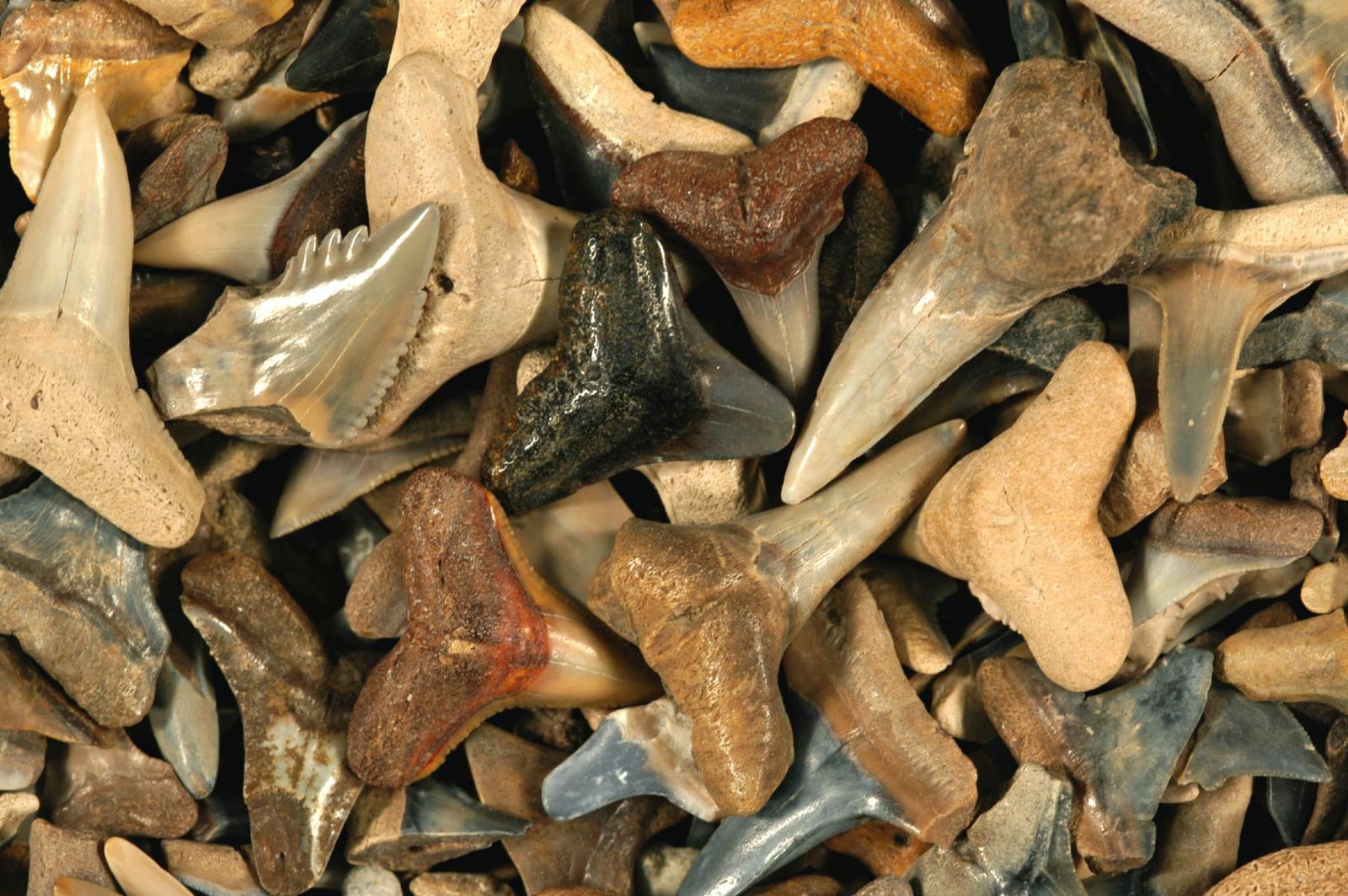
Image context: the cover is a real close-up photograph published by the Florida Museum. Its teeth vary in crown shape and in colors acquired during fossilization. The frame deliberately resembles the tooth-heavy archive viewers expect; the article uses that expectation as the question the video will complicate.[8]
First checkpoint: count production before counting animals
Pause mentally whenever the video presents a tray of teeth. The first question is not “How many sharks?” but “How did these objects enter the record?” Sharks continually form and replace teeth. Multiple rows wait behind the functional row and move forward as teeth are lost. Over a lifetime, one animal can contribute a large number of teeth, while currents and sediment can move those teeth again after shedding.[3]
That production system explains both the power and the trap of the tooth record. Teeth are hard, mineralized, and repeatedly supplied. Their crowns also reflect function: pointed teeth can seize slippery prey, serrated edges can cut, and broad surfaces can crush. Different positions within one jaw may carry different shapes. A tooth-rich deposit can therefore preserve exquisite information about feeding apparatuses without representing an equivalent number of individual sharks. Abundance of parts is not automatically abundance of bodies.
Color adds another layer that should not be mistaken for a living-animal trait. The Florida Museum explains that the mineralized crown coating, or enameloid, is already largely inorganic, while surrounding sediments and groundwater can alter the fossil's color as mineralization proceeds. Brown, gray, blue, and black teeth can record burial chemistry rather than a species-level palette.[8] Shape, position, wear, chemistry, and depositional context all have to be separated before they can be recombined.
This is why recent syntheses of shark paleobiology treat teeth as a dominant archive, not a complete one. Tooth form and geochemistry support powerful analyses of diet, habitat, movement, and climate, but researchers increasingly integrate them with dermal denticles, rare soft tissues, and quantitative models. The object is not to demote teeth. It is to make each inference fit the evidence that actually carries it.[4]
Second checkpoint: let the skin speak, but do not call it a census
The video's small, easily overlooked objects include dermal denticles: tooth-like scales that cover shark skin. A denticle can retain information from a body region that isolated oral teeth do not represent. Its crown form relates to functions such as drag reduction, protection, or abrasion, and fossil denticle assemblages can extend a record of shark communities beyond the charismatic species recognized from large teeth.[4]
Yet denticles introduce their own counting problem. A sediment sample with many scales is not a transparent list of animals that once swam above it. In an experiment on two captive shark species, Erin Dillon and colleagues found that denticle shedding rates differed between the species and varied through time. That result does not invalidate fossil denticle records; it identifies a process that must be calibrated. The number accumulating on the seafloor depends partly on how frequently particular sharks shed, not only on how many sharks were present.[6]
Watch the collection tray accordingly. A denticle is evidence of skin anatomy and, in aggregate, potentially of ecological change. It becomes stronger when its morphology, sedimentary setting, preservation, and shedding process are considered together. It becomes weaker when a visually dense sample is converted directly into headcount.
Third checkpoint: an egg case records a life stage
Fossil shark egg cases change the kind of question completely. Teeth chiefly enter the record through feeding and replacement; an egg case records reproduction. Its shape, attachment structures, associated sediment, and neighboring fossils can help identify the setting in which an egg was deposited. That makes it evidence for behavior and habitat use even when the adult animal is absent.
The limits are as important as the possibilities. A study of spiral fossils called Palaeoxyris used three-dimensional imaging to investigate Early Jurassic specimens from southern Sweden. The authors interpreted the cases as products of hybodont sharks and connected their occurrence with shallow, estuarine environments. Plant associations, including horsetails, supported a proposal that the eggs may have been attached in vegetated water. One specimen contained structures the authors cautiously discussed as possible remains of yolk or an embryo.[7]
None of that makes an isolated egg case a skeleton with a species label attached. Similar case forms can outlast the taxonomic certainty needed to name the parent, and transport can weaken a simple equation between discovery site and nursery site. The correct inference is bounded: the fossil may reveal a reproductive strategy, a developmental stage, and an environmental association. It does not automatically identify the precise animal that laid it.
This portion of the video is valuable because it redirects attention from the adult predator to an entire life cycle. “What did it eat?” is only one paleobiological question. “How did it reproduce, and what environments did its young require?” can depend on a completely different object.
Fourth checkpoint: rare bodies reconnect isolated parts
Sharks are often summarized as animals that leave only teeth because their skeletons are cartilaginous. The shorthand captures a real preservation imbalance but turns a tendency into an absolute. Cartilage and body outlines can survive under exceptional conditions, and Paleozoic chondrichthyans sometimes preserve articulated skeletons. These rare bodies are crucial because they show which elements belonged together and how a tooth, spine, jaw, fin, or soft-tissue outline was arranged in an animal.[4][5]
A large study of Paleozoic chondrichthyan completeness quantified just how uneven that archive is. Isolated teeth, scales, and fin spines dominate many records, while articulated material is scarce; completeness also changes through time, geography, and depositional environment. Repeated shedding further inflates the supply of some elements relative to the number of animals. The record is therefore filtered twice: first by shark biology, which produces and loses some hard parts repeatedly, and then by environments that differ in their capacity to bury and preserve a body.[5]
An exceptional body fossil can calibrate thousands of isolated finds by reconnecting anatomy, but it has a bias of its own. It usually comes from a setting unusually favorable to rapid burial or fine preservation. It should not be treated as the typical fate of every shark. The common teeth and the uncommon body do complementary work: one supplies reach and sample size; the other restores association.
How to watch a fossil-shark cabinet
The episode rewards a simple viewing protocol. For each specimen, ask five questions:
- What tissue or life stage is present? A tooth, skin denticle, egg case, and articulated body begin with different biological information.
- Was it produced once or repeatedly? A skeleton belongs to one individual; a shark can shed many teeth and denticles.
- What can context add? Sediment, associated organisms, wear, and chemistry can distinguish life history from later transport or burial.
- What is the strongest bounded inference? Feeding function, habitat, reproduction, and body plan require different evidence.
- Which other specimen could test it? A claim from teeth may need jaw association, a denticle trend may need shedding calibration, and an egg case may need environmental and anatomical corroboration.
This approach also clarifies what a museum collection contributes. The cabinet is not merely storage for the biggest megalodon tooth. It preserves comparison: large and small, common and rare, spectacular and initially obscure. Labels and collection records keep locality and geological context attached to objects that would otherwise become curios. A tiny denticle or compressed egg case can be more informative for a particular question than the object that first attracts the eye.
The video's deeper subject is thus not megalodon alone. It is the division of evidence. Teeth document a durable, repeatedly shed feeding apparatus. Denticles bring skin and community history into the archive, with a warning about shedding. Egg cases open a window onto reproduction. Rare bodies reconnect structures that ordinary preservation scatters. Shark teeth fill the drawers because biology and geology favor them. The story becomes a shark only when the drawers are read together.
Sources
- Natural History Museum, “Mighty megalodon and the fascinating world of fossil sharks | Hidden Treasures | S2E4” — official YouTube collection tour embedded in this article.
- Natural History Museum, “Hidden Treasures: Season two” — official episode guide and institutional context for the fossil-shark video.
- Natural History Museum, “What can shark teeth tell us?” — tooth replacement, functional form, fossil evidence, and the limits of reconstructing sharks from teeth.
- Sora L. Kim, Meghan A. Balk, Elizabeth C. Sibert, and Lisa Whitenack, “Diving Deeper: New Approaches Using the Fossil Record to Understand Elasmobranch Ecology,” Annual Review of Marine Science 17 (2025) — Smithsonian Research Portal record for a review integrating teeth, denticles, soft tissue, geochemistry, and modeling.
- Lisa Schnetz, Richard J. Butler, Michael I. Coates, and Ivan J. Sansom, “The skeletal completeness of the Palaeozoic chondrichthyan fossil record,” Royal Society Open Science 11 (2024) — analysis of isolated elements, articulated remains, repeated shedding, and preservation bias.
- Erin M. Dillon and colleagues, “Dermal denticle shedding rates vary between two captive shark species,” Marine Ecology Progress Series 688 (2022) — USGS publication record for an experimental calibration of denticle accumulation.
- Ashley Krüger, Sam Slater, and Vivi Vajda, “3D imaging of shark egg cases (Palaeoxyris) from Sweden with new insights into Early Jurassic shark ecology,” GFF 143 (2021) — bibliographic record and abstract covering morphology, possible contents, and estuarine context.
- Florida Museum, “Are shark teeth fossils true fossils?” — institutional explanation of shark-tooth fossilization and source of the cover photograph.