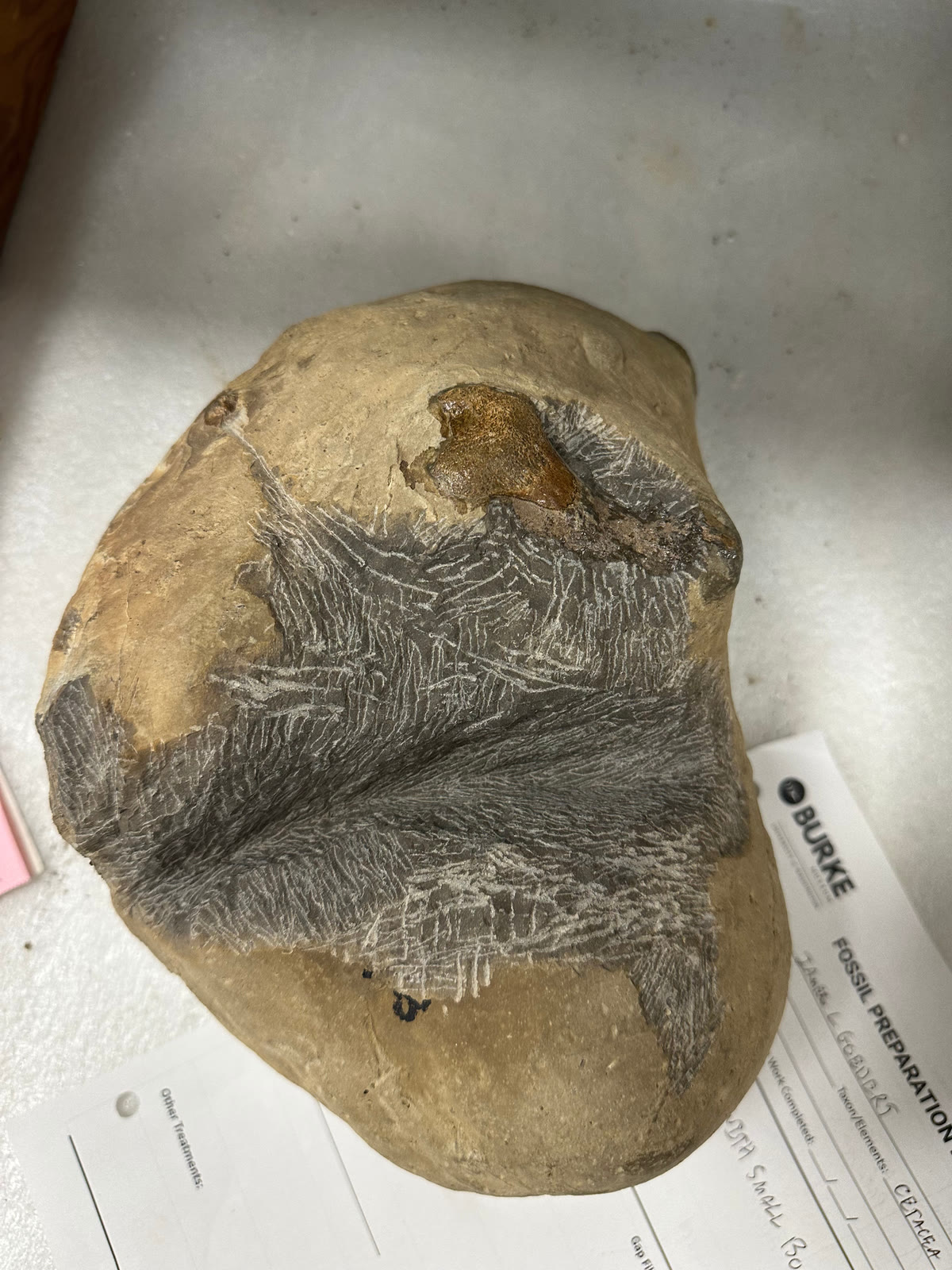
The cover photograph does not show a fossil emerging from a theatrical cloud of dust. It shows a rounded concretion on a laboratory bench. Dense pale tracks left by a pneumatic air scribe cross a dark worked surface below a glossy brown exposure. The image comes from a 2025 Burke Museum workflow for marine concretions collected along the Pacific Northwest coast.[2] It captures a moment when mechanical preparation becomes a problem in materials science.
The preparator could keep cutting. A needle or air scribe would make every decision visible as a groove, chip or accidental touch. Or the preparator could let chemistry remove the remaining carbonate. In an acid bath, the matrix may fizz into solution while the fossil gradually stands proud of it.
That sounds like a tool that knows what a fossil is. It does not. Acid cannot recognize a suture, spare a tooth or pause at a scientifically important surface. It reacts with minerals. Acid preparation succeeds only when fossil and enclosing rock differ enough in chemistry for one to dissolve faster than the other—and when a preparator keeps that temporary advantage under control.[1][3]
The result can be anatomy too delicate or too completely enclosed to uncover safely by hand. It can also be a weakened fossil, erased sedimentary context or a specimen made less useful for a later chemical analysis. Acid preparation is therefore not cleaning in the casual sense. It is an irreversible choice about which evidence to make visible.
The bath sees minerals, not bones
The classic favorable pairing is phosphate-rich vertebrate bone inside a calcareous matrix. Limestone and many marine concretions contain abundant calcium carbonate. In an acidic solution, carbonate consumes hydrogen ions and releases carbon dioxide; the bubbles around a specimen are the matrix ceasing to be rock. Fossil bone is commonly dominated by a form of calcium phosphate, so a weak organic acid can attack the carbonate faster than it attacks the fossil.[1]
Faster is the crucial word. Phosphate is not an invisibility cloak. Fossil bone varies with original tissue, burial chemistry, mineral replacement, pores, cracks and weathering. Some specimens contain carbonate within the fossil itself. A calcitic shell in limestone may offer little useful chemical contrast at all. Before a valuable object goes near a bath, the preparator has to identify both materials and test the proposed treatment on expendable matrix or a non-diagnostic fragment.[1][3]
Museum protocols commonly use dilute acetic or formic acid rather than treating strength as a virtue. The American Museum of Natural History describes dilute solutions, buffering and alternating short exposures with substantially longer water rinses. Formic acid generally acts faster; acetic acid is slower. Neither is inherently the safe choice, because more aggressive chemistry can damage bone quickly while a slower process may subject the specimen to many more wetting, handling and drying cycles.[1]
Experiments on conodont elements make the risk plain at microscopic scale. Conodont feeding elements are phosphatic fossils often extracted from carbonate rocks. Lennart Jeppsson and Rikard Anehus found that unbuffered formic acid—and solutions buffered with only one of the required components—destroyed the phosphatic fossils in their tests. A carefully balanced carbonate-and-phosphate buffer protected them.[4] The lesson is larger than the particular formula: “weak acid” describes a reagent, not a guaranteed outcome.
Preparation begins by deciding not to dissolve everything
Chemical preparation is rarely the first move. The Burke workflow places mechanical reduction before the bath: an air scribe removes bulky matrix so acid does not have to consume an entire concretion.[2] The cover specimen illustrates that division of labor. Broad areas can be approached mechanically before acid is considered for harder boundary work and small recesses.
The decision also runs in the other direction. If matrix and fossil have similar chemistry, if the bone is powdery or highly cracked, or if a research question depends on the enclosing sediment, acid may be the wrong method. The AMNH guidance reserves chemical preparation for cases in which it offers a superior result or is the only safe way to expose the specimen.[1] Preparation is not a contest to reveal the greatest possible area.
Scale complicates the choice. Carlos Padilla and colleagues described acid preparation of Colombian Cretaceous marine reptiles ranging from a 2.3-kilogram turtle skull to a 409-kilogram plesiosaur and a 728-kilogram pliosaur specimen. Large blocks did not behave like small samples enlarged. Surface-area-to-volume ratios changed reaction rates; iron-rich patches resisted the acid; fractures admitted solution toward hidden bone; small pieces finished sooner than massive ones; and the specimen's own weight threatened newly exposed structures.[3]
Their solution was not a stronger universal recipe. It was a changing combination of mechanical work, trial pieces, different weak acids, protected surfaces and repeated inspection. The relevant unit was not “one fossil, one bath.” It was each region of fossil and matrix as its behavior became visible.
A treatment is a pulse, not a soak
Once bone is exposed, selectivity has to be manufactured as well as discovered. Preparators coat visible fossil with an acid-resistant barrier, often an acrylic resin such as Paraloid B-72. The coating does not make buried bone safe, and a thick skin can be undermined through a crack. It protects only the surfaces reached, so newly revealed areas must be inspected and coated as work advances.[1][2][3]
The working rhythm is cyclical: protect, expose briefly, rinse for longer, dry, inspect, document and repeat. Each stage answers a different hazard. The barrier slows attack on visible bone. Short exposure limits what can happen beyond sight. Rinsing removes acid that might continue working inside pores. Drying can reveal fractures, loosened pieces or crystalline residue. Inspection determines whether the next cycle should continue, change or stop.[1]
This is why acid preparation can take considerable labor even though the reagent performs the actual dissolution. At the Burke Museum, Rotenberg's project paired the chemical workflow with safety protocols, volunteer training, specimen labels, logbooks and more than 200 hours of preparation.[2] The bath is only one station in a controlled chain.
The reaction itself keeps changing that chain. More matrix surface can mean faster dissolution. As carbonate is consumed, the solution loses activity. Previously hidden cracks open. A patch of non-carbonate mineral may halt chemical progress while neighboring stone continues to retreat. Gas generated at the reaction surface can exert force on fragile structures. The endpoint is not announced by the chemistry; a preparator defines it according to the specimen's stability and the anatomical question.[1][3]
Dissolving rock can recover a third dimension
The method earns its risk when matrix blocks access to morphology. Mechanical tools approach a surface from outside and require the preparator to anticipate what lies immediately beneath every stroke. Acid can follow a soluble matrix into narrow gaps, around undercuts and between closely packed bones. On the large Colombian reptiles, that capacity exposed sutures, openings and contact surfaces useful for reconstructing complex anatomy.[3]
It can also free a specimen completely. In transfer preparation, one exposed side of a delicate articulated fossil is embedded in resin. Acid then removes the remaining matrix from the opposite side while the resin holds the bones in their original relationship. A flattened fossil fish can become readable from the side that was formerly sealed inside its slab without being asked to support itself.[1]
At a smaller scale, bulk dissolution can turn a block of carbonate into a residue of isolated teeth, scales and conodont elements. That changes the unit of observation. A feature that was effectively invisible inside rock becomes a specimen that can be rotated, imaged and compared. The reward is not cosmetic cleanliness; it is access to surfaces and populations that a split slab or hand tool could not supply.[1][4]
Yet a freed fossil is not necessarily a more complete scientific object. Articulation, orientation and the exact distance between elements can disappear when residue is separated. A bone removed from its matrix loses part of the record of burial, compaction and association. Chemical preparation can improve anatomical information while reducing taphonomic information. Which outcome is preferable depends on the question asked before the first cycle.
The removed matrix was evidence too
Matrix is often treated visually as the material obscuring the fossil, but it can contain grains, microfossils, mineral cements, sedimentary structures and chemical signals that establish environment and preservation. Its contacts with bone may record cracking, transport or mineral growth. Once dissolved, those spatial relationships cannot be put back.
Documentation is therefore part of the specimen, not clerical work after it. The AMNH recommends recording chemicals, concentrations, immersion and rinsing times, observations and photographs at successive stages.[1] The Burke workflow repeatedly couples each container with specimen information and a preparation log.[2] Those records allow a later researcher to distinguish a natural surface from a prepared one, understand why a coating is present and know which chemical histories may complicate a new analysis.
That last point matters because a fossil can look intact while its analytical possibilities have changed. Jo Hellawell and Chris Nicholas tested common chemical treatments used on fossil bioapatites and found that some acid procedures altered measured stable-isotope signatures; their results specifically caution against assuming that buffered formic acid is neutral for every carbon- or nitrogen-isotope question.[5] The experiment does not mean that every acid-prepared specimen is chemically useless. It means visual success is not proof of geochemical neutrality.
Mariana Di Giacomo Caporale reached the broader conservation issue by comparing mechanical, acetic-acid and laser cleaning on 18 fossil-bone fragments from Wyoming's Cloverly Formation. Using microscopy and several compositional methods, the study argued that preparation can affect long-term stability and research suitability when methods are poorly chosen or applied without adequate training.[6] Preparation history belongs in the evidence chain because future techniques may ask questions that the original preparator could not anticipate.
A prepared fossil is a more legible, less untouched object
Acid preparation makes an unusual bargain. It sacrifices selected rock to expose anatomy; adds barrier coatings to prevent a larger sacrifice; uses water, handling and drying to interrupt the reaction; and relies on photographs and logs to preserve something of the context being removed. The clean specimen at the end is not simply the original fossil minus dirt. It is a scientifically transformed object.
That transformation is not a reason to avoid preparation. Without it, delicate fish may remain unreadable in slabs, marine-reptile sutures may stay locked inside concretions and microscopic faunas may never reach a sorting tray. The discipline lies in matching the size of the transformation to the size of the question.
The cover photograph is compelling because the boundary remains unfinished. Air-scribe marks record how much matrix has already been removed; the still-enclosed anatomy shows how much remains uncertain. Rock still supports what it hides. The next step will reveal more only by removing something permanently.
Acid does not discover the fossil. A preparator decides that, in this specimen, a controlled disagreement between minerals can be made more informative than destructive—and keeps watching while the rock disappears.
Sources
- American Museum of Natural History, “Chemical Preparation” — institutional guidance on material identification, dilute acid treatment, buffering, transfer preparation, rinsing, documentation and specimen risk.
- Benjamin Rotenberg, Acid Preparation of Vertebrate Fossils at the Burke Museum of Natural History and Culture, University of Washington, 2025 — project record, downloadable workflow, modern laboratory sequence and source of the cover photograph.
- Carlos B. Padilla, María E. Páramo, Leslie Noè, Marcela Gómez Pérez and Mary Luz Parra, “Acid Preparation of Large Vertebrate Specimens,” The Geological Curator 9 (2010) — full paper on size, matrix heterogeneity, protective coatings and mixed preparation of Colombian marine reptiles.
- Lennart Jeppsson and Rikard Anehus, “A buffered formic acid technique for conodont extraction,” Journal of Paleontology 69 (1995) — experimental evidence that phosphatic fossils require correctly balanced buffering during formic-acid extraction.
- Jo Hellawell and Chris J. Nicholas, “Acid treatment effects on the stable isotopic signatures of fossils,” Palaeontology 55 (2012) — tests showing that chemical treatment can alter some downstream isotope measurements.
- Mariana Lucía Di Giacomo Caporale, The consequences of methods of fossil preparation on the preservation and future research suitability of fossil remains, University of Delaware, 2019 — experimental comparison of mechanical, acetic-acid and laser cleaning on fossil bone.