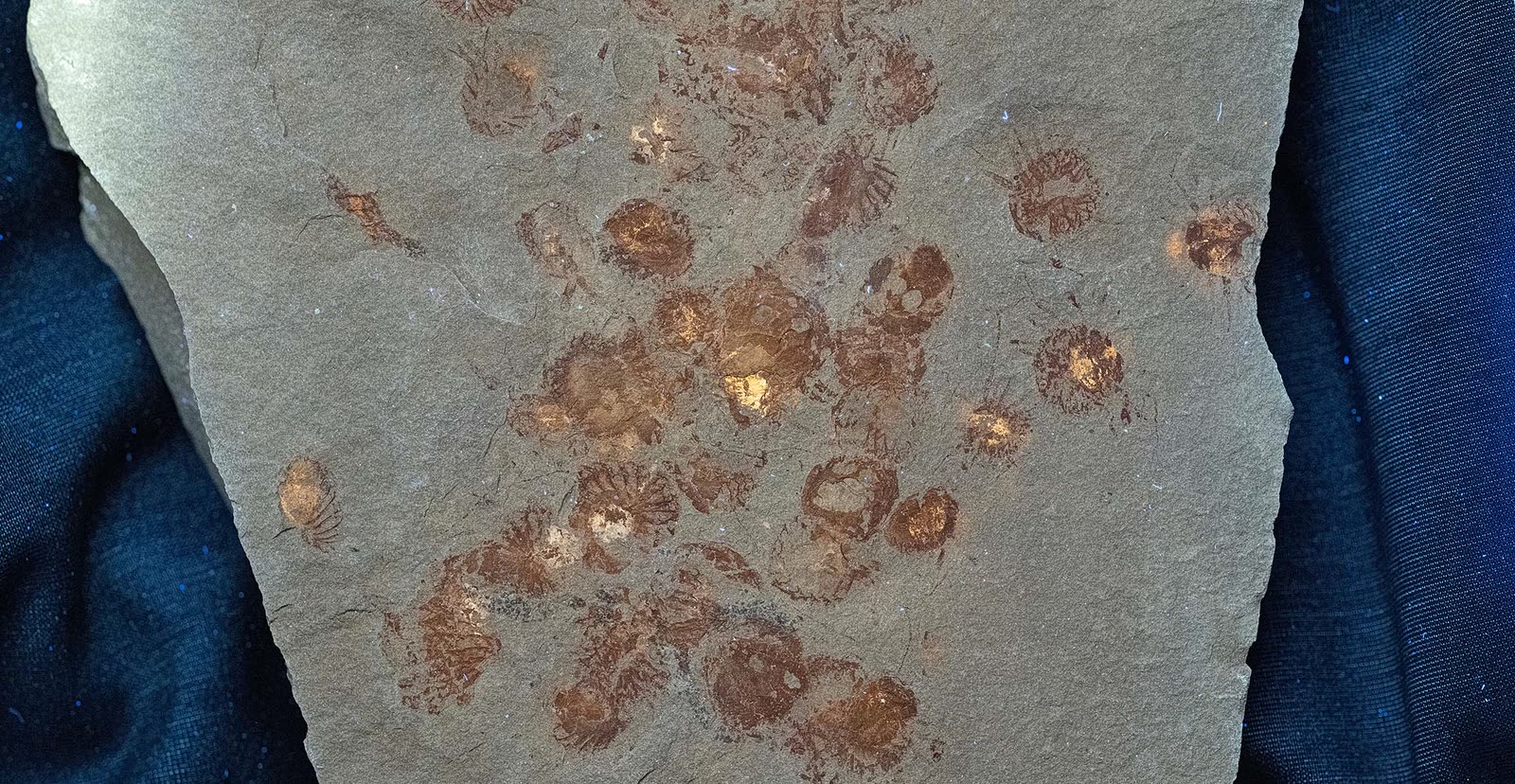
The slab looks sprinkled rather than inhabited. Across gray limestone sit dozens of reddish-brown discs, some no larger in the photograph than a shirt button. Look closer and the circles become bodies. Hair-fine legs fringe a few shields; antennae reach into the stone; one individual may retain traces of its gills. Researchers counted 50 animals, all assigned to the extinct crustacean Schramine montanaensis, on this single surface from Montana's Bear Gulch Limestone.[1][6]
That number invites an instant story: a crowd caught in the act. The fossil does support the crowd. It does not preserve the act. The animals are carcasses, not empty shells shed during moulting, and the burial event that fixed them together also killed them. Their arrangement makes two behaviours plausible—assembling before a synchronized moult or clustering for shelter—but cannot choose between them.[1]
This is what makes specimen LF 7078 more interesting than a frozen spectacle. It shows how fossil behaviour is built by subtraction. Orientation can weaken a transport explanation. Anatomy can separate bodies from moults. Size can make mating less likely. Missing food can argue against scavenging. Yet when those alternatives have been removed, two live histories remain. A close reading should preserve that final fork rather than force the slab to perform one last scene.
First identify the animals beneath the shields
Cyclidans spent roughly a quarter-billion years in marine ecosystems, from the Carboniferous into the Late Cretaceous, but they remain much less familiar than trilobites or true crabs. Their broad, oval-to-round carapaces hide most of the body when viewed from above. Beneath that shield sat paired antennules and antennae, six pairs of thoracic limbs, a reduced abdomen and curved gill structures. The outline invited more than a century of conflicting assignments to trilobites, horseshoe crabs, crabs and other arthropod groups.[1]
Exceptional fossils eventually made the hidden anatomy legible. A 1997 study of Mazon Creek cyclidans used preserved appendages and other ventral structures to argue that these animals were specialized crustaceans, perhaps near copepods, and may have occupied some crab-like ecological roles.[3] Later work has rearranged the higher branches and left their exact position within Pancrustacea disputed. The useful boundary is therefore precise: Schramine can be discussed as a cyclidan crustacean without pretending that its nearest living relatives are settled.[1]
LF 7078 came from the Serpukhovian-aged Bear Gulch Limestone, about 325 million years old. It was acquired by collector Dave Douglass in the early 1980s, displayed in the Douglass family's Prehistoric Life Museum, and later acquired for study by the Lauer Foundation, where its registration number and permanent research access give the spectacular slab a testable curatorial identity.[1] Provenance matters here. A claim about one exceptional surface can be revisited only if other researchers can find the same rock, examine its texture and check each counted animal.
Before reading behaviour, rule out a current
Fifty similar animals on one bedding plane form what paleontologists call a body cluster. That description is spatial, not yet social. Currents can sweep dead bodies into hollows, storms can sort shells by size, and a single layer can compress animals that did not meet while alive. A crowd in stone must first survive the possibility that geology assembled it.[1][4]
Several details make mechanical accumulation a poor fit for LF 7078. The cyclidans range from complete to somewhat fragmentary, but some retain articulated walking legs, long antennules and possible gill tissue. Delicate bodies that had drifted, rolled and accumulated after decay would be less likely to preserve those connections. Just as importantly, their shields do not share a preferred orientation. A bottom current capable of sorting broad, low carapaces should leave a directional signature; here the animals point in different directions.[1]
The regional geology explains why this distinction is possible. Bear Gulch formed in a productive tropical marine bay whose fine sediments accumulated in repeated laminae. Eileen Grogan and Richard Lund's depositional model links the best preservation to seasonal, organic-rich microturbidites: monsoonal runoff or resuspended sediment moved across a density boundary in the water, consumed oxygen as it descended, and could suffocate and bury small animals almost together.[2] Rapid death and rapid burial protected articulation. They also created the analytical problem. The same event preserved a gathering and threatens to be mistaken for the cause of it.
LF 7078 does not remove every conceivable transport process. It does something narrower and stronger: articulation plus the absence of alignment make a living aggregation more economical than a heap assembled by a sustained current. The fatal sediment pulse caught animals that were already near one another.[1][2]
These are bodies, not fifty discarded suits
Arthropods grow by leaving an old exoskeleton behind. A bed full of shed shells can therefore record many animals without preserving many deaths, and a cluster of exuviae can be direct evidence that moulting occurred in one place. Distinguishing an empty moult from a carcass is the hinge of this fossil.
The distinction is not made by calling one specimen “complete.” Moults can remain deceptively coherent, while decay can pull a carcass apart. Researchers instead look for repeated opening patterns, displaced plates and exuvial gaps—the routes through which animals escaped—as well as internal structures that should not have been shed. Reviews of the trilobite record emphasize that posture, disarticulation, local sedimentology and comparison with decay all have to agree before a fossil is labelled a moult.[4]
On LF 7078, twelve individuals visibly preserve walking legs, six preserve elongated antennules and one shows structures interpreted cautiously as possible gills. The high articulation, lack of a repeated escape configuration and presence of tissue that would have remained inside the animal led the research team to identify most or all of the fossils as carcasses.[1] The group died together. It had not yet completed a mass moult.
That finding does not eliminate moulting as the reason for gathering. It changes the tense. The slab could record animals preparing to moult, not animals whose cast-off shells document that the moult occurred. This is a much thinner behavioural claim than the fossil clusters of Canadaspis and other Burgess Shale arthropods interpreted as synchronized moulting because they contain repeated exuviae.[5] LF 7078 preserves anticipation, if it preserves moulting at all.
Size and absence close three tempting stories
The researchers could measure carapace length and width in 27 of the 50 cyclidans. Lengths ran from 4.9 to 10.7 millimetres, with 21 of the measured animals concentrated between 6.9 and 9.4 millimetres. The largest known S. montanaensis reaches about 25 millimetres—more than twice the length of any measured individual on the slab.[1]
That shared small size matters without becoming a birth certificate. Cyclidan maturity is unknown, so the cluster cannot be proven juvenile. Still, a mostly similar, submaximal size class is more compatible with a cohort at a similar developmental stage than with a random sample of the whole population. It also makes synchronous reproduction a weaker explanation, because the animals do not look full-grown.[1]
Two other common reasons for arthropod gatherings leave no positive trace. There is no carcass or other food item at the cluster's centre, which argues against communal scavenging. Nor is there a predator trace beside the group, or a known record of direct predation on cyclidans, to support animals bunching in response to an immediate attacker.[1] These are arguments from absence and deserve the limits of that form. A meal could fail to preserve; a predator need not touch the sediment. The slab makes feeding and an active defence scene less likely, not metaphysically impossible.
After transport, shed exoskeletons, mating, scavenging and an immediate predator response are tested, two explanations carry most of the remaining weight.
A moult that had not started—or shelter that vanished
The first possibility is a pre-moult aggregation. Moulting is a dangerous interval: the old covering must open before the new cuticle hardens, temporarily reducing protection. Living arthropods can synchronize the event or gather while vulnerable, and fossil clusters of actual exuviae show that coordinated moulting has deep roots.[4][5] Similar-sized Schramine may have approached the same growth transition together. Burial then arrived before any diagnostic shell opening was made.
This interpretation fits the bodies, but it does not turn them into a clock. No chemical signal, developmental stage or imminent separation of the old cuticle is preserved. Similar size is compatible with synchronized growth; it does not prove a shared moult schedule. Calling the fossil a “mass-moulting event” without the prefix pre- would erase the most important anatomical result.[1]
The second possibility is sheltering. Modern mysid crustaceans can cluster in protected spaces and in response to environmental disturbance, giving the team a living comparison for small aquatic crustaceans gathering as conditions deteriorate.[1] Bear Gulch supplies a plausible disturbance: a seasonal sediment pulse moving through a stratified bay. The same storm system could have induced animals to bunch together and then delivered the oxygen-poor sediment that killed and sealed them.[1][2]
It is an elegant sequence, perhaps too elegant. No burrow wall, crevice, plant or other shelter is preserved beside the cluster. The storm explains death and burial more securely than it explains the animals' preceding decision. Nor are the two leading scenarios necessarily exclusive in life: animals nearing a vulnerable moult might also seek cover. The rock preserves one final position, not the order of motivations that produced it.
The most honest reconstruction ends at the fork
Future finds could narrow the choice. Repeated clusters dominated by the same size class, especially beside clear exuviae, would strengthen a synchronized-moult model. Aggregations consistently associated with physical cover or particular storm layers would make sheltering more persuasive. Cuticular evidence tied to moult stage could transform “preparing” from analogy into anatomy. A second slab with a different orientation or size pattern could also expose how exceptional LF 7078 really is.
Until then, the fossil supports a hierarchy of claims. Fifty Schramine occupied the same patch: strong. A current did not merely sweep their remains into a pile: well supported. They were mostly bodies rather than abandoned shells: strong. Their small size may represent a juvenile cohort: plausible. They gathered for a coming mass moult or for shelter: best current alternatives. Which one happened: unresolved.[1]
That hierarchy is not a failure to animate the past. It is the animation made accountable. LF 7078 carries social information across roughly 325 million years because anatomy, sediment and spacing eliminate several ways a false crowd could form. Its greatest value is not that 50 tiny crustaceans can be made to tell one vivid story. It is that they allow two vivid stories to survive—and show exactly why the stone cannot yet decide between them.
Sources
- Russell D. C. Bicknell et al., “Gregarious behaviour in Carboniferous cyclidan crustaceans,” Biology Letters 21 (2025)—description, imaging, measurements, taphonomic tests and behavioural alternatives for LF 7078.
- Eileen D. Grogan and Richard Lund, “The geological and biological environment of the Bear Gulch Limestone (Mississippian of Montana, USA) and a model for its deposition,” Geodiversitas 24 (2002)—bay setting, seasonal microturbidites, oxygen depletion and rapid burial (official journal PDF).
- Frederick R. Schram, Ronald Vonk and Cees H. J. Hof, “Mazon Creek Cycloidea,” Journal of Paleontology 71 (1997)—soft-anatomy evidence, taxonomic history and the crustacean interpretation of cyclidans.
- Harriet B. Drage and Allison C. Daley, “Recognising moulting behaviour in trilobites by examining morphology, development and preservation,” BioEssays 38 (2016)—criteria and taphonomic cautions for distinguishing fossil moults from carcasses.
- Joachim T. Haug, Jean-Bernard Caron and Carolin Haug, “Demecology in the Cambrian: synchronized molting in arthropods from the Burgess Shale,” BMC Biology 11 (2013)—comparative fossil clusters containing exuviae and the limits of behavioural analogy.
- Natural History Museum, London, “Fossil of ancient crustacean gathering reveals new insights into their lives” (2025)—institutional account and source page for the photograph of LF 7078.