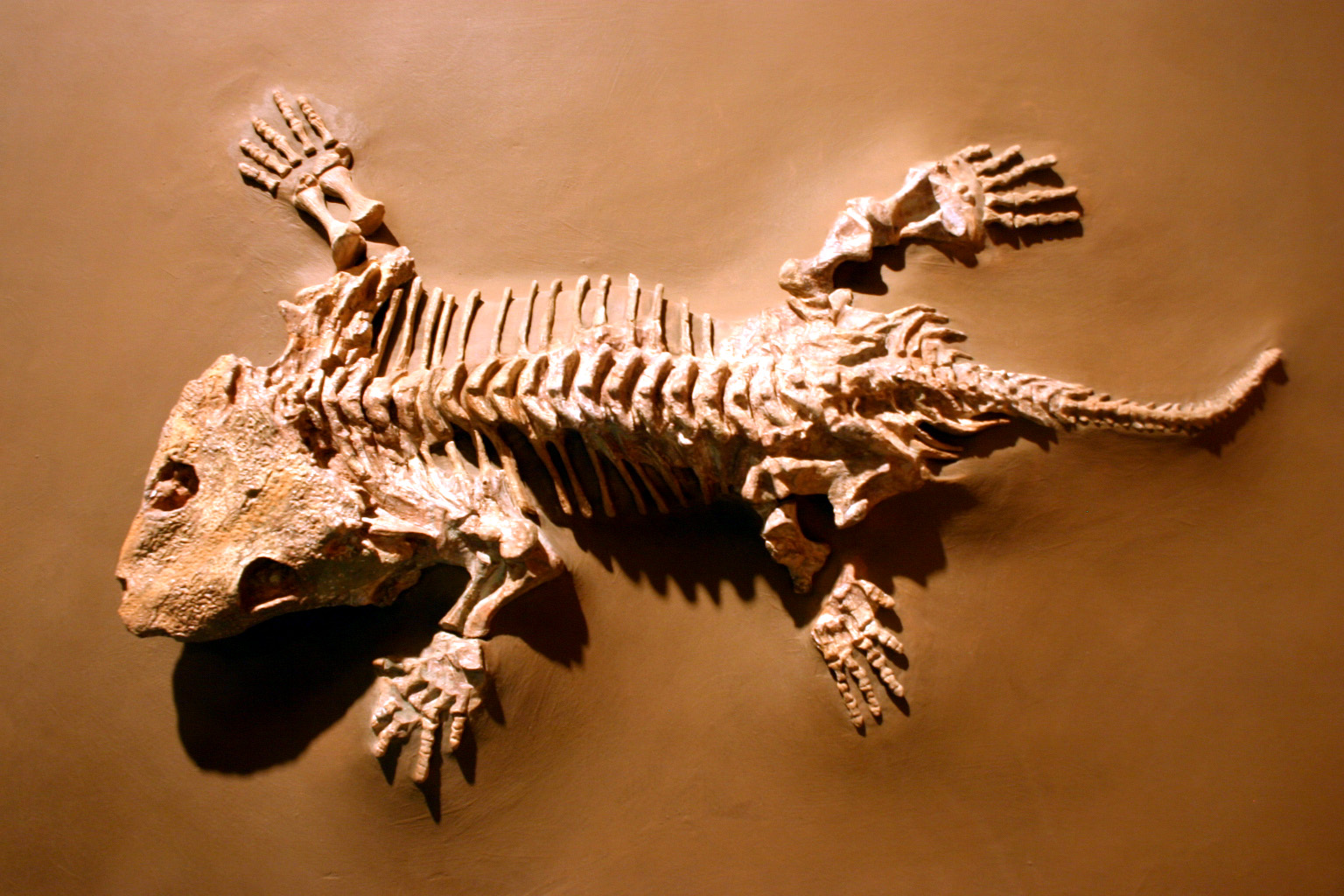
Seymouria is most useful when it refuses to stay in the box where the eye first puts it. The adult skeleton looks squat, strong-limbed, and almost reptilian: broad skull, short trunk, stout limbs, five-fingered hands, and a body that seems built to push across Early Permian ground rather than sag in water.[1][2] That appearance made historical sense. For much of its scientific life, Seymouria was treated as a candidate near the base of reptiles, or at least as a fossil close enough to the amniote threshold to make the land transition feel almost solved.[1]
The better species profile keeps that first impression and then disciplines it. Seymouria was not a tiny lizard waiting for a modern label. It was a seymouriamorph, a reptile-like non-amniote tetrapod whose adult skeleton carries terrestrial signals while its broader life-history context still points back toward water.[1][2][4] The animal matters because it preserves the messy middle: an adult body that had moved far into land anatomy, but not a clean amniote package with dry-land reproduction safely assumed.
The body is terrestrial, but not conclusive
Laurin's redescription of Seymouria baylorensis is a useful reset because it does not let the fossil become either a slogan or a simple ancestor. The paper notes a mosaic skull: some traits look more amniote-like than older reports allowed, while other characters remain primitive enough to weaken any easy placement inside the amniote crown group.[1] That is the key to the animal. Seymouria is not interesting because it gives one perfect answer. It is interesting because different anatomical systems point with different strengths.
The postcranial record sharpens the adult profile. Bazzana and colleagues describe Seymouria as the best known seymouriamorph and use articulated skeletons, histology, and comparative anatomy to test how terrestrial these animals really were.[2] Their work supports a strongly land-capable adult: robust limbs, reduced reliance on cartilage in the vertebrae, and bone tissues more consistent with a terrestrial life than with a permanently aquatic one.[2]
That is a real claim, but it has boundaries. A terrestrial adult is not the same as a true reptile. A skeleton can tell us how an animal stood, moved, supported weight, and grew. It cannot by itself prove that the animal laid amniotic eggs away from water. That is where Seymouria becomes more than a body plan. It becomes a test of how carefully paleontology separates locomotion from reproduction.
The water boundary comes from the life cycle
The Carnegie Museum's Bromacker account gives the public version of the problem in unusually concrete form. Seymouria sanjuanensis is described there as a terrestrial amphibian that returned to water to breed, with strong skeletons suited for land movement and a diet probably built around insects and small terrestrial vertebrates.[4] The Bromacker specimens also matter because they are not isolated curiosities. Juveniles and adults from the Tambach Basin, along with material from New Mexico and Utah, make S. sanjuanensis a geographically and developmentally useful species rather than a single spectacular skeleton.[4]
The word "amphibian" needs care here. It should not make the animal seem like a modern frog with a Permian costume. The point is narrower: seymouriamorphs sit outside the amniote condition, and the broader group preserves evidence that the move onto land did not happen as one clean jump.[1][2][4] A lineage can produce adults that are excellent on land before it has fully escaped water-dependent reproduction.
That distinction is the heart of the profile. In popular deep-time storytelling, land conquest often gets compressed into a ladder: fish, amphibian, reptile, mammal. Seymouria damages that ladder in a useful way. Its adult body looks more terrestrial than the label "amphibian" makes many readers expect. Its life-cycle boundary looks less reptilian than the adult skeleton first suggests. The animal belongs in the middle not because it is vague, but because the middle was anatomically real.
The teeth keep the animal close to the jaw
Recent dental work makes Seymouria more specific still. Maho and Reisz examined tooth histology and replacement patterns, finding pleurodont implantation, plicidentine, and an alternating replacement pattern that retained a primitive tetrapod condition while still making the animal useful for comparison with stem amniotes and amniotes.[3]
That kind of result is easy to underrate because teeth do not carry the immediate visual drama of a whole skeleton. But for a small Permian predator, teeth are where ecology and phylogeny meet. The numerous pointed teeth described in the Bromacker material fit a diet of small land animals rather than fish at that locality, especially because the quarry record lacks fish fossils or fish coprolites.[4] The histology adds another layer: the mouth was not just a row of generic spikes. It was a replacement system and attachment system with evolutionary information inside it.[3]
This matters because Seymouria should not be flattened into "almost reptile." Its jaws, skull, limbs, vertebrae, growth tissues, and local deposits each contribute a different kind of evidence. Some evidence speaks to diet. Some speaks to movement. Some speaks to phylogenetic placement. Some speaks to habitat. A good profile has to let those channels remain separate long enough to hear their disagreement.
The profile is strongest as a threshold, not an ancestor myth
The most tempting sentence about Seymouria is also the weakest: it was a missing link between amphibians and reptiles. The animal deserves better. Laurin's cranial work shows why resemblance to amniotes does not automatically settle relationship.[1] Bazzana and colleagues show why terrestriality can be strong without erasing the seymouriamorph life-cycle problem.[2] Maho and Reisz show that even the teeth preserve a mix of primitive retention and comparative value.[3] The Bromacker record then gives that anatomy a lived basin, a species distribution, juveniles, adults, and a reason to imagine an animal moving across dry ground while still needing water in its reproductive story.[4]
Read that way, Seymouria is not a failed reptile or a dressed-up amphibian. It is a Permian animal caught at a real evolutionary boundary. Its adult skeleton makes land life visible as engineering: stronger limbs, supportive vertebrae, a compact head, and a body no longer written mainly by swimming. Its classification boundary keeps the story honest: land competence came in pieces, and the amniotic egg was not simply implied by a sturdy leg.
That is why the flat museum skeleton works so well as the article's single image. It looks decisive at first glance. Then the science makes it less decisive and more interesting. Seymouria stands near the amniote story, but it is most valuable when it is allowed to remain just outside the easy version of that story, with one foot on land and the life cycle still answering to water.
Sources
- Michel Laurin, "A redescription of the cranial anatomy of Seymouria baylorensis, the best known seymouriamorph (Vertebrata: Seymouriamorpha)," PaleoBios 17, no. 1 (1996), UCMP PDF.
- Kayla D. Bazzana et al., "Postcranial anatomy and histology of Seymouria, and the terrestriality of seymouriamorphs," PeerJ 8 (2020), PMC full text.
- Tea Maho and Robert R. Reisz, "Dental anatomy and replacement patterns in the early Permian stem amniote, Seymouria," Journal of Anatomy 241, no. 3 (2022), PMC full text.
- Amy Henrici, "The Bromacker Project Part VI: Seymouria sanjuanensis, the Tambach Lovers," Carnegie Museum of Natural History (2020).
- Wikimedia Commons, "File:Seymouria1.jpg," source page for the photographed Seymouria baylorensis skeleton used as the article image.