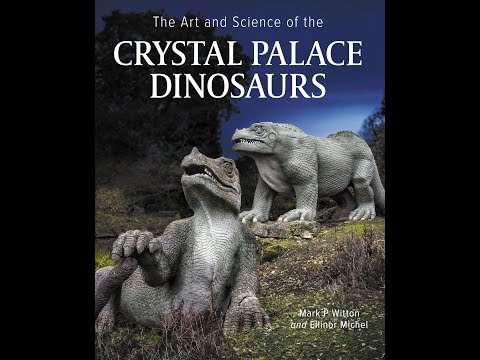
The Crystal Palace Dinosaurs are easy to laugh at if they are judged only against a modern dinosaur book. The Iguanodon horn is on the nose rather than the hand. Megalosaurus stands on four heavy limbs. Several animals in the display are not dinosaurs at all. But that is exactly why the lecture below is worth watching carefully. Its value is not that it rescues every Victorian anatomical choice. Its value is that it treats the sculptures as early public paleontology: a moment when fragmentary fossils, comparative anatomy, sculpture, park design, geology, and mass education were forced into one visible form.[1][2]
That makes the site different from a museum case or a modern reconstruction. Benjamin Waterhouse Hawkins unveiled the sculptures in 1854, with advice from Richard Owen, at a time when dinosaurs were still a new scientific category and the available fossils were sparse.[2][3] Natural History Museum paleontologist Susie Maidment's account is especially useful here because it refuses the cheap version of the joke. The models look strange now, but they were built from limited bones, living-animal analogies, and the best available mid-nineteenth-century interpretation.[2] The wrongness is therefore historical evidence, not just error.
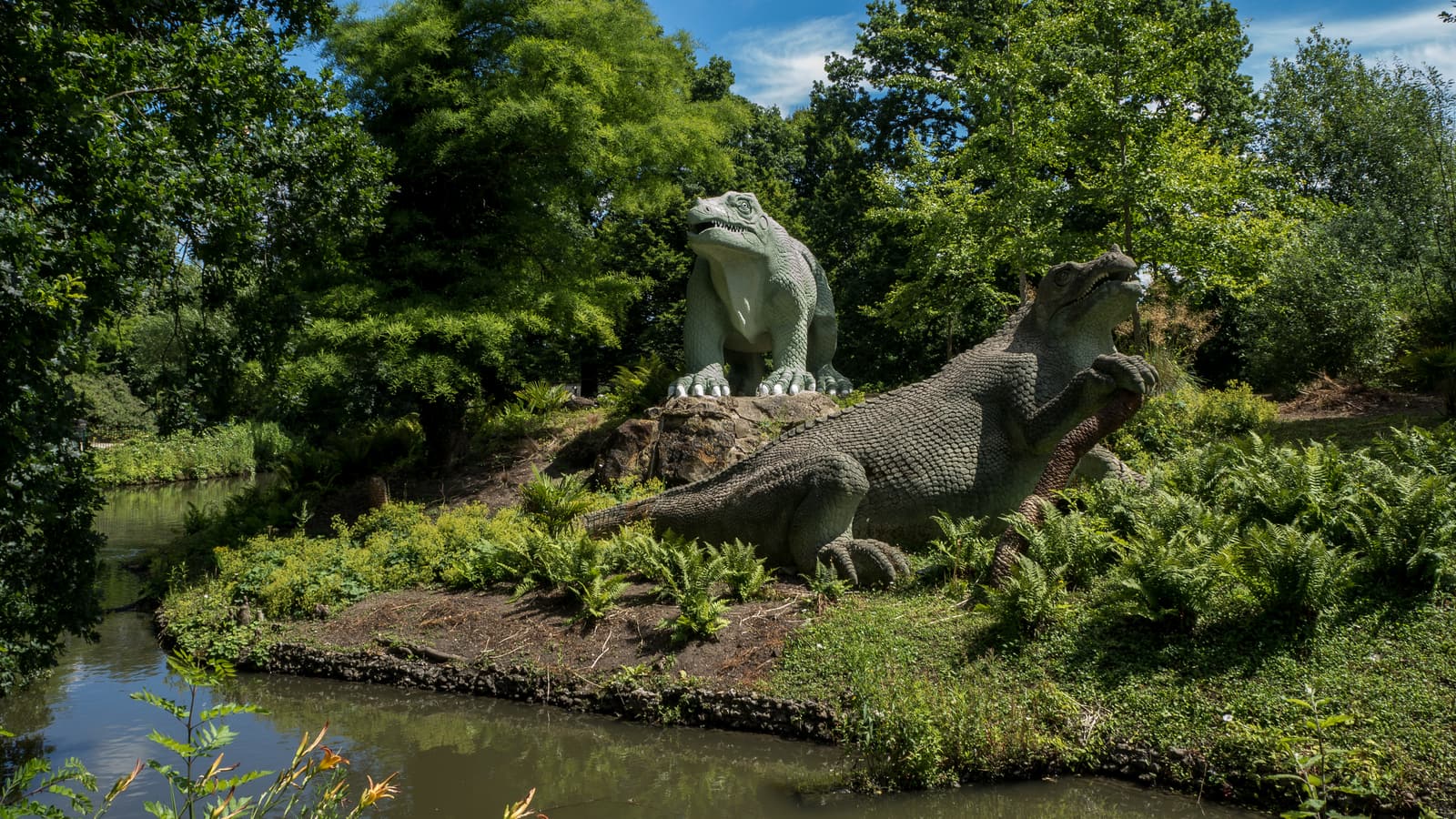
Image context: the lead image is Peter Cooper's real 2016 photograph of the Crystal Palace Iguanodon sculptures, sourced through Wikimedia Commons. It is not a generated scene or a diagram. It matters here because these reconstructions are still outdoor objects, not only illustrations in a history of science textbook: scale, placement, weathering, and public distance are all part of what the article is asking the viewer to notice.[5]
The lecture works best when the sculptures are treated as arguments
The strongest way to watch this lecture is to keep asking what kind of claim each object is making.[1] The Crystal Palace animals are not neutral decorations. They are hypotheses made in cement, clay, brick, iron, paint, and landscape. When the Iguanodon stands as a broad quadruped, that pose encodes a Victorian answer to a real problem: how do you reconstruct a giant reptile when the skull, posture, hand anatomy, and locomotion are still incompletely understood?[2]
The Natural History Museum article gives the key boundary. The mid-nineteenth-century builders did know these were reptiles, and they had teeth, femora, vertebrae, armor, spikes, and other fragments to work from. They did not yet have the Bernissart Iguanodon discoveries that later moved the famous spike from nose to hand, nor the broader comparative framework that made bipedal theropods routine to visualize.[2] That means the old models should be read less as failed modern dinosaurs and more as fossil interpretation under shortage.
This is where the video's art-and-science frame matters. Hawkins was not merely decorating Owen's ideas, and Owen was not merely handing a sculptor a finished body plan. Public paleontology had to pass through craft. Someone had to decide volume, skin texture, posture, sightlines, and how a visitor would encounter extinct life at full scale.[1][2] A paper can leave uncertainty in prose. A life-size sculpture has to put the uncertainty somewhere physical.
The park made deep time walkable before dinosaur anatomy was settled
The Crystal Palace display also teaches a lesson about format. The animals were placed in a designed park, arranged with geological scenery, water, islands, and paths rather than isolated in a cabinet.[2][3] That matters because the site was trying to make deep time public before most visitors had any stable visual vocabulary for extinct animals. The models were educational infrastructure as much as sculpture.
Historic England's feature describes the group as life-size statues of dinosaurs and other extinct animals at Crystal Palace Park, with Grade I listing and heritage-risk attention in the modern period.[3] That heritage status is not a sentimental footnote. It reflects the fact that the sculptures are part of the history of paleontology itself. They preserve not only a set of extinct-animal reconstructions but a public method: turn fossil interpretation into a walkable sequence that visitors can compare, remember, and argue with.[3]
Seen this way, the site's famous mistakes become part of its scientific use. The Iguanodon nose horn shows how a single detached bone can be misoriented when the rest of the body is unknown.[2] The heavy Megalosaurus body shows how analogy with large living reptiles could dominate when a complete theropod skeleton was not available.[2] The broader animal collection shows that "dinosaur" functioned publicly as a convenient umbrella even though the display included marine reptiles, mammals, amphibian-grade forms, and other extinct animals.[2][3]
Conservation turns the old reconstructions into active evidence
The lecture also lands differently once the sculptures are treated as aging objects rather than static images.[1] Historic England's conservation reporting makes the point directly: the dinosaurs have endured weather, drought, cracking, repair, and renewed survey work, and partners have been studying materials, scanning, archival evidence, and long-term management needs.[4] In other words, the Crystal Palace Dinosaurs are not only about what Victorians thought extinct animals looked like. They are also about how a public paleontology object survives 170 years outdoors.
That survival changes the ethics of correction. A modern museum can replace a wrong model with a new one. Crystal Palace cannot be "updated" in that simple way without destroying the very evidence that makes it important. Its wrong Iguanodon is historically right because it preserves the moment before Bernissart and later dinosaur anatomy rewrote the animal.[2] Conservation therefore has to protect both material fabric and intellectual context. Repairing the sculptures is not the same as modernizing their anatomy.
This is the main reason an annotated viewing works better than a standard species profile here. The subject is not Iguanodon alone, or Megalosaurus alone, or Hawkins alone. The subject is a public reconstruction system. The video supplies the spine: art and science meeting in one Victorian site.[1] The written sources keep the boundaries honest: the science was limited but serious, the errors are historically interpretable, the listing reflects public heritage value, and the ongoing deterioration is a conservation problem, not just a tourism inconvenience.[2][3][4]
Watched that way, the Crystal Palace Dinosaurs stop being a punchline. They become a rare case where paleontology's uncertainty is still standing in the park. The sculptures are wrong because science moved on. They are useful because they let us see what moving on looked like from the starting line.
Sources
- Friends of Crystal Palace Dinosaurs, "The Art and Science of the Crystal Palace Dinosaurs," YouTube video.
- Natural History Museum, "The world's first dinosaur park: what the Victorians got right and wrong."
- Historic England, "Crystal Palace Dinosaurs."
- Historic England, "Saving the World-Famous Crystal Palace Dinosaurs."
- Wikimedia Commons file page for the lead image, "Crystal Palace Dinosaurs - Iguanadons.jpg."