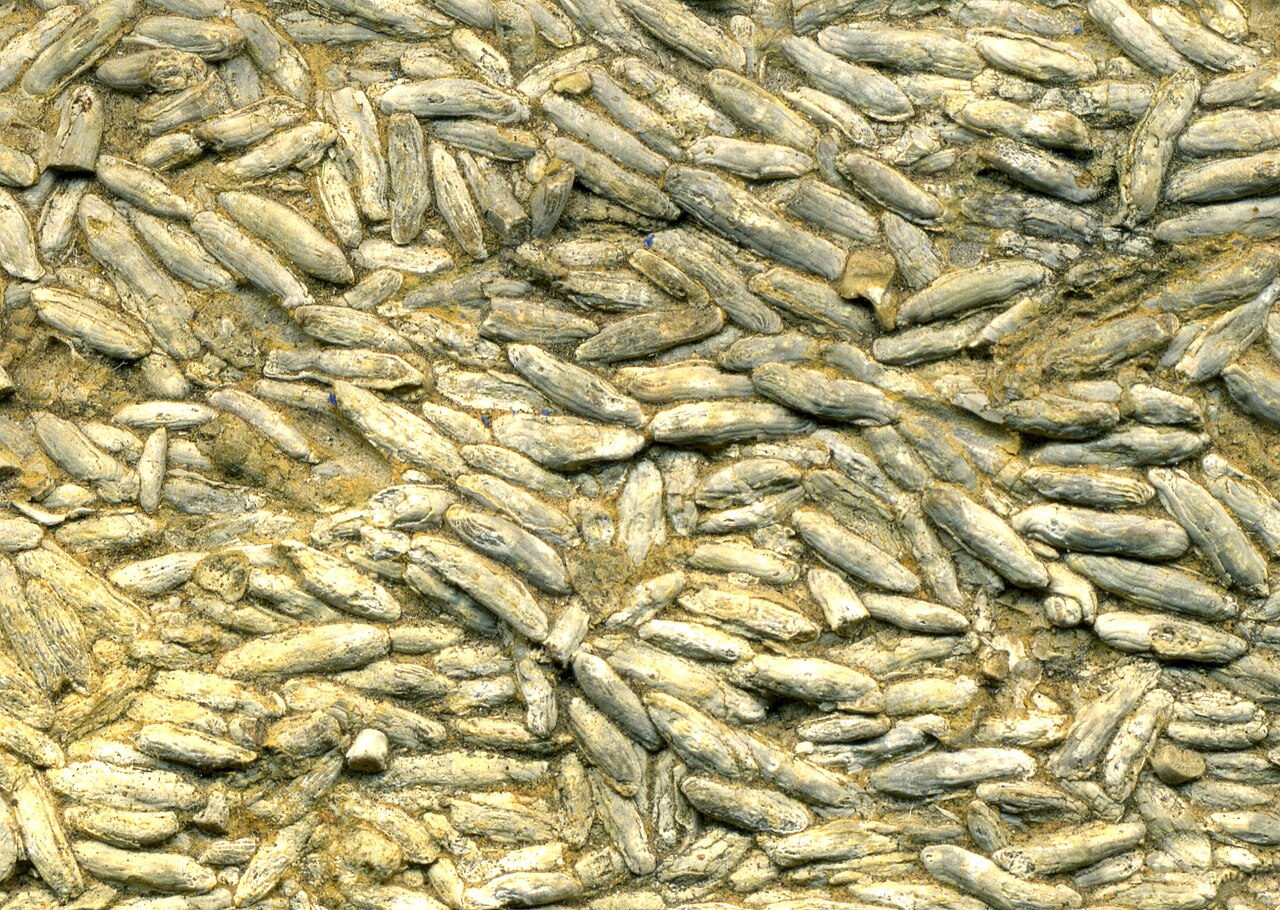
Fusulinids look too small to carry the weight they do. On a limestone surface they can resemble pale grains of rice scattered through gray rock, or tiny wheat seeds caught in cement. That modest appearance is the trap. Each grain is the shell, or test, of a single-celled marine foraminiferan, and the scientific value sits in the mismatch between biological scale and geological consequence.[1][2][3]
The better way to read fusulinids is not as miniature shells alone. They matter because the same object works at three levels. A test is a piece of cellular architecture, built chamber by chamber around a longitudinal axis. A crowded slab is a shallow-marine accumulation that can become limestone. A succession of different fusulinid forms is a time signal, because the group evolved fast enough and spread widely enough for geologists to correlate rocks across large distances.[1][2]
The shell is the method
Foraminifera are amoeba-like protists that secrete or build tests, and the test is the part most likely to enter the fossil record.[3] That general fact matters before fusulinids become special. A living foram may be soft protoplasm, but the durable shell makes it collectible, sectionable, comparable, and datable. In fusulinids, the shell became unusually informative because it was internally complex while remaining externally easy to underestimate.[1][2]
GeoKansas gives the clean public version of that anatomy. Fusulinid tests are calcium carbonate shells divided into chambers; as the organism grew, the test coiled around itself and added chambers along its long axis.[1] Britannica sharpens the same point: many fusulinids resemble wheat grains, but the internal structure is complex and distinctive, with patterns of walls and deposits that help classification and evolutionary interpretation.[2]
That is why an uncut fusulinid can mislead. From the outside, many specimens look similar. Under a microscope, especially in cross section, the internal chamber pattern becomes the real evidence.[1][2] The fossil is therefore not only a shape in a hand sample. It is a tiny architectural record that often has to be cut, polished, and read from within.
This is a useful discipline for paleontology generally. Some fossils announce themselves with a skull, a claw, or a trackway. Fusulinids work more like a code. The exterior tells you where to look. The interior tells you what you have.
Abundance turns cells into limestone
The Kansas examples show why fusulinids outgrow the category of "interesting microfossil." GeoKansas notes that fusulinids are common in Pennsylvanian and Permian rocks of eastern Kansas, and that some Kansas limestones are made up almost entirely of fusulinid fossils.[1] The photographed slab used here makes that claim tangible: the visible surface is a dense concentration of fusulinid tests from the Upper Pennsylvanian of Elk County, Kansas.[6]
That abundance changes the kind of evidence a fusulinid provides. One test can identify a taxon if it is preserved and sectioned well enough. Thousands of tests in a limestone bed can also say something about environment, accumulation, sorting, and carbonate production. GeoKansas describes fusulinids as preferring clear offshore marine water and possibly reef settings, while Britannica similarly places most fusulinids in clear marine water far from shore.[1][2]
The word "possibly" matters. A fusulinid-rich limestone is not a direct snapshot of a living colony arranged exactly as it was in life. Shells can be transported, concentrated, reworked, or dissolved before final burial. But the abundance still has force. A rock packed with fusulinids tells us that these single-celled organisms were not peripheral decorations in late Paleozoic seas. They were common enough in the right settings to become a visible component of carbonate rock.
That is the central scale shift. The animal is one cell. The test is millimeters to centimeters. The limestone bed is landscape. Fusulinids connect all three.
Timekeeping comes from rapid change
Fusulinids became especially powerful because they did not stay anatomically static. GeoKansas summarizes an eighty-million-year history in which early forms were minute and somewhat spherical, while later forms commonly became longer, narrower, larger, and internally more ornate.[1] Britannica gives the practical consequence: fusulinids are useful for correlating widely separated rock units and for subdividing geologic time.[2]
The reason is simple but demanding. A fossil becomes a good time marker when it is common, widespread, preservable, and changes fast enough that one interval differs from another. Fusulinids meet that standard unusually well in Carboniferous and Permian shallow-marine rocks.[1][2][4] They are not just present. They are differentiated, abundant, and tied to an evolutionary sequence.
This is why the rice-grain metaphor has to be retired quickly. A handful of similar-looking grains on a slab may seem repetitive. In thin section, those grains can belong to different lineages, different growth stages, or different time intervals. The time signal is not carried by prettiness. It is carried by disciplined comparison of internal architecture across many specimens and many beds.
The 2025 Science Advances study shows how far that timekeeping role can now be pushed. Zhang and colleagues analyzed a high-resolution global dataset of fusuline foraminifera, treating them as the most diverse marine fossil group from the Carboniferous to the Permian, roughly 340 to 252 million years ago.[4] Their reconstruction worked at a temporal resolution finer than 45,000 years and identified major diversification and decline patterns, with long-term cooling associated with diversification and warming events linked to extinctions in the group.[4]
That does not mean fusulinids are a simple climate thermometer. It means their fossil record is dense enough to let researchers ask unusually fine questions about biodiversity through deep time. A good index fossil can date a bed. A very dense index-fossil record can become a biodiversity instrument.
The wall itself remains an evidence problem
The shell is not only a shape and not only a clock. It is also a material object whose microstructure affects classification. British Geological Survey's foraminifera overview places fusulinids among microgranular-walled forams in the traditional wall-texture vocabulary.[3] That category has long been part of how paleontologists recognized major foram groups.
But even here, the method has become sharper. Dubicka and Gorzelak's 2017 Scientific Reports study challenged the old assumption that the "microgranular" texture in some Paleozoic fusulinid-like foraminifera was primary. Their Devonian material from Poland preserved nanograin structures closer to hyaline foraminifera, leading them to argue that some supposed microgranular textures were diagenetic artifacts rather than original biology.[5]
The safest reading is not to flatten that paper into a total rewrite of every fusulinid wall. The useful lesson is methodological. Fusulinid anatomy is partly visible in ordinary fossil abundance, but the deepest claims depend on preservation quality, sectioning, microscopy, chemistry, and the ability to separate original shell construction from later mineral alteration.[3][5]
That boundary keeps the fossil honest. A limestone full of fusulinids can look self-explanatory. It is not. The paleontologist still has to ask which features belong to the living test, which belong to growth, which belong to taxonomic difference, and which were introduced by diagenesis after burial.
Why the tiny clock still matters
Fusulinids are most impressive when they are allowed to stay small. They do not need to become charismatic animals in miniature. Their force comes from being single-celled organisms that built enough chambered architecture to become readable, enough shell material to become rock, and enough evolutionary turnover to become one of the great late Paleozoic clocks.[1][2][4]
The end of the story is also part of the lesson. Fusulinids persisted until the end of the Permian, disappearing in the crisis that closed the Paleozoic world.[1][2][4] That makes them doubly useful. They record ordinary shallow-marine time in bed after bed, and they also register the vulnerability of carbonate-sea ecosystems when environmental conditions cross hard limits.
So the best way to look at a fusulinid limestone is twice. First, see the crowd: a rock face packed with rice-grain tests, a carbonate surface made from biological repetition. Then look inward: chamber walls, coiling, wall texture, species turnover, stratigraphic range, climate-linked diversity. The slab is not just full of fossils. It is full of little clocks, each one built by a single cell.
Sources
- GeoKansas, "Fusulinids" - overview of fusulinid test anatomy, chamber growth, Kansas limestone abundance, stratigraphic range, environment, and correlation use.
- Encyclopaedia Britannica, "Fusulinid" - concise reference on fusulinids as extinct foraminiferans, their Carboniferous-Permian range, complex internal shells, clear-water habitat, and stratigraphic use.
- British Geological Survey, "Foraminifera" - general foram biology, test construction, wall types, and the role of tests as the fossilized part of the organism.
- Shu-Han Zhang et al., "Global cooling drove diversification and warming caused extinction among Carboniferous-Permian fusuline foraminifera," Science Advances 11, no. 25 (2025), PubMed record.
- Zofia Dubicka and Przemysław Gorzelak, "Unlocking the biomineralization style and affinity of Paleozoic fusulinid foraminifera," Scientific Reports 7 (2017).
- Wikimedia Commons, "File:Fusulinid limestone, Upper Pennsylvanian; Elk County KS.jpg" - source page for the real fossil limestone photograph used as the article image.