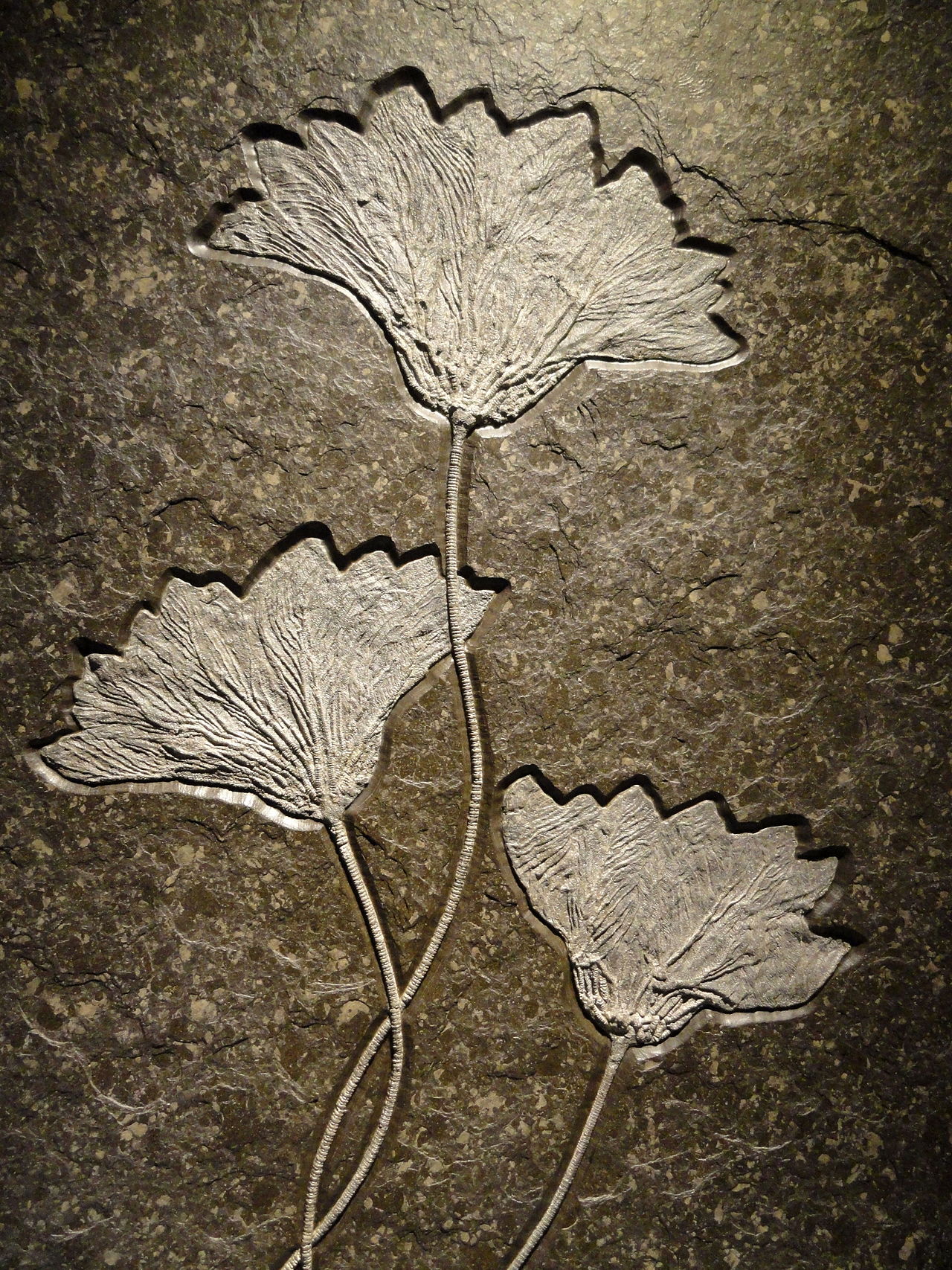
The first mistake is to see Seirocrinus as a flower. The name "sea lily" is useful at museum distance, where the fossil reads as stems and blossoms spread across black stone. Biologically, though, crinoids are echinoderms, relatives of starfish and sea urchins, built from calcareous plates and feeding with feathery arms rather than petals.[3][4] The plantlike look is the trap. The fossil becomes sharper when the viewer asks how an animal that looked rooted could travel.
The spectacular Lower Jurassic specimens from Holzmaden answer with a strange compromise: not swimming, not walking, not fixed to a reef, but living from a temporary wooden platform. Michael Simms's classic comparison of Lower Jurassic crinoids treated pentacrinitids such as Seirocrinus subangularis as pseudopelagic animals, suspended beneath floating objects such as driftwood rather than anchored permanently to the bottom.[1] That single shift changes the whole fossil. The long stem stops being a decorative stalk and becomes a tether. The crown stops being a flower and becomes a feeding fan. The log becomes habitat.
Holzmaden itself makes the scene unusually legible. The town's public account of its fossil heritage notes that fossils from the Posidonia shale of an ancient Jurassic sea, up to about 180 million years old, were discovered during attempts to extract shale oil in the 1860s and later prepared, studied, and displayed in museums.[5] That mining history matters because the most memorable Seirocrinus slabs are not isolated bones. They are whole episodes of sea surface, decay, drift, sinking, and burial compressed into stone.
The animal was a filter, not a fossil ornament
A crinoid body is easy to fragment. The stem is made from stacked discs called columnals or ossicles; after death, those pieces often separate, while delicate arms are harder to preserve intact.[3][4] That is why complete crinoids feel so extravagant. They require more than an animal dying. They require timing.
In life, the useful part of Seirocrinus was the crown. Its arms made a food-collecting surface in moving water. BGS describes stemmed crinoids as able to bend toward currents and use their brachia as nets for food particles, with pinnules improving the collecting surface in some groups.[3] Put that behavior beneath a floating log and the animal becomes a suspended filter. It is not rooted in a garden. It is hanging under moving debris, using the ocean itself as conveyor belt.
Simms's argument is powerful because it does not rest on a single romantic picture of a crinoid raft. It combines taphonomy, morphology, and population pattern. Lower Jurassic pentacrinitids differ from bottom-dwelling isocrinids in their association with driftwood, the condition of their remains, geographic spread, and inferred growth and reproductive strategy.[1] In other words, the fossil is not merely "found near wood." The whole pattern fits a life organized around rare floating substrates.
That rarity is the key. A seafloor animal can wait for current. A driftwood animal must first find a platform. Larvae had to settle on a log before it waterlogged or was destroyed. The animals then had to grow quickly enough to make use of a moving, temporary habitat.[1] The raft was therefore both opportunity and deadline. Seirocrinus lived in an ecological clock.
The stem made distance useful
The long stem can look excessive until it is read as spacing technology. On a crowded raft, crowns too close to the wood or to each other would compete for flow. Length helped place feeding fans into water where particles were available and neighbors did not fully steal the current. This is an inference from form and from Simms's discussion of high filtration efficiency and adult size, not a directly filmed behavior.[1] But it explains why the preserved geometry matters. The animal's body plan was not just a way to attach. It was a way to occupy water column space.
That matters for paleontology because it turns a fossil slab into a record of constraints. The crown needed flow. The stem needed flexibility and strength. The holdfast needed purchase on wood, not rock. The wood needed buoyancy long enough for growth and reproduction. Later, the same system had to sink into conditions quiet enough to preserve a body that would otherwise fall apart.
Russell Hall's description of an almost complete Seirocrinus subangularis from the Fernie Formation in Alberta adds a useful control outside the famous German material. The specimen was dated by associated ammonites to the Late Pliensbachian, and Hall interpreted its preservation as soft mud on a quiet, oxygen-deficient seafloor, with one surface intact and the exposed upper surface more disturbed.[2] That detail is important because it separates life position from death environment. A crinoid could have lived in the water column and still required a low-energy, low-oxygen bottom to become a good fossil.
The Holzmaden image therefore should not be read as a snapshot of happy animals still waving beneath a log. It is a death-and-burial arrangement. The feeding platform failed, sank, or was carried into a preservational setting. The dark shale did not create the ecology, but it saved enough of it that the ecology can be reconstructed.
The raft was an ecosystem with a short lease
Driftwood makes the story bigger than a single taxon. A floating trunk in a Jurassic sea was surface, shelter, food source, dispersal vehicle, and eventual deadfall. For Seirocrinus, it was mainly an attachment surface that made open-water filtering possible. For other organisms, the same wood could have been a place to settle, graze, hide, or hitchhike. The point is not that the raft was stable. The point is that instability created a niche.
That is why Seirocrinus is more interesting than a "giant sea lily" headline. Its most important trait is not size alone, but dependence. Remove the wood and the adult animal loses its platform. Remove the current and the crown loses its food stream. Remove quiet bottom water and the fossil loses its articulation. Remove the quarrying and preparation history at Holzmaden and much of the public image of the animal disappears into uncut shale.[5][6]
The fossil also keeps artistic reconstruction honest. It is tempting to paint a Jurassic raft as a floating garden, but the evidence is skeletal and taphonomic. Stems, crowns, attachment, driftwood association, shale, and comparative crinoid anatomy support the pseudopelagic reading.[1][3][4] Color, motion, crowd behavior, and exact daily rhythm remain inferred. The strongest version of the animal is not less vivid because of those limits. It is vivid because the limits are visible.
Why this fossil still teaches well
Crinoids are often introduced through fragments: little discs in limestone, star-shaped columnals in a hand sample, scattered stems in a roadcut. Those pieces are useful because they show how durable the skeleton was. But Seirocrinus shows the opposite lesson: sometimes the discipline advances because enough fragile arrangement survives to let paleontologists read behavior at the scale of a whole platform.
BGS notes that abundant fossil crinoids can indicate marine conditions and, in Paleozoic rocks, shallow-water settings, while rare complete specimens point toward rapid burial in quiet, possibly poorly oxygenated water.[3] The National Park Service makes the complementary point at specimen scale: ossicles fossilize well, but full stalks and arms are harder to keep together.[4] Seirocrinus sits at the intersection of those truths. It is made of durable pieces, but the story depends on those pieces staying arranged.
That is the real lesson of the Holzmaden rafts. They are not merely beautiful fossils. They are preserved systems. The animal's shape, the wood's buoyancy, the sea's flow, the seafloor's chemistry, and human preparation all had to cooperate across radically different timescales. A living crinoid needed days, years, and currents. A fossil needed burial, mineralization, quarrying, and display.
Read that way, Seirocrinus turns deep time from a parade of extinct forms into a problem of temporary infrastructures. A log floated. Animals attached. Crowns filtered. The platform failed. Shale kept the arrangement. Millions of years later, the slab still asks the same question: what had to stay together long enough for this animal's way of life to become visible?
Sources
- Michael J. Simms, "Contrasting lifestyles in Lower Jurassic crinoids: a comparison of benthic and pseudopelagic Isocrinida," Palaeontology 29, no. 3 (1986), Palaeontological Association archive page.
- Russell L. Hall, "Seirocrinus subangularis (Miller, 1821), a Pliensbachian (Lower Jurassic) crinoid from the Fernie Formation, Alberta, Canada," Journal of Paleontology 65, no. 2 (1991), Cambridge Core abstract and DOI page.
- British Geological Survey, "Crinoids," fossil and geological-time guide page covering crinoid anatomy, environment, and preservation.
- U.S. National Park Service, "Crinoid Fossil," Grand Canyon National Park fossil explainer with crinoid anatomy and preservation notes.
- Gemeinde Holzmaden, "Urwelt entdecken," municipal guide to the Holzmaden fossil site, Posidonia shale fossils, museum, and quarry.
- Wikimedia Commons, "File:Seirocrinus subsingularis, view 2, Jurassic, Hlzmaden Black Shale Formation, Holzmaden, Germany.JPG" - source page for the real fossil photograph used as the article image.