Rhamphorhynchus muensteri is usually remembered through silhouette: narrow wings, a long stiff tail, and a little diamond or leaf at the end. That last part is easy to treat as decorative, as if the animal were a prehistoric kite with a flourish tied to the string. The fossil record points to a better reading. The tail vane was soft tissue, but it was not ornamental fluff. It sat at the end of a long caudal series in one of the best-sampled non-pterodactyloid pterosaurs, and recent work makes it harder to separate flight control, tensioned tissue, growth, and display into tidy boxes.[1][3][4]
The reason this animal can carry that much interpretation is the Solnhofen record. Bennett's statistical work treated the named Solnhofen forms of Rhamphorhynchus as year-classes of a single large species rather than a crowd of separate species split by size and maturity.[1] Hone, Henderson, Therrien, and Habib later emphasized that the genus is known from more than 100 specimens, many complete and articulated, with some preserving soft tissues such as wing membranes and tail vanes.[2] That combination matters. A rare structure preserved once can become a curiosity. A rare structure preserved across a useful sample can become a method.
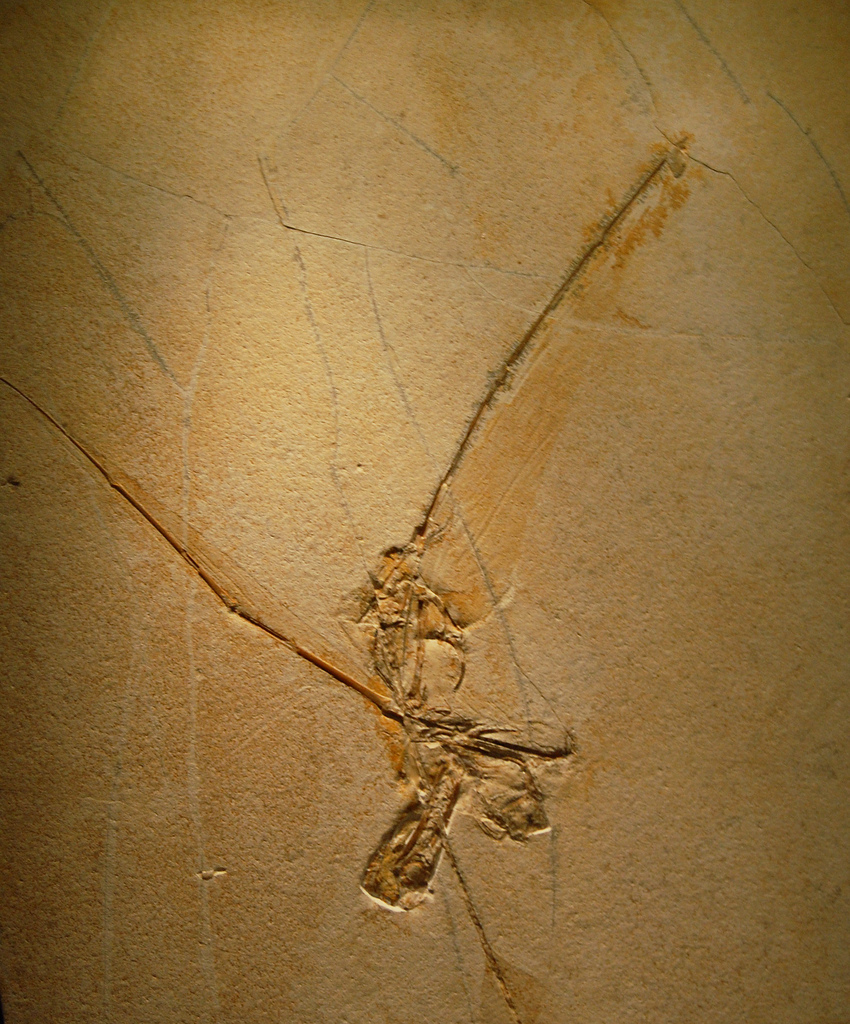
Image context: the cover uses a real Wikimedia Commons photograph of a Rhamphorhynchus fossil at the National Museum of Scotland.[5] It belongs here because the argument starts with anatomy before reconstruction. The tail is not a tiny afterthought once the slab is read as a whole body. It is part of the flight apparatus that has to be interpreted alongside the wings, torso, and growth series.
1. The tail is not just a line behind the wings
The first correction is anatomical. In later pterodactyloid pterosaurs, the shortened tail can make modern readers treat the long-tailed condition as primitive clutter. In Rhamphorhynchus, the tail was still a major body component. The 2024 variation study by Habib and Hone is useful because it does not ask only whether the forelimb was constrained for flight. It tests variation across body regions and finds high constraint across appendicular and axial elements, including the head, neck, torso, tail, forelimbs, hindlimbs, and related structures.[4]
That result changes the tone of the profile. If the tail varies under the same broad flight-system constraints as the rest of the body, it should not be described as a passive streamer. A flying animal pays for every long projection in drag, mass distribution, and handling. A tail this persistent needs either a performance role, a signal role strong enough to justify its cost, or both. The best current reading is the coupled one: the tail and vane helped make the animal controllable in the air, while also carrying a visible surface that could become socially informative, especially in larger individuals.[3][4]
This is where Rhamphorhynchus becomes better than a cartoon of "early pterosaur with a tail." The body forces a flight-control question. What does a long stiff tail do once it ends in soft tissue? If the vane flutters, buckles, or drags unpredictably, it becomes a liability. If it is dynamically tensioned and integrated with tail movement, it becomes hardware.
2. Soft tissue preservation turns a vague outline into a structure
The 2015 PeerJ specimen described by Hone and colleagues shows why soft tissue changes the argument.[2] Their Royal Tyrrell Museum specimen preserves impressions of the wing membranes, a tail vane, traces of the uropatagium, stomach contents, and a putative coprolite.[2] The diet evidence is interesting, but for this article the soft tissues are the key. They show that the parts most likely to vanish in ordinary preservation are exactly the parts needed to understand how the animal worked.
Bone alone can tell us the tail was long. It cannot tell us enough about the vane's surface mechanics. Compression fossils from Solnhofen are frustrating because soft tissues can appear as shadows, films, or subtle impressions, yet that is also why the locality is so valuable. It gives paleontologists a chance to read membranes directly rather than outsourcing everything to analogy.[2][3]
That directness has limits. A preserved vane is not a wind tunnel. It does not replay a banked turn or a courtship display. But it does constrain the model. The article's strongest claim does not need the vane to have only one function. It needs the vane to be treated as real tissue with real stiffness, geometry, and load behavior rather than as a painted-on tail tip.
3. Laser-stimulated fluorescence made the tissue mechanical
The decisive recent step is the eLife study on pterosaur tail vanes.[3] Jagielska and colleagues used laser-stimulated fluorescence to examine well-preserved tail vanes from Solnhofen pterosaurs, including Rhamphorhynchus, and reported a cross-linked lattice within the vane tissue.[3] That phrase is the center of the anatomy-and-method lesson. A lattice is not just a shape. It is an engineering clue.
Their interpretation is that the lattice supported a dynamic tensioning system that helped maintain vane stiffness, allowing the tail to augment flight control while the vane could also function as a display structure.[3] The key word is "while." Older public descriptions often make readers choose: rudder or ornament, flight surface or signal. The tissue evidence makes that split too simple. A visible soft-tissue surface attached to a long tail still had to survive air loads. If it was also a signal, it had to remain mechanically competent enough not to ruin the flight system that carried it.
This is the strongest reason to stop calling the vane decorative. Decorative surfaces can be cheap in a drawing. They are not cheap on a flying body. A surface that catches air behind the center of mass affects stability, maneuvering, and energy cost. The eLife paper's value is that it brings the preserved tissue into that mechanical conversation instead of leaving the vane as an aesthetic outline.[3]
4. Growth and variation keep the signal claim bounded
The display side of the argument becomes stronger when it is tied to variation rather than to imagination. Bennett's year-class framework already made Rhamphorhynchus unusually useful for thinking about growth, because many old species names could be reinterpreted as maturity stages within one species.[1] Habib and Hone's 2024 study then adds a sharper pattern: tail variation increases among the largest specimens, which they interpret as evidence consistent with reduced constraint and/or stronger sexual selection on the tail in more mature individuals.[4]
That is a careful statement, and it should stay careful. It does not prove a complete social life. It does not identify sexes in every specimen. It does not tell us the color of the vane or the exact behavior used to show it. What it does show is that the tail is not behaving like a random leftover. Its variation pattern is interesting in the part of the sample where mature signaling would be more plausible.[4]
The result is a better balance. The flight-control reading is constrained by tissue mechanics and whole-body proportional constraint.[3][4] The display reading is constrained by growth and variation rather than by a guess that anything conspicuous must be sexual. Together, they make a stronger animal than either claim alone.
5. Why the tail vane still matters
The tail vane matters because it makes Rhamphorhynchus a test case for how paleontology handles soft tissue on a flying animal. If we had only the bones, the long tail would already be worth explaining. If we had only a faint vane impression, the feature might stay visually memorable but mechanically vague. What makes the genus powerful is the layered evidence: Solnhofen sampling, growth interpretation, membrane preservation, laser fluorescence, and variation analysis.[1][2][3][4]
That layered evidence also keeps the interpretation from becoming overconfident. Rhamphorhynchus was a Late Jurassic pterosaur, not an aircraft with a single engineered purpose assigned to each part. Living structures often do more than one job. The tail vane could help stabilize or control the body in flight, resist flutter through internal tissue architecture, and still become a surface shaped by display pressure in larger individuals.[3][4] None of those roles cancels the others.
The more disciplined conclusion is simple: the tail vane was not a decorative kite tail. It was a soft-tissue structure carried by a powered flyer, preserved well enough to expose a mechanical problem and sampled well enough to make growth and variation matter. Rhamphorhynchus becomes most interesting when the famous silhouette is read as a working system rather than a charming outline.
Sources
- S. Christopher Bennett, "A statistical study of Rhamphorhynchus from the Solnhofen Limestone of Germany: year-classes of a single large species," Journal of Paleontology 69, no. 3 (1995).
- David Hone, Donald M. Henderson, Francois Therrien, and Michael B. Habib, "A specimen of Rhamphorhynchus with soft tissue preservation, stomach contents and a putative coprolite," PeerJ 3:e1191 (2015), via PubMed Central.
- Natalia Jagielska and colleagues, "New soft tissue data of pterosaur tail vane reveals sophisticated, dynamic tensioning usage and expands its evolutionary origins," eLife (2024).
- Michael B. Habib and David W. E. Hone, "Intraspecific variation in the pterosaur Rhamphorhynchus muensteri - implications for flight and socio-sexual signaling," PeerJ 12:e17524 (2024), via PubMed Central.
- Wikimedia Commons, "File:Rhamphorhynchus fossil.jpg" - source page for the National Museum of Scotland fossil photograph used as the lead image.