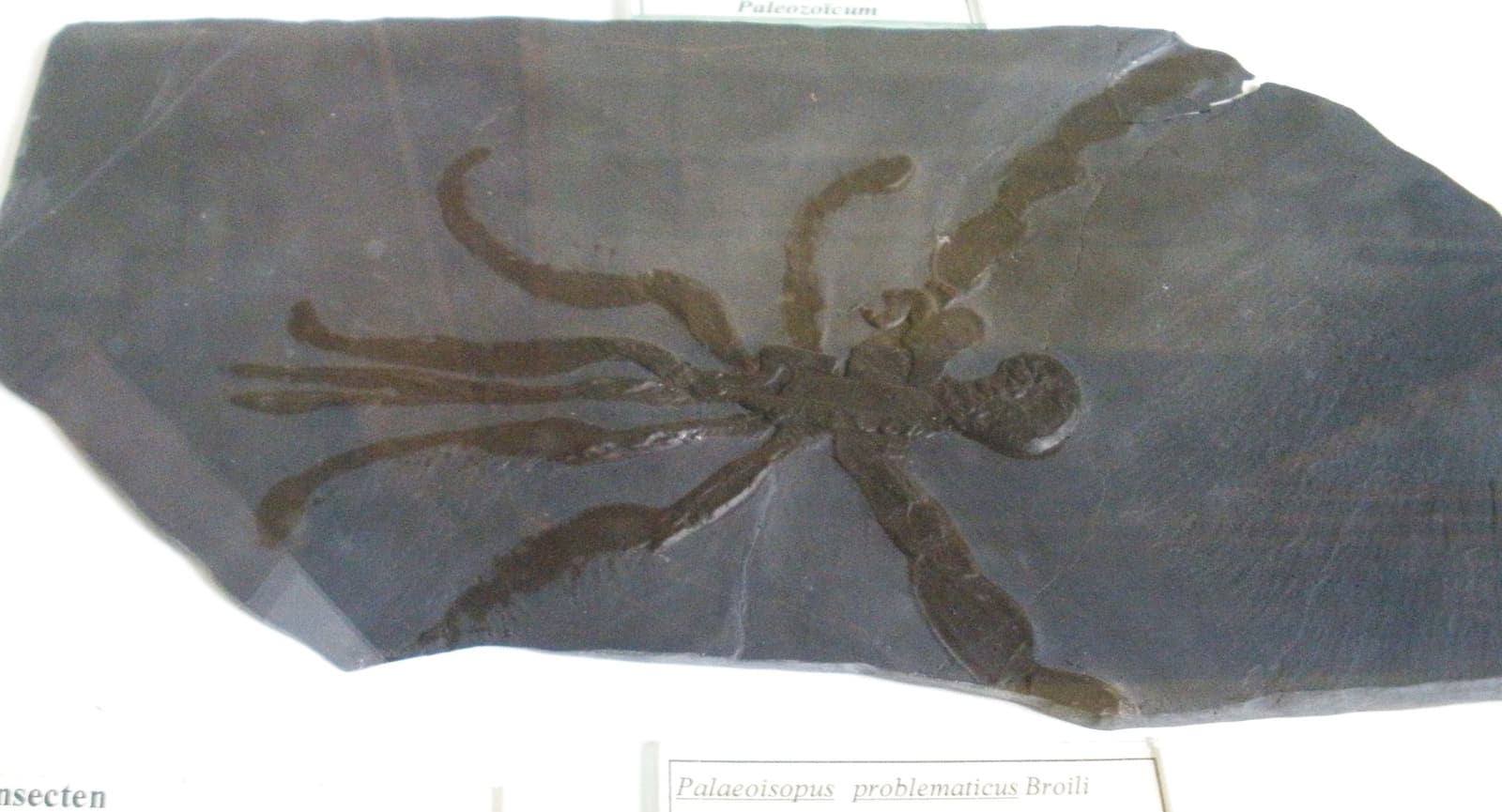
The legs spread across the stone, but the rear of the animal deserves a second look. Palaeoisopus problematicus, a sea spider from Germany's Early Devonian Hunsrück Slate, carried a long, segmented abdomen. Its flattened limbs also departed from the slender, cylindrical legs of living sea spiders. The fossil belongs to a familiar group with an unfamiliar range of bodies.[2]
That difference opens two questions. When did the surviving sea-spider lineage acquire its distinctive anatomy? And how much of its early history has failed to reach us? Recent studies show why answering the first question can change the evidence available for answering the second.
Which relatives belong inside the crown?
All living sea spiders belong to Pantopoda. Their small trunk ends in a reduced, unsegmented projection. Fossils with jointed rear sections and different leg construction complicate attempts to put every recognizable sea spider inside that same group.[3]
Paleontologists call the last common ancestor of living members, together with all its descendants, a crown group. Extinct relatives branching off before that ancestor belong to its stem group. A stem fossil can be unmistakably related to modern animals while preserving features outside the surviving group's shared inheritance. It need not be their direct ancestor.
This distinction turns a tail into more than an anatomical curiosity. A fossil assigned inside the crown can establish a minimum age for that crown. Moving it onto an earlier branch removes that particular age constraint. The fossil's geological age stays the same; what it can date on the family tree changes.
Two small bodies change an old assignment
Haliestes dasos comes from the Silurian Coalbrookdale Formation of Herefordshire, roughly 430 million years ago. Its first description rested on one specimen. In 2023, Derek Siveter and colleagues studied two more, reconstructing their bodies from photographs taken as the fossils were ground away in tiny successive layers.[3]
The new specimens helped resolve a crucial ambiguity. Differences between the specimens supported an interpretation of three articulating segments, rather than bends in a single rear projection. Rings around the leg bases supplied another resemblance to Devonian forms. The authors placed Haliestes outside the crown, alongside the broader assemblage of extinct sea-spider relatives.[3]
An older fossil does not automatically sit closer to the ancestor of everything alive today. Its position depends on the characters it preserves. Here, additional specimens made a familiar fossil less suitable for one dating role, while making its anatomy more informative.
The Devonian record adds a larger experiment in body form. In their 2024 re-examination of the roughly 400-million-year-old Hunsrück fauna, Romain Sabroux and colleagues interpreted the broad limbs of Palaeoisopus as adaptations for swimming. That is a functional inference from shape, rather than a preserved observation of movement. Their wider review found no compelling evidence that the known Devonian sea spiders belonged to Pantopoda.[2]
This leaves room for extinct branches to have shared the seas with an early crown lineage that has not yet been recognized in rock. Excluding known specimens from a group does not demonstrate that the group was absent everywhere.
Familiar families in Jurassic stone
At La Voulte-sur-Rhône in France, Middle Jurassic fossils provide a different kind of evidence. A 2023 study used X-ray microtomography and photographs illuminated from different directions to recover details that earlier examinations had missed. Sabroux and colleagues assigned the studied sea spiders to the crown group.[4]
The small appendages around the head mattered. Colossopantopodus boissinensis had palps and ovigers, specialized limbs whose construction linked it to living colossendeids. Palaeoendeis elmii showed affinities with Endeidae. A third species, Palaeopycnogonides gracilis, combined features unlike those of any living family and received a family of its own.[4]
The Jurassic assemblage therefore preserves both recognizable surviving branches and a branch without living representatives. Crown membership does not guarantee survival. Nor does membership in an extant family make a fossil species identical to its modern relatives.
These fossils provide dated points within the surviving radiation. They tell us that particular branches had already separated by the time the animals were buried; they do not reveal the instant when those separations happened.
An older history between the specimens
Morena Nava and colleagues tested that missing interval in a 2025 molecular-clock analysis. They combined genetic data from 198 sea-spider taxa with fossil calibrations informed by the revised anatomy. Their estimated interval for the origin of the crown stretched from about 435 to 367 million years ago, well before the Jurassic fossils.[5]
This is a model-based estimate with uncertainty, rather than a newly discovered Paleozoic specimen. Nevertheless, the analysis still inferred an ancient crown after the fossil assignments used in earlier work had been reconsidered. The authors interpreted the long stretches without fossils as consistent with sea spiders' poor preservation potential.[5]
The resulting history contains more branches than a simple succession from tailed fossil to modern animal. Distinctive extinct forms could persist while the ancestors of living families diversified elsewhere. Anatomy identifies the relationships that fossils can support; genetic change, calibrated against those fossils, helps estimate the time between them.
Look back at the spread of limbs in the slab. Recognition is only the beginning. The useful details are the ones that resist familiarity: a jointed rear section, a paddle-shaped limb, a small appendage recovered from stone. They determine which part of a much larger family history this animal can actually illuminate.
Sources
- Ghedoghedo, “Palaeoisopus problematicus,” Wikimedia Commons (photographed 2011)—photograph, Bundenbach provenance and Teylers Museum location.
- Sabroux and colleagues, “New insights into the Devonian sea spiders of the Hunsrück Slate (Arthropoda: Pycnogonida),” PeerJ (2024)—anatomy, swimming interpretation and reassessment of Devonian crown-group evidence; full text.
- Siveter and colleagues, “Newly discovered morphology of the Silurian sea spider Haliestes and its implications,” Papers in Palaeontology (2023)—new specimens, articulated trunk end and stem-group placement; institutional record with full text.
- Sabroux and colleagues, “New insights into the sea spider fauna (Arthropoda: Pycnogonida) of La Voulte-sur-Rhône, France (Jurassic: Callovian),” Papers in Palaeontology (2023)—head appendages, family assignments and fossil calibrations; institutional record with full text.
- Nava and colleagues, “A timescale for the evolutionary history of sea spiders (Arthropoda: Pycnogonida),” Evolutionary Journal of the Linnean Society (2025)—molecular dating with revised fossil calibrations and the inferred Paleozoic crown origin.