At least eleven young dinosaurs lie tangled together, their skeletons overlapping in the rock. They belong to Mussaurus patagonicus, an early relative of the giant long-necked sauropods. Excavated from the Laguna Colorada Formation in Patagonia, this small gathering became a key part of a 2021 argument that dinosaurs were living in organized groups roughly 193 million years ago.[2]
The arresting detail is their company. A skeleton tells us how an animal was built; several skeletons can preserve something about how animals shared a place. But burial also brings bodies together. To recover a social group, researchers must explain why the arrangement is more likely to have begun while its members were alive.
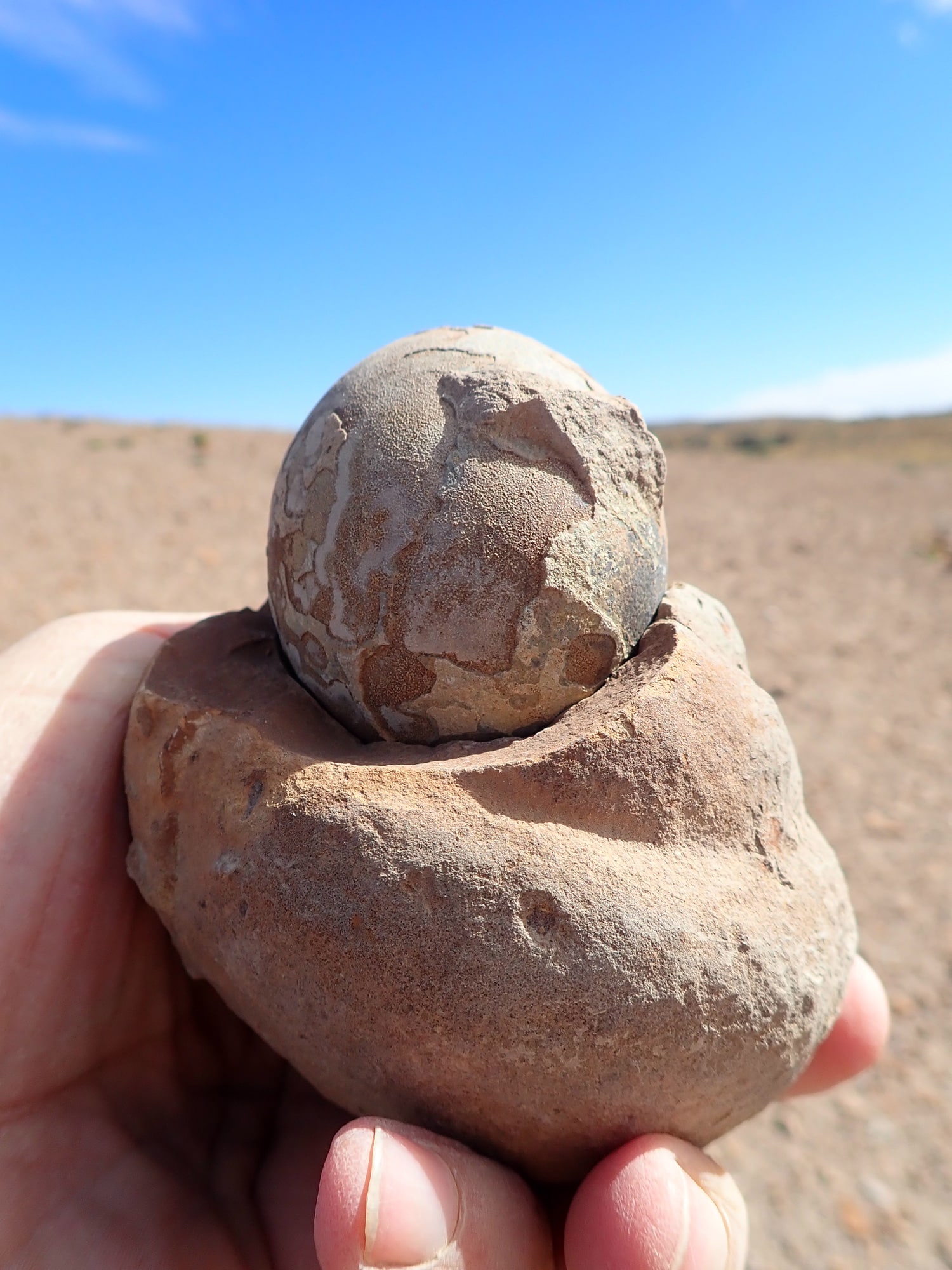
Connecting the eggs to the skeletons required a look inside them. In 2017, researchers brought thirty of them to the European Synchrotron Radiation Facility in Grenoble. One cracked specimen already exposed embryonic bones, but an earlier laboratory scan had struggled to distinguish their parts. The synchrotron offered a way to resolve anatomy through the surrounding material while keeping the specimens intact.[3]
That distinction matters: detecting something inside an egg and identifying it are different achievements. The ESRF team scanned eggs alongside a baby skeleton and a juvenile skull, building three-dimensional records that could be examined after the visit. Not every egg was expected to contain a recoverable embryo; decay could have removed the very evidence the beam was seeking.[3]
The eventual identification of embryos as Mussaurus linked the eggs to the animals found around them.[2] Diego Pol and colleagues also described eggs stacked in shallow excavated depressions. Nest spacing suggested a shared breeding ground, with room between nests, rather than a tightly packed colony.[1]
Now the juvenile cluster could be read within a reproductive landscape. The study argued against carcasses being transported and concentrated after death: many bones remained joined, and the intertwined skeletons supported death and burial together.[1] This is the crucial change in the question. The researchers were trying to explain a gathering of bodies whose original relationships had survived, rather than merely a high count of bones.
Age required another kind of evidence. Thin sections from three juveniles showed rapidly deposited bone without growth-arrest lines. The authors favored animals that had died before their first birthday, while allowing that uninterrupted growth could conceal a longer history.[1] The cluster was clearly young; the calendar was less secure.
A later study makes that qualification consequential. In 2022, Ignacio Cerda and colleagues examined twenty long bones from thirteen Mussaurus individuals. Growth rates varied markedly, and body size correlated poorly with age or developmental stage. The species included both cyclical and continuous growth patterns.[4]
This finding changes how confidently we can translate a group of similarly sized animals into an exact age cohort. It does not, by itself, dissolve the juvenile gathering. My reading is that the strongest account combines the small bodies, their bone tissue and their physical association, while leaving room for differences in individual growth. A shared size is useful evidence; it is an unreliable birthday certificate.[1][4]
There was nevertheless a substantial biological reason for young and mature Mussaurus to have different daily demands. Alejandro Otero and colleagues' 2019 study modeled bodies at successive growth stages, from tiny hatchlings to adults weighing over a tonne. As the animals grew, their center of mass shifted backward toward the pelvis. Changes in the tail and neck mattered especially to that redistribution.[5]
The researchers inferred a transition from four-legged hatchlings to two-legged adults. These are reconstructions tested against anatomy and alternative body models, rather than observations of a living gait.[5] They give the social interpretation a physical setting: a hatchling and an adult were doing the work of moving and feeding with very different bodies. Keeping similarly developed animals together could have eased coordination, although body mechanics alone cannot establish that they did so.
The ground itself adds a final complication. Fossils occurred at three closely spaced levels, supporting repeated use of the area as a breeding ground.[2] The entire site therefore should not become one instantaneous scene of a herd struck down. The juvenile cluster and the accumulating history of the locality operate at different scales.
That distinction also leaves the family portrait unfinished. The layout does not establish kinship, identify supervising adults or show food being brought to young. Those details would require further evidence. What survives is already substantial: young dinosaurs buried in company, eggs tied to their species, and a place used repeatedly for reproduction. The most revealing object here is the space between one skeleton and the next.
Sources
- Diego Pol and colleagues, “Earliest evidence of herd-living and age segregation amongst dinosaurs.” Scientific Reports (2021); nests, juvenile association, bone histology and burial interpretation.
- Jennifer Chu, “Dinosaurs may have lived in social herds as early as 193 million years ago.” MIT News (2021); field context, embryo identification, repeated horizons and Roger Smith's egg photograph.
- Montserrat Capellas Espuny, “Scientists try to unveil how dinosaurs became giants with synchrotron X-rays.” ESRF (2017); the scanning campaign. Its older geological-age assignment predates the 2021 dating study.
- Ignacio A. Cerda, Diego Pol, Alejandro Otero and Anusuya Chinsamy, “Palaeobiology of the early sauropodomorph Mussaurus patagonicus inferred from its long bone histology.” Palaeontology (2022); variation in growth and the limits of size as an age proxy.
- Alejandro Otero and colleagues, “Ontogenetic changes in the body plan of the sauropodomorph dinosaur Mussaurus patagonicus reveal shifts of locomotor stance during growth.” Scientific Reports (2019); body models and inferred postural change.