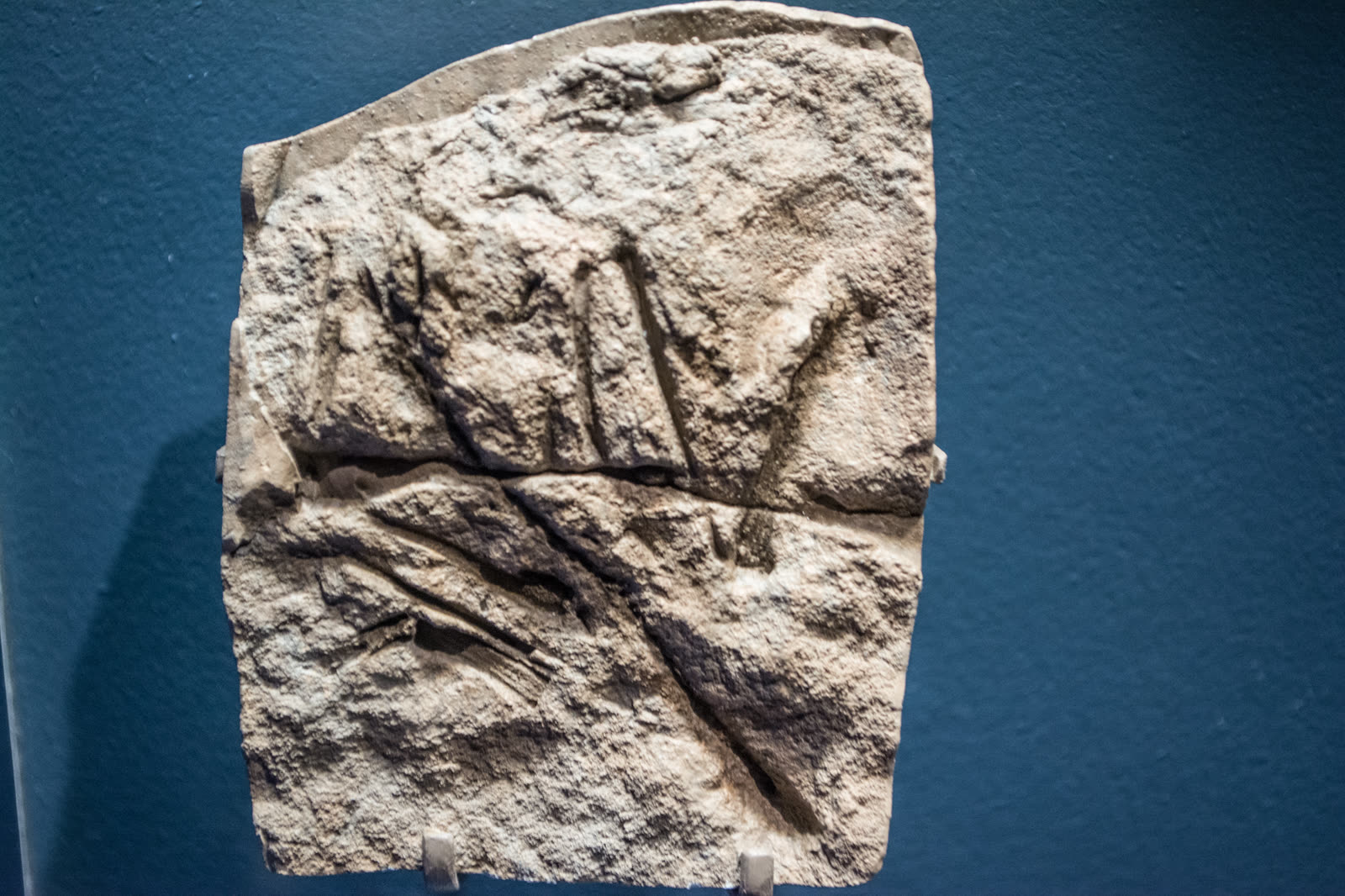
Scleromochlus taylori is easy to misplace because it sits next to a famous question. Pterosaurs were the first vertebrates to evolve powered flight, but their earliest history has always had a gap: the first clear pterosaurs arrive in the Late Triassic already looking like flying reptiles, while their closest ground-dwelling relatives are much harder to pin down.[1] Put a tiny Scottish reptile near that gap and the temptation is obvious. It can become an origin story before it has become an anatomical object.
The better reading runs in the opposite direction. Scleromochlus matters because it shows how a pterosaur-origin problem can first be a fossil-reading problem. The animal comes from the Lossiemouth Sandstone Formation near Elgin in Moray, Scotland, and the available specimens are notoriously difficult: the bones themselves were largely destroyed after burial, leaving void space in sandstone rather than clean skeletons ready for description.[2] For more than a century, researchers had to work through natural impressions and physical molds. That method could reveal real anatomy, but it could also flatten, omit, or distort the very details needed to decide where the animal belonged.[2][3]
Image context: the cover uses a real photograph of a displayed cast rather than a life reconstruction. That fits the article because the central issue is not what Scleromochlus looked like running through Triassic Scotland, but how a tiny animal preserved as impressions became readable enough to influence the pterosaur-origin debate.[5]
1) The animal was named early, but not made easy
Arthur Smith Woodward named Scleromochlus in 1907 from Triassic material at Lossiemouth, and later twentieth-century work repeatedly returned to the same basic puzzle: was this animal close to pterosaurs, dinosaurs, both, or neither in the way earlier reconstructions implied?[1][4] Benton treated Scleromochlus as important to the origin of dinosaurs and pterosaurs, placing it near the bird-line archosaur problem and emphasizing features such as long hindlimb elements and an elongate metatarsus.[4] That older work made the animal scientifically central, but it also made clear why its evidence was fragile.
The fragility came from preservation. A fossil that exists as a void is not the same evidentiary object as a three-dimensional bone. Historic molds can enter the cavity and make anatomy visible, but they are still interpretations made in material form. They depend on access, angle, completeness, and the assumption that the mold is faithfully reproducing the biological structure rather than preservation damage. In a small animal, where the skull, ankle, wrist, hand, and foot carry much of the phylogenetic signal, a little distortion can become a large evolutionary claim.[2][3]
That is why Scleromochlus is more interesting than the phrase "pterosaur ancestor" suggests. It is not a clean missing link pulled from a drawer. It is a century-long argument about how much anatomy can be extracted from poor preservation, and how confidently that anatomy can be scored in evolutionary matrices.
2) CT changed the argument by reading the voids without remaking them
The 2022 Nature paper by Foffa and colleagues reset the discussion because it used microcomputed tomography to build the first accurate whole-skeletal reconstruction and revised diagnosis of Scleromochlus.[1] The technical point matters. CT did not simply add a prettier image. It let researchers visualize previously inaccessible portions of the specimens and treat hidden void geometry as data without relying only on older physical molding traditions.[1][2]
That changed the level of the debate. The 2022 paper concluded that Scleromochlus was a close pterosaur relative within Pterosauromorpha, specifically more similar to lagerpetids than to pterosaurs themselves.[1] This is a narrower and stronger conclusion than turning the animal into a proto-pterosaur with a simple pre-wing silhouette. The claim is about position in a broader clade: pterosaurs plus animals closer to them than to dinosaurs. In that frame, Scleromochlus helps define what the ground-dwelling side of the pterosaur neighborhood may have looked like before powered flight appeared.[1][2]
The 2023 detailed osteological redescription made the same methodological lesson harder to miss. Foffa and colleagues described new information from the skull, mandible, trunk, tail, girdles, forelimb, and hindlimb, and they explicitly argued that historic molding techniques had failed in some cases to capture the anatomy accurately.[2] That is the key sentence for reading the animal well. Scleromochlus did not become important because CT produced a dramatic new monster. It became important because CT lowered the noise floor around small bones and old impressions.
3) The result is a pterosaur-origin signal, not a tiny pterosaur
Once the new anatomy is in view, the animal becomes less cinematic and more useful. The 2022 paper identifies Scleromochlus as a tiny, probably facultatively bipedal, cursorial animal and argues that early flying reptiles evolved from small, ground-running ancestors rather than from arboreal gliders already halfway to wings.[1] That is a consequential shift because pterosaur origins have often been pulled between two easy pictures: a tree-down glider story or a ground-up runner story. Scleromochlus does not solve every step between running and flight, but it makes the ancestral neighborhood smaller, more terrestrial, and more anatomically constrained.[1][2]
The boundary is just as important. Scleromochlus was not a pterosaur, did not have a pterosaur wing, and should not be forced to act out the entire origin of flight alone.[1][2] Its value is comparative. It retains primitive avemetatarsalian features in the postcranial skeleton while also showing characters that tie it to pterosauromorphs, especially lagerpetids.[2] That combination makes it a better bridge than a mascot. It shows that the roots of pterosaurs belonged inside a wider bird-line archosaur world of small-bodied experimentation, not in an isolated flight-ready lineage that appears from nowhere.
This is also where Bennett's 2020 reassessment remains useful, even though the later CT work changed the balance of evidence. Bennett argued against the standard bipedal-runner interpretation and proposed a different locomotor reading, treating the animal as neither runner nor obligate biped but more hopper-like.[3] The point here is not that every detail of that view survives the 2022 and 2023 revisions. The point is that Scleromochlus had earned disagreement because the specimens were genuinely hard to read. The later CT work is powerful precisely because it addresses the source of that disagreement rather than merely choosing a side by assertion.[1][2][3]
4) The fossil teaches method before ancestry
The strongest lesson from Scleromochlus is that ancestry claims depend on preparation, imaging, and scoring discipline. A small Triassic skeleton preserved mostly as empty space can look like a weak foundation for a major origin story. But that is exactly why the specimen matters. It forces the chain of inference into view: sandstone void, mold, scan, digital model, anatomical description, character coding, phylogenetic placement, evolutionary narrative.
At each step, the claim can either tighten or drift. If the old mold captures a foot bone poorly, locomotion may be overcalled. If the skull is reconstructed too confidently, a phylogenetic score may become stronger than the fossil deserves. If the final tree is converted into a simple ancestor image, the animal stops teaching what it actually teaches. The 2022 and 2023 work is valuable because it keeps those steps visible: the fossils are difficult, CT improves access to them, and the resulting anatomy supports a position near lagerpetids within Pterosauromorpha.[1][2]
That makes Scleromochlus a small animal with an unusually large methodological footprint. Its importance is not that it gives us a ready-made flying reptile before flight. It gives us a better ground-level starting condition: a tiny Late Triassic archosaur from Scotland, known through awkward preservation, now read with enough precision to make pterosaur origins less mysterious without making them simple. The flight story comes later. First, the mold had to become evidence.
Sources
- Davide Foffa et al., "Scleromochlus and the early evolution of Pterosauromorpha," Nature 610 (2022) - CT-based reconstruction, revised diagnosis, and pterosauromorph placement.
- Davide Foffa et al., "The osteology of the Late Triassic reptile Scleromochlus taylori from µCT data," The Anatomical Record (2023) - detailed osteology and preservation-method boundary.
- S. Christopher Bennett, "Reassessment of the Triassic archosauriform Scleromochlus taylori: neither runner nor biped, but hopper," PeerJ 8:e8418 (2020) - PubMed record for the pre-CT reassessment and contested locomotor interpretation.
- University of Bristol record for Michael J. Benton, "Scleromochlus taylori and the origin of dinosaurs and pterosaurs," Philosophical Transactions of the Royal Society B 354 (1999) - older phylogenetic and functional framing.
- Wikimedia Commons file page for "Cast of Scleromochlus taylori - Pterosaurs Flight in the Age of Dinosaurs.jpg," the photographed museum cast used as the article image.