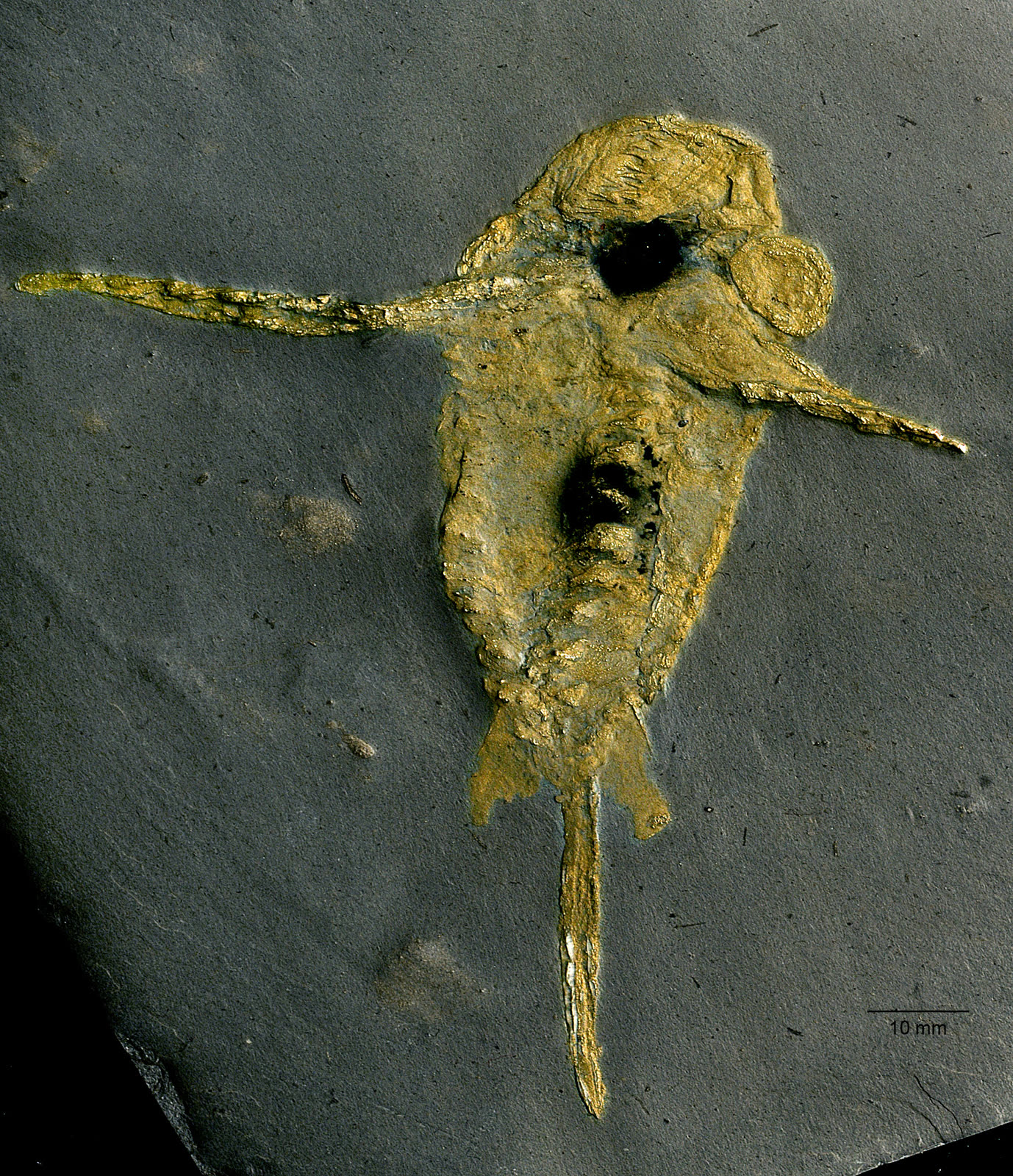
At first the fossil looks like a pale seam running through dark slate. A broad, cluttered head narrows into a segmented trunk, then finishes in a tail spine so fine that it almost returns to the rock. There is no shell, carapace or mineralized skeleton that should have made this animal easy to preserve. Yet the slab holds a pair of grasping frontal limbs, a ring-shaped mouth, stalked eyes and a body unlike that of any living arthropod.[1]
All of those parts belong to one specimen. Schinderhannes bartelsi is known only from holotype PWL 1994/52-LS, collected from the Lower Devonian Kaub Formation at the Eschenbach-Bocksberg quarry near Bundenbach, Germany, and held by the Naturhistorisches Museum Mainz. Including its tail spine, the animal measures 98 millimeters. The 2009 description moved an anatomical package associated with Cambrian radiodonts far forward in time and placed this animal just outside the lineage containing living arthropods.[1][4]
Later analyses changed the branch. They repeatedly recovered Schinderhannes inside Radiodonta, often among hurdiids—the family that includes such Cambrian and Ordovician animals as Hurdia and Aegirocassis. If that placement is right, this unassuming strip of pyritized anatomy is the youngest radiodont yet known. But the strongest modern review also adds a warning: the head looks persuasively hurdiid, while the trunk departs so sharply from the usual radiodont body plan that the assignment should remain open until the fossil is restudied or another specimen appears.[2]
That tension is the reason to read the slab closely. Schinderhannes does not merely fill a gap. It shows how a gap, a reconstruction and a family name can all become too heavy for one flattened body to carry.
Start with the head
The best radiodont signal sits at the front. The original authors described two preoral appendages, each divided into at least nine segments, or podomeres. The more distal segments carry long lateral spines as well as inward-projecting, comb-like structures furnished with rows of smaller spines. Behind them lies a roughly circular mouth ring with possible tooth plates. Farther out sit two large stalked compound eyes; in the better-preserved eye, the fossil retains a field of tiny hexagonal lenses.[1]
This is not a loose resemblance to a generic “primitive arthropod.” Radiodonts are defined by a distinctive construction: paired frontal appendages in front of the mouth, a radial oral apparatus, large eyes and a trunk that usually bears swimming flaps and blade-like respiratory structures. Hurdiid frontal appendages in particular tend to carry long, plate-like inner spines. Read by itself, the Schinderhannes head combines several of those features in the expected positions.[1][2]
It also demonstrates why naming a structure is already an interpretation. The 2009 paper called the front limbs “great appendages,” linking them to a broader argument about how the specialized head limbs of later arthropods arose. Subsequent phylogenetic work has instead placed Schinderhannes within Radiodonta and treated the limbs as especially hurdiid-like.[2] The fossil did not change between those readings. The comparative framework around it did.
The head therefore supports a bounded statement: Schinderhannes preserves a radiodont-like feeding apparatus with strong hurdiid affinities. It does not, by itself, prove that every less legible feature behind it must also be read as a standard radiodont part.
The trunk creates the problem
Behind the head, the original description reconstructed twelve trunk segments. The first ten appeared to carry dorsal plates, or tergites, and paired biramous limbs—the two-branched appendages familiar from true arthropods. The eleventh segment bore a lateral, fluke-like structure; the twelfth lacked an appendage; a long spine completed the tail. At the back of the head, a pair of unusually large triangular flaps was interpreted as specialized swimming appendages.[1]
That combination drove the original evolutionary claim. A radial mouth and spiny frontal limbs looked anomalocaridid-like, while tergites and biramous walking limbs looked more like the equipment of euarthropods. In the 2009 phylogeny, Schinderhannes landed between radiodont-grade animals and the arthropod crown. It seemed to preserve a body-plan transition in one individual.[1]
But a mosaic is only as secure as the identification of each tile. The specimen lies oblique to the bedding plane. Its left and right head flaps were flattened differently; one is foreshortened and the other visibly wrinkled. The authors explicitly noted that those flaps were difficult to interpret without specimens preserved at other angles. Parts of a possible head shield were obscured because mineralization was incomplete. Under those conditions, apparent boundaries among flaps, limb branches and overlapping structures are difficult to score confidently from this individual.[1][2]
The 2021 review made this the central boundary. Repeated phylogenetic analyses had nested Schinderhannes among hurdiids, and its preoral appendages strongly favor that result. Yet its supposed tergites, biramous limbs and other trunk features remain a major departure from verified radiodont anatomy. The reviewers judged a hurdiid identity plausible but questioned whether a single flattened individual can securely establish it.[2]
This does not reduce the fossil to “too weird to classify.” It separates two questions that are often collapsed. The first asks which interpretation currently fits best; hurdiid radiodont is a serious, repeatedly recovered answer. The second asks how stable that answer is; with no second specimen and no independent view of the trunk, stability remains limited.
Pyrite is both archive and filter
The Hunsrück Slate can preserve bodies that ordinarily disappear. Research on its fossilization chemistry found that decay-prone tissues were mineralized by pyrite in iron-rich mud, sometimes retaining exceptionally fine anatomy. The surrounding slate was later compressed and altered, and much of the original pyrite weathered to iron oxides. Because the mineralized tissues differ in density from the rock, X-radiography can expose details that ordinary surface light misses.[3][4]
Schinderhannes was photographed, drawn and X-rayed. That combination made its mouth ring, appendages and segment boundaries more legible than any one view could. It also prevents a seductive mistake: an X-ray is not a transparent window onto an untouched animal. It maps surviving mineral density. Where soft tissue decayed before pyrite formed, there is no signal; where pyrite spread beyond a boundary, a structure can look broader; where the slab compacted an oblique body, separate layers can overlap.[1][3]
Preservation quality therefore varies within the same individual. The minute lenses of one compound eye are direct, repeated surface features. The mouth ring is visible but partly concealed beneath the frontal appendages. The putative head shield is largely inferred. The large flaps retain distortion. The trunk branches are interpretations of compressed and incompletely mineralized traces.[1]
That ranking matters more than a simple label such as “exceptionally preserved.” Exceptional fossils are not complete fossils. They preserve enough unusual information to make new questions possible, along with a new set of ways to be misled.
The missing interval moved
When Schinderhannes was described in 2009, the authors wrote that great-appendage arthropods had not been known after the Middle Cambrian. On that baseline, the Hunsrück animal extended their range by roughly 100 million years.[1] Subsequent discoveries and revisions established radiodonts in younger Cambrian rocks and in the Early Ordovician. A 2021 review therefore measured a narrower—but still extraordinary—gap of about 66 million years between the youngest secure Early Ordovician radiodonts and Devonian Schinderhannes.[2]
Both numbers describe the state of evidence at a particular time. The smaller gap does not make the fossil less important; it records a better post-Cambrian fossil inventory. Nor does the remaining empty interval prove that a Schinderhannes-like lineage cruised unchanged through tens of millions of years. Radiodont bodies were weakly mineralized, and deposits capable of preserving them are unevenly distributed. The blank could represent genuine rarity, ecological decline, missing rocks, preservation failure—or all four.[2][3]
This is why “living fossil” is the wrong shortcut. Nothing in the slab demonstrates evolutionary stasis. Even if Schinderhannes is a hurdiid, its contentious trunk may document substantial change. What the specimen establishes is survival of a recognizable anatomical system into the Early Devonian, not an unchanged Cambrian species wandering into a later sea.
The same restraint applies to diet. The long, spinose appendages and forward-facing feeding apparatus make active food collection a reasonable inference. The original account emphasized a raptorial limb and popular summaries cast the animal as a predator.[1][4] Yet hurdiid appendages supported a wide range of feeding strategies, and no gut contents or captured prey occur in this slab. “Feeder with combed frontal appendages” stays closer to the fossil than a detailed hunting scene.
What one fossil can license
The holotype securely licenses several claims. A roughly ten-centimeter arthropod with huge compound eyes, a radial mouth and segmented frontal appendages lived in the Hunsrück sea during the Early Devonian. Its head shares a precise suite of features with radiodonts and especially hurdiids. Its discovery showed that anatomy once treated as overwhelmingly Cambrian persisted much later than the record had suggested.[1][2][4]
The slab licenses other claims only provisionally. The trunk may combine radiodont-like and euarthropod-like structures, or flattening may have made ordinary radiodont components look unfamiliar. A hurdiid placement is supported by multiple analyses, but it rests on character scores taken from this sole individual. Its status as the youngest radiodont depends on that placement. Its ecology remains an inference from form rather than direct evidence of a meal.[1][2]
A second specimen would do more than double the sample. A different burial angle could reveal whether the triangular head structures were truly specialized flaps, whether the trunk carried paired limb branches, and which apparent plates are anatomical rather than taphonomic. Repetition could turn wrinkles into characters—or erase characters that were only wrinkles.
Until then, the most honest reading is also the most interesting. Schinderhannes is not a failed missing link because its branch moved after 2009. It is a rare test of how paleontologists recognize a body plan when preservation, phylogeny and geological time all pull on the same specimen. The head makes a strong radiodont case. The trunk keeps the verdict open. The long gap raises the stakes, but it cannot cast the deciding vote.
Sources
- Gabriele Kühl, Derek E. G. Briggs and Jes Rust, “A great-appendage arthropod with a radial mouth from the Lower Devonian Hunsrück Slate, Germany,” Science 323 (2009)—original description of PWL 1994/52-LS, its anatomy, X-radiography and initial phylogenetic interpretation.
- Xuejian Zhu, Rudy Lerosey-Aubril and Javier Ortega-Hernández, “Furongian (Jiangshanian) occurrences of radiodonts in Poland and South China and the fossil record of the Hurdiidae,” PeerJ 9 (2021)—critical review of the post-Cambrian radiodont record and the evidence for and against a hurdiid assignment of Schinderhannes.
- Derek E. G. Briggs et al., “Controls on the Pyritization of Exceptionally Preserved Fossils: An Analysis of the Lower Devonian Hunsrück Slate of Germany,” American Journal of Science 296 (1996)—mineralization chemistry and the preservational limits of Hunsrück soft tissues.
- Johannes Gutenberg University Mainz and Naturhistorisches Museum Mainz, “Hunsrückschiefer—Leben im Devon” (2024)—institutional exhibition on the deposit, X-ray-visible fossils and the unique Schinderhannes specimen.
- Informationsdienst Wissenschaft, “Photograph of Schinderhannes bartelsi”—institutional press image of the ventral holotype used as the article cover, photographed by Alexandra Bergmann and Georg Oleschinski.