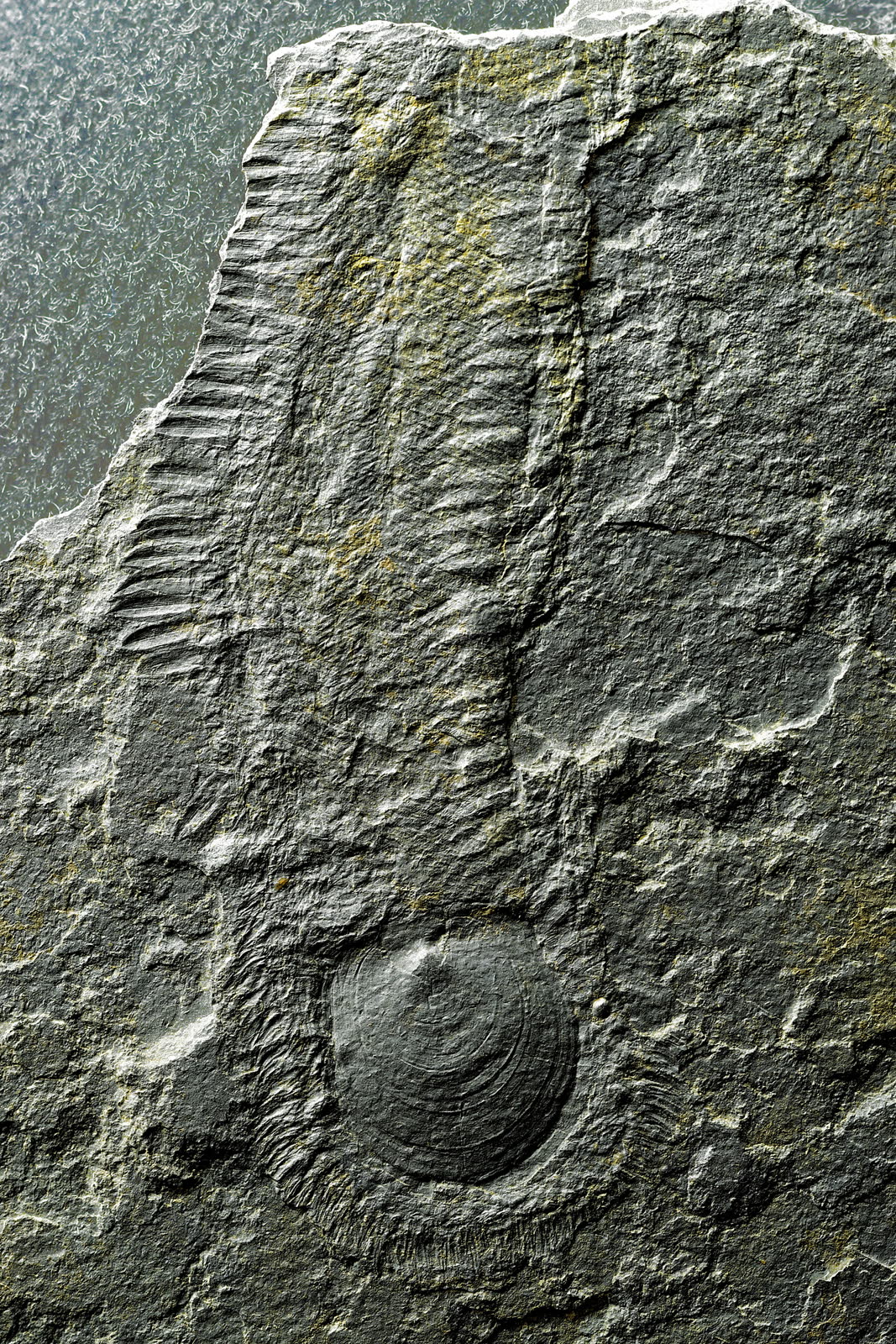
The fossil looks less like an animal than a path pressed into dark shale. A broad oval plate anchors one end of the photograph. Beyond it, the rock carries a narrow field of repeated ridges, scales, and blades, some crisp and some nearly lost in the matrix. Nothing resembles a familiar face. No eye tells the viewer where to begin.
That visual difficulty is the reason Halkieria evangelista matters. Before articulated specimens from North Greenland joined its pieces together, paleontologists mostly knew halkieriids from tiny, isolated hard parts—the sort of “small shelly fossils” that survive acid preparation and sorting but arrive without an obvious owner. The Sirius Passet material showed that several shapes of sclerite, plus a shell plate at each end, belonged to one bilaterally organized animal.[1][2] A drawer of loose parts became a body.
The conversion did not settle where that body belongs on the animal tree. It made the argument possible. Since complete specimens were first reported in 1990 and treated in fuller detail later, Halkieria has been read near brachiopods, inside or close to Mollusca, and within broader proposals about the early radiation of lophotrochozoans—the great branch that includes molluscs, annelid worms, brachiopods, and their relatives.[1][3][4][5] New fossils have repeatedly rearranged the comparison without making Halkieria anatomically obsolete.
Its durable lesson is therefore not that one armored slug is the ancestor of a modern phylum. It is that early animal skeletons were assembled from modules. To understand the lineage, the modules must stay in their original positions.
Three kinds of armor, not a bag of scales
The articulated Halkieria evangelista specimens come from the early Cambrian Buen Formation at Sirius Passet in Peary Land, North Greenland. The locality preserves a diverse soft-bodied fauna in rocks formed near the outer shelf and slope more than half a billion years ago.[1][2] That exceptional preservation is crucial: mineralized pieces readily enter the ordinary fossil record, but the soft body and the relative placement of those pieces usually disappear.
Descriptive work on the articulated specimens identified three zones in the body covering, or scleritome. Palm-shaped sclerites lay in oblique rows across the dorsal region. Blade-like cultrate sclerites occupied the lateral zone. More spine-like siculate elements formed imbricated bundles along the ventrolateral margin. At the front and rear sat larger shell plates with radial ornament.[1][5] The names are technical, but the pattern is simple: the armor changes systematically from the middle of the back toward the body's edge.
That organization rules out a heap assembled by current or decay. It also turns isolated sclerites from other Cambrian deposits into more useful evidence. A loose element can be compared not only by shape but by the position it may once have occupied in a complete covering. Halkieria became a template for reconstructing disarticulated scleritomes while also warning that similar-looking pieces need not come from identical animals.[1][5]
The two end shells add a different sort of modularity. They are not simply enlarged versions of every scale between them. Together with the repeated sclerites, they make Halkieria a compound skeleton: a soft body carrying hundreds of small elements and two conspicuous plates. That combination is why the fossil has been compared with chitons and other aculiferan molluscs, with armored annelids, and with early relatives of brachiopods.[1][3][5] Each comparison asks whether similar hard parts are inherited from a common ancestor, independently assembled, or only superficially alike.
A whole animal exposes the homology problem
Classification depends on more than resemblance. A sclerite can look like a chiton scale, an annelid bristle, or a tommotiid plate because the structures share ancestry, because evolution has modified an older common toolkit, or because unrelated animals solved the same defensive problem in similar ways. Those alternatives are difficult to separate when the fossil record supplies only isolated pieces.
Early interpretations treated the articulated body as evidence for connections among annelid, molluscan, and brachiopod lines, including a specific scenario near the brachiopod stem.[3][5] In 2005, Jakob Vinther and Claus Nielsen re-examined original specimens and argued that the securely observable characters were compatible with molluscs. They proposed Halkieria as a distinctive molluscan class, Diplacophora, emphasizing the creeping sole, mantle-like body covering, shells, and sclerites while rejecting a direct annelid or brachiopod placement.[3]
Even the possible feeding apparatus shows why certainty remains bounded. One specimen has a cluster interpreted as a radula, the serial toothed ribbon characteristic of molluscs. The photograph used for this article depicts that specimen, and its lighting was deliberately combined from opposite directions to make low relief easier to read.[7] But the putative radula lies near a folded margin of the scleritome, where displaced sclerites can imitate a tooth row. A feature that would strongly favor a molluscan reading is therefore not secure enough to carry the classification alone.[3][5][7]
This is not a choice between bold science and timid science. It is a question of evidential weight. The three sclerite zones and two shell plates recur across articulated individuals and are hard anatomical observations. A muscular creeping sole is a functional inference from body shape and comparison. A radula is a contested identification. A place on the animal tree is a hypothesis that must make all those layers cohere.
Orthrozanclus breaks the neat family portrait
In 2007, the description of the Burgess Shale animal Orthrozanclus reburrus seemed to supply a useful intermediate combination. It carried one anterior shell resembling a halkieriid plate, plus a covering of sclerites and long spines that invited comparison with Wiwaxia. Conway Morris and Caron grouped these animals as “halwaxiids” and placed them in the early history of lophotrochozoans.[4] The proposal made evolutionary sense by reducing several Cambrian oddities to variations on a related armored body plan.
Then a second species changed which similarities mattered. Orthrozanclus elongata, described from the early Cambrian Chengjiang biota in 2017, preserved its scleritome clearly enough for Martin Smith and colleagues to compare the positions of the elements rather than their overall spiny appearance. They found three concentric zones that correspond more closely to Halkieria than to the eight or nine transverse rows reconstructed for Wiwaxia.[5]
That result strengthened an Orthrozanclus–Halkieria connection while weakening the tidy halwaxiid package. The authors instead noted comparisons between the tripartite halkieriid arrangement and camenellan tommotiids, fossils discussed near the brachiopod and phoronid stem. They also stressed that sclerite coverings have evolved independently in living lineages, including scaly-foot gastropods and some annelids.[5] Armor is phylogenetic evidence, but “armored” is not itself a relationship.
The episode is a model of why articulated fossils outrank silhouettes. Wiwaxia, Orthrozanclus, and Halkieria can all be drawn as low, slug-like animals under spines or scales. Yet the sequence, orientation, composition, and regional zoning of those parts may preserve different construction rules. A lineage argument lives in those rules, not in the fact that all three reconstructions look prickly.
A newer stem mollusc changes the background
The debate did not stop with named Cambrian problematica. In 2024, researchers described Shishania aculeata from early Cambrian deposits in Yunnan, China. Unlike Halkieria, Shishania had no shell plates. It combined a broad foot and mantle cavity with dense, hollow chitinous sclerites whose microscopic structure resembles the cellular impressions associated with chaetae, or bristles, in annelids and brachiopods.[6]
The authors placed Shishania on the molluscan stem and argued that it bridges ordinary lophotrochozoan chaetae and the mineralized sclerites of aculiferan molluscs. In their reconstruction, the ancestral mollusc was not necessarily a smooth animal waiting for a shell to appear. It may have carried a dense covering of hollow organic elements before later lineages mineralized, fused, reduced, or reorganized them.[6]
That finding does not prove that Halkieria is a crown mollusc, a stem aculiferan, or the direct ancestor of anything living. It changes the prior question. Sclerites no longer have to be treated as exotic inventions unique to a few Cambrian forms. They can be investigated as transformations of a deeper lophotrochozoan structural system, with mineralization and shell plates added in different combinations.[5][6]
Seen in that context, Halkieria is valuable because it preserves one combination exceptionally well: a bilateral soft body, three ordered sclerite zones, and a shell at either end. Its mosaic is not an embarrassment to classification. It is the evidence that early lineages were still partitioning a shared set of tissues and skeletal possibilities into the more distinct body plans recognized later.
What Halkieria fixes—and what it leaves open
The fossils establish several strong points. Halkieriid sclerites of different shapes could belong to one animal. Their differences mapped onto consistent regions rather than random variation. The shell plates and sclerites functioned as one compound external skeleton. The animal lived in an early Cambrian marine ecosystem, and its body was organized for life on or close to the seafloor rather than for active swimming.[1][2][3]
They do not preserve a complete organ-by-organ anatomy. The feeding apparatus remains disputed. The exact homologies among halkieriid sclerites, molluscan sclerites, annelid chaetae, and brachiopod-related tommotiid elements depend on microstructure, development, and comparisons with other fossils. The topology changes when a new taxon preserves a better scleritome or a more informative soft part.[3][5][6]
That boundary makes the lineage story stronger. A simple “primitive mollusc” label would turn Halkieria into a station on a ladder. A simple “weird Cambrian animal” label would isolate it from the evolutionary questions its anatomy can test. The more accurate frame sits between them: Halkieria is an articulated experiment in building a skeleton, close enough to major lophotrochozoan lineages to inform their origins and distinctive enough that no single modern body plan can absorb it without argument.
The dark fossil photograph captures that scientific history in one surface. The oval plate is easy to see. The repeated armor takes longer. Once the eye follows the sclerites as an ordered body rather than background texture, the animal appears—and with it, the harder question of which later skeletons reused the same construction logic. The breakthrough was not finding one more loose shell. It was keeping the shells together.
Sources
- Simon Conway Morris and John S. Peel, “Articulated halkieriids from the Lower Cambrian of north Greenland,” Nature 345 (1990)—the primary report of complete halkieriid scleritomes and the unexpected anterior and posterior shells.
- International Union of Geological Sciences Geoheritage Commission, “The Cambrian Explosion in Sirius Passet—Peary Land, North Greenland”—site setting, discovery context, fauna, and significance of the early Cambrian Lagerstätte.
- Crossref metadata and abstract record for Jakob Vinther and Claus Nielsen, “The Early Cambrian Halkieria is a mollusc,” Zoologica Scripta 34 (2005)—re-examination of original material and the proposed Diplacophora interpretation.
- Simon Conway Morris and Jean-Bernard Caron, “Halwaxiids and the early evolution of the lophotrochozoans,” Science 315 (2007)—the Orthrozanclus comparison and original halwaxiid framework.
- Martin R. Smith et al., “Orthrozanclus elongata n. sp. and the significance of sclerite-covered taxa for early trochozoan evolution,” Scientific Reports 7 (2017)—open-access comparison of Halkieria, Orthrozanclus, and Wiwaxia scleritome architecture and competing relationship hypotheses.
- Guangxu Zhang et al., “A Cambrian spiny stem mollusk and the deep homology of lophotrochozoan scleritomes,” Science 385 (2024)—Shishania anatomy and the proposed relationship between chaetae and aculiferan sclerites.
- Wikimedia Commons, “File:Halkieria SMX24926.1.jpg”—Martin R. Smith's high-resolution, multi-illumination photograph of the Sirius Passet specimen used as the article image, with Figshare provenance.