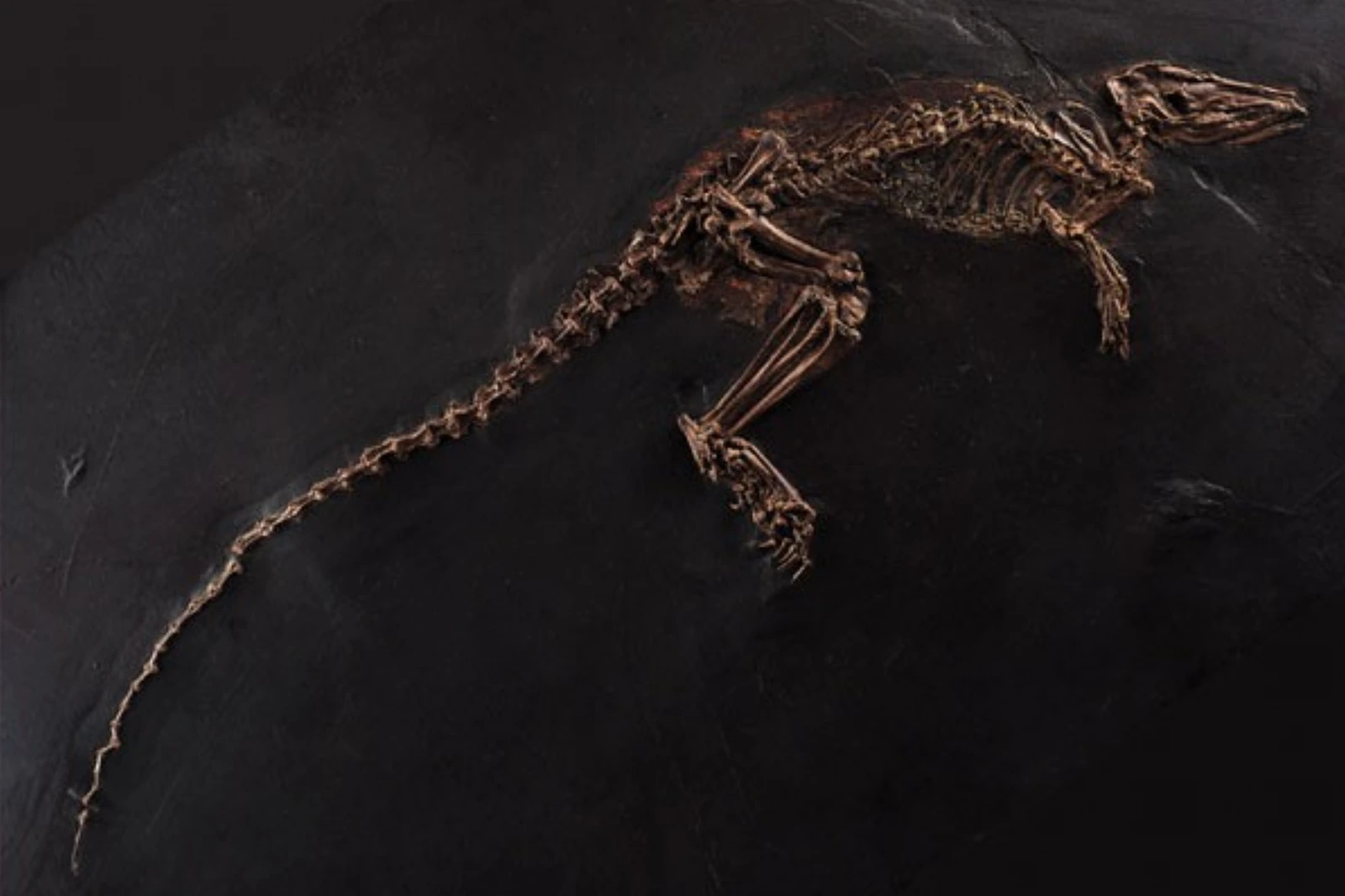
The fossil does not look incomplete. That is precisely the problem.
On a dark slab, a Leptictidium nasutum skeleton keeps nearly everything needed to recognize an animal: narrow skull, arched back, delicate ribs, small hands, folded hind legs and a tail that sweeps across most of the frame. The proportions are so emphatic that the body seems ready to move. Yet the instant we make it move—kangaroo-style hops, alternating two-legged strides, a low quadrupedal shuffle—the evidence changes category. Bone has become animation.[1]
Leptictidium is one of the most visually legible mammals from the Eocene and one of the hardest to give an honest gait. Its complete skeletons establish a strange construction. Its stomach contents preserve actual meals. Its inner ear records the demands of balancing an agile head. None preserves a footfall.
That distinction makes the genus more interesting than the usual comparison with a tiny kangaroo or an elephant shrew. Leptictidium was not an early draft of either. It was a European eutherian with a body plan that has no close living repeat—and a profile best built by asking how much each part of that body really licenses us to say.
Read the imbalance first
The Messel Pit in Germany preserves three named species: L. auderiense, described by Heinz Tobien in 1962; L. nasutum, named by Gerhard Storch and Adrian Lister in 1985; and L. tobieni, named by Wighart von Koenigswald and Storch in 1987.[1][4] They lived around a maar lake during the transition from the early to middle Eocene. Current dating places the lake's formation at about 48.06 million years ago and its persistent phase through at least 47.22 million years ago.[4]
All three belong to Pseudorhyncocyonidae, an extinct European branch within the wider and still awkward leptictidan problem. Calling them eutherians is safe; fastening them neatly inside the crown group that contains living placental mammals is not. Even the official Messel account notes that researchers differ over whether leptictidans fall inside or outside that crown.[1][2]
The skeleton is clearer than the family address. The rear of the animal dominates. In comparative measurements, European Leptictidium species have intermembral indices of 45–48—the forelimb-to-hind-limb ratio is less than half—whereas the North American Leptictis dakotensis measured 61. The largest Messel species, L. tobieni, combined a head-and-body length of roughly 375 millimeters with a tail about 500 millimeters long.[3]
Those numbers describe an animal organized around long hind limbs and an even longer tail. They do not describe a scaled-down kangaroo. The official Messel account describes five digits on each foot, with the outer two greatly reduced. Unlike the compared North American leptictidans, Leptictidium also retained separate tibia and fibula rather than a fused lower leg.[1][2] Its forelimbs were not absent or vestigial; comparative anatomy has associated their proportions with digging. The animal could interact with the ground in more than one way even if rapid travel was dominated by the rear legs.[3]
The hind limbs narrow the options, but not to one
Two broad locomotor pictures have competed. In one, both hind feet leave and meet the ground together in saltation: a sequence of hops powered through the long rear limbs. In the other, the feet alternate during fast bipedal running. Both are reconstructions from anatomy rather than observed footfall sequences.[2]
The skeleton rules out some casual reconstructions. A body with such unequal limb lengths was not built for ordinary, evenly loaded quadrupedal running. It also resists the mechanics expected of a human-like biped that must balance over one narrow stance foot at a time. Earlier biomechanical work therefore favored hopping, while other reconstructions retained rapid bipedal running as an option. The 2016 inner-ear study still introduced Leptictidium as a probable bipedal runner or jumper rather than pretending the dispute had vanished.[2]
This is an important paleontological boundary. Limb proportions can show where power and reach were concentrated. Joint shapes can show permitted ranges, and the pelvis can reveal where muscles attached. But an unusual combination may lack a trustworthy modern analogue. A kangaroo answers questions about a kangaroo's fused set of specializations; it cannot automatically complete the missing motion of an Eocene mammal with different ankles, feet and lower-leg construction.
The strongest profile therefore stops one step short of choreography. Leptictidium was highly specialized for rapid, hind-limb-dominated movement. Bipedal hopping is a serious mechanical interpretation. The precise rhythm of its feet remains inferred rather than observed.
The inner ear records agility, not a footfall
Irina Ruf and colleagues approached the movement problem from inside the skull. They used high-resolution computed tomography on a new L. auderiense specimen from Messel and digitally reconstructed its bony labyrinth. The semicircular canals register angular acceleration of the head in life, so their relative dimensions can preserve a broad locomotor signal even when the soft sensory organs are gone.[2]
Compared with the North American leptictidans Leptictis and Palaeictops, Leptictidium had proportionally larger semicircular canals. One set of estimates gave it agility scores of 4.6 and 5.5, in the range of living sengis and bipedal hopping placentals; the compared North American forms scored 3.4–4.1. That supports an animal capable of quick head rotations and demanding maneuvers, not a slow forest-floor plodder.[2]
The same study also supplied its own brake. A different metric, based on predicted angular velocity from canal angles, produced a conflicting agility pattern. The authors warned that intraspecific variation and the limited comparative sample could change the result.[2] An inner ear is powerful independent evidence for agility, but it cannot tell whether two feet struck the leaf litter together. Balance hardware constrains performance; it does not preserve a gait label.
That makes the scan most valuable when it is not asked to settle everything. The limb proportions and labyrinth agree on speed, maneuverability and a specialized locomotor system. Their agreement raises confidence in those broad claims. Their silence about footfall sequence keeps hopping versus running open.
The mouth is less mysterious than the stride
At the other end of the skeleton, Leptictidium offers unusually direct evidence. The Messel site describes the teeth of L. nasutum as three functional zones: front teeth suited to seizing, a middle set that could hold and dispatch small prey, and rear teeth for breaking it down. Its chewing musculature was not built for tackling large animals.[1]
More importantly, some individuals died with food still in the abdomen. One preserved bones from a lizard-sized squamate along with a small amount of leaf material. Another contained remains of a mouse-sized mammal and abundant plant fragments. Comparative accounts also record insects and small vertebrates among the meals.[1][3] These are not ecological guesses made from tooth shape alone. They are traces of particular feeding events.
They still need careful wording. A gut sample records what one animal ate shortly before death, not the exact percentage composition of a species-wide diet. Plant fragments may represent deliberate feeding, incidental ingestion or material swallowed with prey. Together, however, the dentition and stomach contents make a small-prey omnivore much firmer than any single reconstruction of the stride.[1][3]
The narrow snout illustrates the next rung down the evidence ladder. Leptictidans are often drawn with a flexible, sengi-like nose. Bony depressions for muscles of the nose and upper lip make extra mobility plausible, and a narrow rostrum would have been useful when probing litter. But the comparison does not preserve a proboscis. The primary anatomical review used by later workers explicitly notes that no definitive argument establishes a highly mobile cartilaginous tip.[3] A sensitive fleshy nose is reasonable; its exact length, shape and behavior belong to reconstruction.
Messel preserved a body, not a movie
The Messel lake explains why this profile can be so anatomically rich. During its stable meromictic phase, deep water remained stratified and oxygen-poor. Fine oil-shale sediment accumulated on the floor of a volcanic maar, preserving organisms from microbes and plants to insects, fish, reptiles, birds and mammals in the same basin. A 2024 inventory counted 1,409 documented taxa, while stressing that the number does not translate neatly into biological species.[4]
For Leptictidium, that archive delivered articulated skeletons rather than the isolated teeth and jaws that dominate many small-mammal records. It also delivered digestive residues. This is why one genus can be approached through whole-body proportions, ear anatomy and last meals at once.[1][2][4]
Exceptional preservation can nevertheless create a false feeling of completeness. A side-on skeleton loses the third dimension. Cartilage, muscles and tendons are mostly absent. A long tail survives as vertebrae, but its mass and flexibility in life must be rebuilt. Feet preserve bones, not the timing or forces of contact. The slab gives more evidence than most sites, not omniscience.
The photographed Messel specimen is useful precisely because it keeps that tension visible. The actual bones make the imbalance undeniable: long tail, large hind limb, abbreviated forelimb.[1] The pose is a burial pose. It is not a freeze-frame of a leap.
A profile with one verb left open
The direct record supports a compact description. Leptictidium was a medium-sized Eocene eutherian of European forests, represented at Messel by three species. It carried a long tail, greatly lengthened hind limbs, short but functional forelimbs and a narrow, small-prey head. Gut-region contents document insects and small vertebrates; plant material is present but harder to interpret as deliberate food. The inner ear of L. auderiense is consistent with high agility.[1][2][3][4]
Comparative inference adds a little more. Fast movement was probably bipedal and powered chiefly by the hind limbs. The forefeet may have dug, and the snout may have ended in a mobile fleshy tip.[2][3]
What remains open is the verb at the center: did it hop, run, or switch between gaits? That uncertainty is not a failure to understand the animal. It is the result of understanding the limits of three unusually good kinds of evidence. A skeleton preserves construction. An inner ear preserves sensory demand. A stomach preserves a meal. None preserves a stride.
That is why Leptictidium is so easy to recognize and so hard to animate. The fossil gives us almost the whole animal—right up to the instant it moves.
Sources
- Messel Pit World Heritage Site, "Leptictidium nasutum"—institutional account of the three Messel species, dentition, gut contents, unresolved crown-placental placement and the articulated fossil photograph used as the cover.
- Irina Ruf et al., "Digital reconstruction of the inner ear of Leptictidium auderiense (Leptictida, Mammalia) and North American leptictids reveals new insight into leptictidan locomotor agility," Paläontologische Zeitschrift 90 (2016)—repository record and abstract for the CT-based agility analysis and its limits.
- T. J. Meehan and Larry D. Martin, "New Large Leptictid Insectivore from the Late Paleogene of South Dakota, USA," Acta Palaeontologica Polonica 57 (2012)—open comparative paper covering Leptictidium limb ratios, body proportions, diet evidence and the boundary around a mobile snout.
- Krister T. Smith et al., "The biodiversity of the Eocene Messel Pit," Palaeobiodiversity and Palaeoenvironments 104 (2024)—peer-reviewed synthesis of lake age, depositional context, biodiversity and the three Leptictidium species.