The Bernissart iguanodons became famous in public as silhouettes before they became legible as evidence. What most readers remember is the tall, tail-dragging, almost kangaroo-like dinosaur that stood inside the Brussels museum and helped define the nineteenth-century dinosaur imagination. What paleontology actually inherited from Bernissart is much richer and more demanding: around thirty relatively complete skeletons discovered 322 meters underground in a Belgian coal mine, still close enough to their original positions that quarry maps, block extraction, and later preparation all became part of the evidence story.[1][2] The scientific force of Bernissart is not one dramatic pose. It is the full stack from buried bodies to museum mount.
That is why the site deserves a fossil-find close reading. Bernissart did not deliver a single celebrity specimen. It delivered a quarry problem, a conservation problem, a mounting problem, and eventually a posture-revision problem.[2][3][4] Each layer changed how Iguanodon could be seen. The find mattered first because so many articulated skeletons survived together. It mattered again because pyrite-filled bones had to be removed, stabilized, and reconstructed without losing their positional logic.[2] It mattered a third time because the famous upright display turned out to be historically important and anatomically outdated at the same time.[2] Very few dinosaur discoveries make their own afterlife this visible.
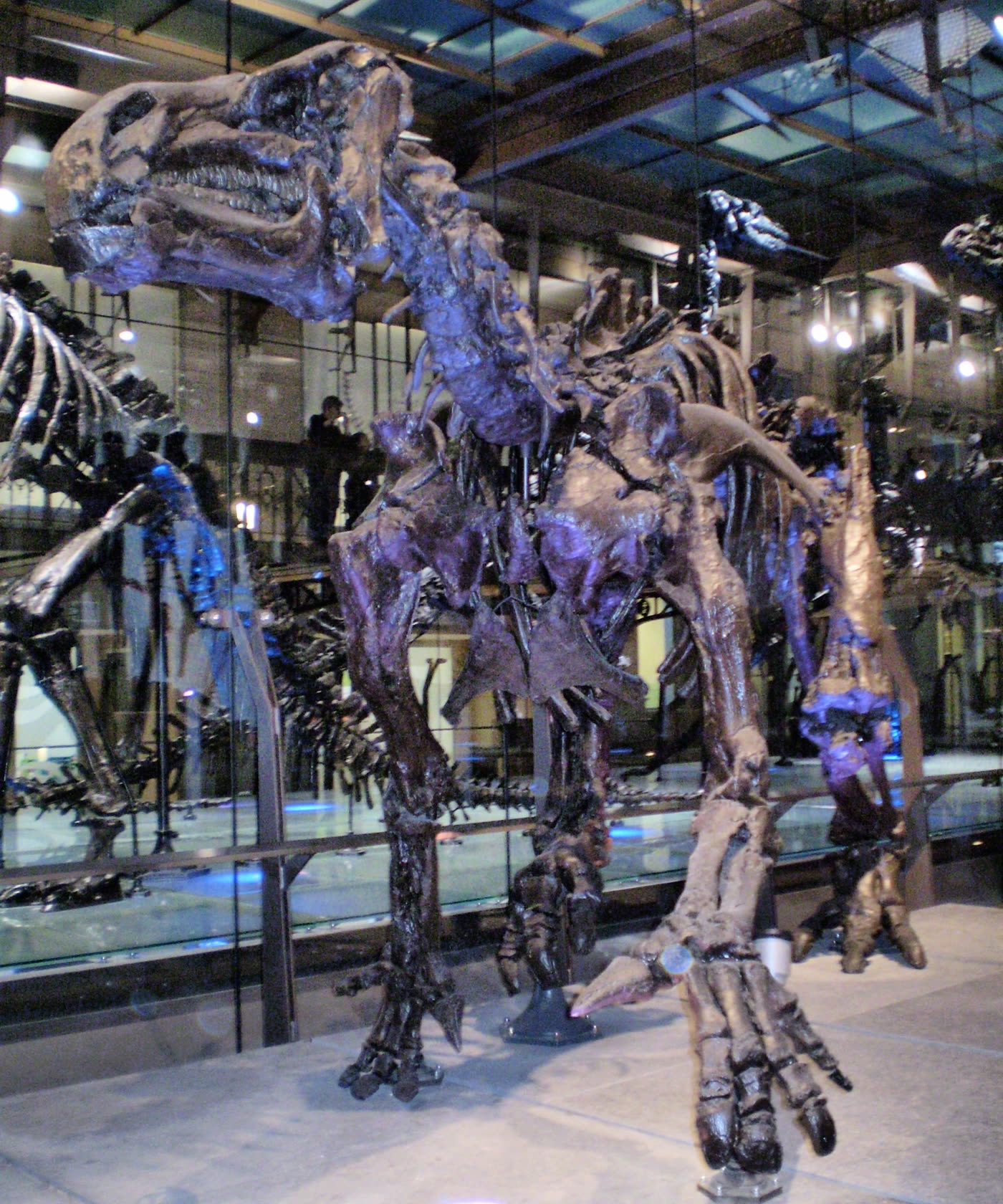
Image context: the cover uses a Wikimedia Commons photograph of one Bernissart mount in Brussels. It is the right image for this article because the historical upright pose is itself one of the article's subjects: readers need to see the public version before the quarry evidence and later revision can be compared against it.[5]
1) The first fact is not the species name. It is the scale and articulation of the find.
The Institute of Natural Sciences describes the Bernissart discovery in the simplest useful way: thirty relatively complete iguanodon skeletons were found underground in a coal mine, and because the bones were still in their original positions, they could later be presented in lifelike poses.[1][2] That sentence contains the real threshold. Bernissart was not just a place where Iguanodon happened to occur. It was a place where multiple bodies arrived in a state that preserved anatomical relationships strongly enough to shape preparation, display, and later argument.
The deeper historical page from the same museum makes the context clearer. In March and April 1878, miners at Sainte-Barbe were working 322 meters down when they entered a clay-filled pocket and encountered what they first took for wood or gold-bearing material; the bones were encrusted with pyrite, the "fool's gold" that made the discovery visually strange from the start.[2] That matters because the site was already a taphonomic event before it was a dinosaur headline. The bodies were buried in a particular sedimentary pocket, under mine conditions, with mineral replacement severe enough to change how the fossils looked and later how they had to be handled.[2]
This is the first reason Bernissart remains so important. A single skeleton can teach anatomy. A quarry with many articulated individuals can also teach distribution, orientation, preservation, and extraction method. Bernissart's power comes from being a sample of bodies in context rather than an isolated icon.
2) The quarry maps and preparation history are part of the evidence, not backstage trivia.
The museum's Bernissart guide is especially valuable because it does not separate scientific discovery from workshop labor.[2] Fossils were divided into numbered blocks, their positions were recorded, and the excavation plans allowed later workers and artists to reconstruct where particular individuals lay in the "Cran of the Iguanodons."[2] Some skeletons were found in more vertical attitudes, others more horizontally, and those positional differences stayed legible because the quarry documentation was treated seriously.[2]
That documentary layer is not secondary. Once a mass fossil discovery is cut out of the ground, the map becomes part of the specimen. Bernissart shows this with unusual clarity. The articulated bodies were too large and fragile to move whole; the site therefore had to be translated into transportable pieces without destroying anatomical and spatial meaning.[2][4] The result was a hybrid archive: bones, plaster, iron reinforcement, quarry letters, plans, and later drawings all working together.[2]
The preparation history pushes the lesson even further. The museum notes that the pyrite-filled fossils were cleaned, dipped in hot glue to consolidate them, and protected against damp; later decades brought additional dismantling and protective treatment because the mounts remained vulnerable to humidity and temperature change.[2] That means Bernissart is not only a fossil deposit. It is also a long conservation history. The skeletons readers see today are inseparable from the choices that kept them from crumbling away.
3) The famous biped pose was historically powerful, but it was never the last word.
In 1882, Louis Dollo supervised the first assembly of the Bernissart iguanodons in the upright biped posture that would make them famous.[2] The museum explains his reasoning in period terms: differences between forelimbs and hindlimbs, the form of the spinal column, and track evidence were read as support for a biped animal.[2] By 1883, one assembled specimen was already on public display, and the Bernissart mounts quickly became part of the visual grammar of dinosaurs.[2][3]
This is where the discovery turns into a lesson about public paleontology. The upright pose was not foolish. It was a serious nineteenth-century reconstruction built from the best synthesis then available.[2][3] But it also hardened into an image long after the interpretation beneath it had shifted. The same museum page notes that nearly a century later David B. Norman re-examined Iguanodon bernissartensis and concluded that the trunk was held more horizontally in movement, making the old kangaroo posture untenable as a living-body reconstruction.[2] The original skeletons, however, were too fragile to be radically remounted.[2]
That gap between scientific revision and museum object is exactly why Bernissart stays interesting. The standing mount is still worth preserving, not because it remains biomechanically current, but because it records a real phase in how paleontology reasoned from bones to life. The site therefore preserves two histories at once: Early Cretaceous bodies in a mine and nineteenth-century science in a gallery.
4) Bernissart works best when the quarry, the mount, and the revision are read together.
The strongest reading of the Bernissart iguanodons in 2026 is layered. The quarry gives the discovery its weight: many articulated skeletons, deep underground, with associated plants and other animals that also help recover environment.[1][2] The preparation history gives the find its material caution: pyrite, transport blocks, reinforcement, consolidation, dismantling, and re-treatment.[2][4] The mount history gives the fossils their public career: the first giant display that taught generations what a dinosaur could look like.[2][3] The later posture revision restores anatomical discipline without erasing that museum history.[2]
That is why Bernissart should not be compressed into one standing dinosaur. The iconic pose is real, and it remains worth seeing. But the deeper scientific object is the whole chain that produced it. Bernissart matters because it shows paleontology in the round: discovery underground, documentation under pressure, reconstruction in public, correction through later anatomy, and preservation work that keeps old interpretations visible even after they stop being current. Few fossil finds let readers watch all of that at once.[1][2][3][4]
Sources
- Institute of Natural Sciences, "The Bernissart Iguanodons" - museum exhibition page on the discovery, display case, and why the skeletons remain central to the Brussels dinosaur gallery.
- Institute of Natural Sciences, "The Bernissart Iguanodons at a glance" - detailed history page covering the 1878 Sainte-Barbe discovery, pyrite-filled bones, excavation plans, 1882 mounting, and later posture revision.
- G. A. Boulenger, "The Bernissart Iguanodon," Nature 28 (1883) - early scientific-public account of the Bernissart material and its importance.
- BELSPO BRAIN-be project, Iguanodon 2.0: Shepherding the "Belle-Epoque" Bernissart Iguanodons - conservation-focused overview of the Bernissart collection and its long material history.
- Wikimedia Commons, "File:Iguanodon de Bernissart IRSNB 01.JPG" - file page for the museum photograph used to prepare the article image.