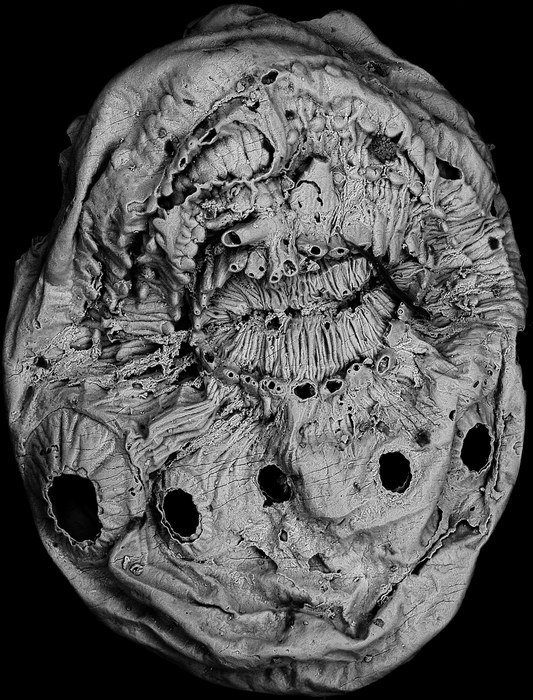
Saccorhytus coronarius is easy to remember for the wrong reason. In 2017 it entered public circulation as a tiny, wrinkled, bag-like animal that might sit close to the origin of deuterostomes, the broad animal branch that includes vertebrates, echinoderms, and hemichordates.[2] The headline version was irresistible: a roughly millimeter-scale Cambrian creature with a large mouth, no obvious anus, and lateral openings that looked like possible precursors of gill slits.
The stronger story is what happened after that claim weakened. In 2022, new material and synchrotron-based work moved Saccorhytus away from the earliest-deuterostome interpretation and into total-group Ecdysozoa, the broader moulting-animal side of the tree.[1] That correction did not make the fossil less important. It made it more useful. Saccorhytus became a lesson in how tiny anatomical claims can carry huge evolutionary weight, and how quickly that weight has to be redistributed when preservation, imaging, and sample size improve.
Image context: the cover moves away from a specimen close-up and into the imaging environment. That matters because the article turns on method: better specimens, synchrotron-based three-dimensional work, and the separation of preserved anatomy from preservation artefact.[3][5]
The fossil was never big enough for casual reading
The original description placed Saccorhytus in the Cambrian Kuanchuanpu Formation of South China and treated it as part of an Orsten-like preservation window: tiny three-dimensional fossils recovered from rocks that could retain fine surface anatomy.[2] The animal was not a slab-mounted celebrity skeleton. It was a microscopic body that looked like a compressed sack with a prominent mouth, folds around that mouth, lateral cone-like structures, and no clear anus.[2][3]
That scale matters. In large vertebrate fossils, a misread bone can be corrected by adjacent anatomy, joint surfaces, or comparison with several articulated specimens. In a microfossil like Saccorhytus, a small hole or cone can shift the whole phylogenetic story. If the lateral openings are true body openings related to a pharyngeal system, the fossil starts to look relevant to deuterostome origins. If they are decay, breakage, compression, or artefacts of preservation, the same surface becomes much weaker evidence for that placement.[1][2]
The 2017 interpretation leaned on those openings. Han, Conway Morris, Ou, and colleagues described the body as bearing up to four conical openings on each side and suggested that lateral openings could have been connected to water and waste flow, possibly relevant to the evolution of pharyngeal gill structures.[2] That was not a silly claim. It was a reasoned reading of the specimens available at the time. But it placed a lot of evolutionary responsibility on very small features.
The mouth stayed; the holes changed status
The 2022 Nature paper by Liu, Carlisle, Zhang, and colleagues did not simply announce a new label. It changed the evidentiary hierarchy. With new material, the team reconstructed Saccorhytus as a millimetric, ellipsoidal meiobenthic animal with spinose armor, a terminal mouth, and no anus.[1] Several parts of the old picture survived: tiny body, large mouth, no confirmed anal opening, and an animal living among sediment grains near the seafloor.[1][3]
The major break was the lateral-opening claim. The 2022 paper argued that the supposed pharyngeal openings used to support the deuterostome hypothesis were taphonomic artefacts.[1] In plain terms, the holes were no longer strong anatomy. They were preservation history masquerading as anatomy.
That distinction is the whole fossil. A circular surface feature can be a biological opening, a broken body cone, a collapsed structure, or a preparation and preservation signal. The body does not label itself. The method has to decide whether repeated features are organized in a biological pattern, whether they connect internally, and whether they survive across many specimens in a way that makes anatomical sense.[1][3]
The Virginia Tech account of the 2022 work gives the practical field-and-lab sequence behind that shift. Researchers recovered hundreds of specimens, dissolved fossil-bearing rock with a vinegar solution, picked through the remaining grains, and used intense X-rays at the Swiss Light Source to build three-dimensional digital models from many images taken at different angles.[3] That workflow matters because Saccorhytus is not a fossil you can safely classify from a single dramatic photograph. It is a fossil that needs a population of specimens and a three-dimensional check on what the surface seems to promise.
The ecdysozoan reading is not a consolation prize
Moving Saccorhytus to total-group Ecdysozoa is not a demotion. It changes the question from "Is this our earliest known deuterostome relative?" to "What does this animal reveal about the early diversity of moulting-animal body plans?"[1][4] That second question is less headline-friendly, but it is probably more durable.
Ecdysozoa includes arthropods, nematodes, priapulids, kinorhynchs, and other animals whose evolutionary history is tied, in broad terms, to moulting cuticles and body-wall architecture. The 2022 paper emphasized a Saccorhytus with spinose armor and an anatomy that expands early Cambrian ecdysozoan disparity.[1] A later eLife paper on early ecdysozoan body plans similarly treats Saccorhytus within Saccorhytida and discusses the group as part of the problem of reconstructing early ecdysozoan form rather than as a primitive deuterostome anchor.[4]
The useful point is not that every detail is now settled. It is that the fossil has moved to a better-bounded uncertainty. The strongest current reading keeps Saccorhytus as a tiny, mouth-forward, anus-lacking, armored Cambrian animal with body cones and surface features that require careful separation from preservation artefact.[1][4] That is already strange enough. It does not need to be the earliest known member of our side of the animal tree to matter.
Why the correction improves the fossil
The old deuterostome claim tried to solve a timing problem. Molecular estimates have often placed deep animal divergences earlier than the clearest fossil representatives, so a very early Cambrian deuterostome-like microfossil was tempting.[2][3] It could help fill a gap between predicted lineage splits and the later, more convincing fossil record of deuterostomes.
The 2022 correction reopens that gap. Virginia Tech quoted Shuhai Xiao describing the search for the earliest animal with a secondary mouth as essentially back at square one, with convincing later deuterostome fossils still substantially younger.[3] That may sound like a loss, but it is a healthy one. A gap should stay a gap until the anatomy closes it. Paleontology does not become stronger by letting a tiny surface hole do the work of a whole pharyngeal system.
That is the article's central lesson. Saccorhytus matters because it shows how fossil interpretation can fail productively. The original paper made a bold anatomical and phylogenetic proposal. The later work did not merely disagree; it brought more specimens, better imaging, and a sharper test of whether the disputed features were biological structures.[1][2][3] The result is not embarrassment. It is the normal correction cycle working at millimeter scale.
What a close reading can safely keep
A cautious reader can still keep several claims with confidence. Saccorhytus coronarius was a microscopic early Cambrian animal from South China, preserved in a way that retained three-dimensional surface detail.[1][2] It had a conspicuous mouth, a wrinkled ellipsoidal body, no confirmed anus, and repeated surface structures that made it anatomically unusual.[1][2][5] Its old placement near the earliest deuterostomes depended heavily on lateral openings that the 2022 redescription treats as taphonomic artefacts.[1]
The boundaries are just as important. The fossil does not currently prove that deuterostomes began as tiny bag-like animals. It does not supply secure early gill slits. It does not let a reader draw a straight line from a Cambrian grain-sized body to humans. What it does supply is a sharper caution: evolutionary placement is not a reward for visual drama. It has to survive anatomy, preservation, comparison, and repeatability.
That is why Saccorhytus is more compelling after the reversal. It has stopped performing as a tiny ancestor mascot and started working as a method fossil. The big mouth remains. The missing anus remains an interpretive problem. The side openings no longer carry the same weight. The animal now sits where the evidence can better support it: not at the front door of our own lineage, but in the crowded early history of moulting animals, where weird little bodies were already testing forms the later fossil record would not make easy to classify.
Sources
- Yunhuan Liu, Emily Carlisle, Huaqiao Zhang, et al., "Saccorhytus is an early ecdysozoan and not the earliest deuterostome," Nature 609 (2022), publisher page.
- Jian Han, Simon Conway Morris, Qiang Ou, et al., "Meiofaunal deuterostomes from the basal Cambrian of Shaanxi (China)," Nature 542 (2017), publisher page.
- Virginia Tech via EurekAlert!, "Geosciences' Shuhai Xiao part of international team to uncover surprising evolutionary secrets of microfossil Saccorhytus" (2022), institutional release on the 2022 reinterpretation and imaging workflow.
- Jie Yang, Yunhuan Liu, Huaqiao Zhang, et al., "Early evolution of the ecdysozoan body plan," eLife 13 (2024), full text at PubMed Central.
- EurekAlert!, "Saccorhytus" multimedia image - fossil-focused visual material accompanying institutional coverage of the 2022 reinterpretation.